
Study sites in cropland
Study sites in grazing land
Study sites in forests
Evolution of Timahdit SES
| Authors: | Barhdadi Abdelali, Hajar Bouchikhi, Ahmed El Aich, Ouail Hrich, Zineb Koumya |
| Coordinating authors: | Concepción L. Alados, Giovanni Quaranta, Rosanna Salvia |
| Editors: | Alexandros Kandelapas, Jane Brandt |
Editor's note 20Mar14: Source D132-4.1
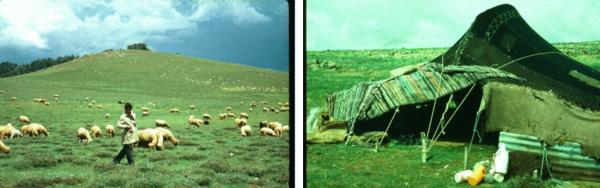
The rural community of Timahdit is located in the Middle Atlas of Morocco. The Ait Arfa du Guigou, which is part of the Timahdit area, belongs to the Beni Mguild Berbers. Traditionally they grazed their land with a vertical migration pattern: in the summer the sheep were pastured on the highlands, in the winter on the lowlands. Because of these seasonal movements the people lived in tents, but they also had winter houses where they stored agricultural equipment and grain. Families left the house in spring to live in the summer pastures. Only a guard or a member of the family remained in the house. Nowadays the Beni Mguild are settled and it is the shepherd who lives in a tent on summer pastures.
Many inhabitants of the Beni Mguild area originally came from elsewhere. Some immigrants arrived in order to take advantage of trading opportunities. Because the shepherds were remunerated against part of the increase of the herd, they had access to the communal rangelands. The increase of the population coincided with an increase of land used for agriculture. Because the grazing pressure on the pastures led to increasing tensions among the pastoralists, the Beni Mguild started to deny the recently arrived immigrants access to the communal pastures. To overcome these tensions, arrangements were made between Beni Mguild pastoralists and newcomers. Conflicts between the original population and newcomers, and increased suspicion between locals as regards secret arrangements, started in the 1940s.
As a result, in the early 1980s grazing pressure averaged three sheep per hectare, whereas it should be only one sheep and a lamb per hectare. Allocation of lowland to agriculture reduced areas for grazing and resulted in breakdown of the vertical transhumance. This fact increased grazing pressure on what was left of land for grazing. The breakdown in the vertical transhumance obliged several pastoralists to stop moving their herd between summer and winter pastures and to graze the same area continuously. This encouraged pastoralists to settle in the summer grazing lands.
The following major states of the SES of the Ait Arfa du Guigou can be identified:
Pastoral Society (1970s)
This period is characterized by state interventions and land colonization resulting in loss of Beni M'guild land. At the same time, population growth leads to a severe reduction in land availability and individuals are forced to expand farmland at the expense of rangelands. State policies bring radical changes in the institutional regulation of grazing on the Ait Arfa du Guigou collective, steadily eroding traditional management and enforcing central government control.
Agro-pastoral society (1980s)
Transhumance to the lowlands is finally abandoned in favour of construction of camps on moutain pastures. Changes in the farming system provide enough feed for animals, while the state enforces legislation to enhance sedentarization. The old order is weakened and herdsmen begin to employ new strategies that bypass old institutions.
Semi-intensive agro-pastoral society (2000s)
This period is characterised by increasing population and animal numbers. As a result of the marginality of grazing activity, farmers and grazers employ strategies strategies for semi-intensive livestock and agro-pastoral farming systems, focusing also on horticultural production where possible.
| More details ... each period is fully described in the following articles |
Pastoral society (1970s)
Agro-pastoral society (1980s)
Semi-intensive agriculture society (2000s)