
Study sites in cropland
Study sites in grazing land
Study sites in forests
Agro-pastoral society (1980s)
| Authors: | Barhdadi Abdelali, Hajar Bouchikhi, Ahmed El Aich, Ouail Hrich, Zineb Koumya |
| Coordinating authors: | Concepción L. Alados, Giovanni Quaranta, Rosanna Salvia |
| Editors: | Alexandros Kandelapas, Jane Brandt |
Editor's note 20Mar14: Source D232-4.2.2
Assessment of natural, economic and social capitals
| Natural capital | |
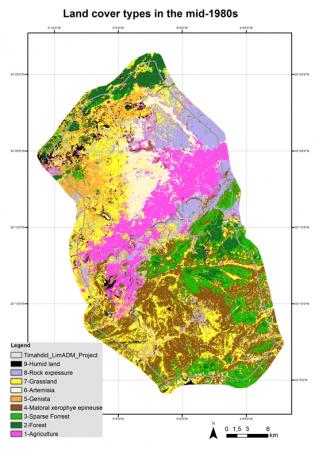
| Assessment | Nine land cover formations can be distinguished including three different types of matoral with different pastoral value (Genista, xerophyt espinouse, Artemisia). Impact of grazing on these matorral is different according to its pastoral value. During the 1980s, land cover is dominated by matorral which coveres 36% of the area of Timahdit. Forest covers almost 16%. Grasslands (the last step in the vegetation succession before bare ground) represents almost 21%, while bare ground averages almost 11%.
In the early 1980s, continuous grazing impacts groups of forage as well as species of high pastoral value. As far as the groups of forage are concerned, grasses are severely affected. The most preferred grass species increases greatly when pasture is allowed a certain amount of rest, as was previously practiced within the Ait Arfa gi Guigou “agdal” territory. Other species with high pastoral value such as Dactylis glomerata, Festura spp, Poa bulbosa and Stipa parviflora also show great response with seasonal rest. |
| Critical functions | - |
| Critical variables | - |
| Economic capital | |
| Assessment | In 1982, the number of livestock in Ait Arfa du Guigou totals 104,044 sheep, 5,660 goats and 2,170 cattle. Animals are spread over 725 herds, 76% of which have fewer than 200 sheep. In terms of disparities, this 76% own 40% of the total number of sheep while the remaining 24% own the 60% of the remaining herd. Large herdsmen, owning more than 500 sheep, represent 19.8%.
Oral contracts between farmers are common, those who cannot afford to buy animals enter contractual agreements. Contractors split profit according to the provisions of the contract. Of all farmers, 75% do not enter into contracts and directly manage their herds. Off the 25% who do have contracts, 11 contract for a herd of size of 100 to 300 sheep. Agriculture retained its traditional subsistence form. Overall
Agriculture is dominated by crops with low added value such as cereals, forage and legumes. Of the only 11.7% of the area is was ploughed by tractor. Fallow and cereals occupy more than 95% of the farming system during the 1980s. Grain yields are very low (9-11 quintals per ha). |
| Critical functions | - |
| Critical variables | - |
| Social capital | |
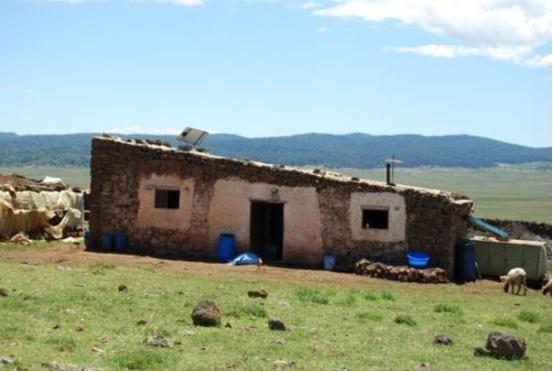
| Assessment | With the breakdown in the double transhumance system, herdsmen of the Ait Arfa du Guigou are obliged to graze all year round in the high altitude pasture lands, constructing sheep pens (270 in total; 28% for Ait Ben Yacoub fractions, 27% for Ait Ben Hcine ou Hand, 25 % for Ait M’Hamed and 20% for Ait Ben Hcine). Of the settlements, 74% belong to the individual’s descendant from the tribe while strangers build 26%. Since 1981, local authorities have in principal prohibited new construction on pasturelands.
|
| Critical functions | - |
| Critical variables | - |
Main LEDD problems and responses
Traditional institutions include measures for controlling the collective land use including closing agdal areas to grazing or opening only during specific seasons. While closure of agdals is normally decided at the subfraction level, it must now be registered and approved by the Ministry of the Interior, a practice which is becoming rare. In each douar (village), breeders choose "naibs" to manage the pastures. Functions of naibs include solving troubles concerning limits of rangelands, water points, closing and opening and closure of agdals.
In 1969, the state attempted to secure the future of these communal lands and pastoral people by creating new management institutions to replace the traditional ones that were perceived to be archaic and ineffective. A pastoral research station was created in 1977 to study the issues related to rangeland degradation. In addition the Moyen Atlas Central Project, conducted in the territory of the Ait Arfa Guigou looked at 1) rangeland development 2) forest conservation and development 3) development of forage production on marginal land 4) transformation of extensive livestock farming to intensive/ semi-intensive 5) development of land suitable for irrigation and 6) diversification of agricultural production in the area and their revaluation (high added value).
Policy context
AK: to check that implementation, impacts and effectiveness of selected policies are discussed in this text. Look at D242 to see if there is any additional information.
--
Properties of the system
AK: to check if there is any further relevant information in D233
Natural capital: --
Economic captial: --
Social capital: --
Socio-ecological resilience
AK: to be added, source: D233
Socio-ecological fit of the dominant response to LEDD
AK: to be added, source: D233