
Study sites in cropland
Study sites in grazing land
Study sites in forests
Pastoral society (1970s)
| Authors: | Barhdadi Abdelali, Hajar Bouchikhi, Ahmed El Aich, Ouail Hrich, Zineb Koumya |
| Coordinating authors: | Concepción L. Alados, Giovanni Quaranta, Rosanna Salvia |
| Editors: | Alexandros Kandelapas, Jane Brandt |
Editor's note 20Mar14: Source D232-4.2.1
Assessment of natural, economic and social capitals
| Natural capital | |
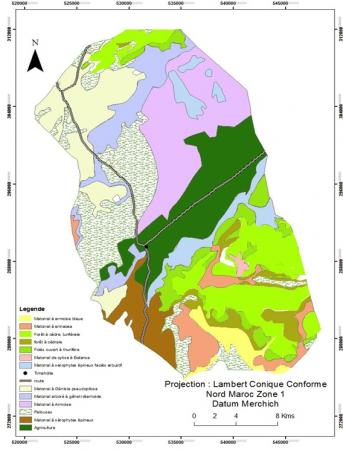
| Assessment | Five vegetation formations characterize vegetation capital of the tabular Middle Atlas: cedar forests, Quercus ilex, Juniperus thurifera, matorral and grasslands.
|
| Critical functions | - |
| Critical variables | - |
| Economic capital | |
| Assessment | Transhumant livestock especially sheep, is the most important capital in the Middle Atlas. Lanscape organization for the Beni Mguild allows for both crop production and husbandry: for each tribe, there is one block for cropping (private land tenure) and a second block dedicated to livestock grazing (collective lands under council decisions).
There is a lack of members of Ait Arfa Guigou in Azarhar, compared to other tribes of the Bbeni M’Guild confederation. The Ait Arfa Guigou are stationed on the plateau of the Middle Atlas on both sides of Timahdit. They are therefore obliged to make agreements with adjacent tribes about where they spend winter and allow other tribes to spend the summer in the Ait Arfa Guigou high altitude grazing lands. During 1930-1935, the Ait Ahcine Ben Yakoub of Ait Guigou du Guigou send on average 48,000 sheep to Irklaouen on the plateau of Ito in the Azarhar.
During the 1930s there is a rapid increase in acreage of cropland and herd numbers. This growth is linked not only to population growth, but also to the introduction of a market economy after pacification and the opening of Morocco, and improved communication and transportation. This boom is followed by the dramatic crisis of 1945-1946, leading to sharp reduction of livestock herds and acreage of cultivated land. The crisis brings important changes to the cropping system: durum is replaced by the more suitable barley and wheat. Also, sheep husbandry is shown to be particularly fragile and many people switch to goats and cattle. Intervention by the State consists of
|
| Critical functions | - |
| Critical variables | - |

| Social capital | |
| Assessment | The population of the Beni M'guild Confederation is just over 80,000 people at the 1960 census. Population of the Ait Arfa du Guigou is 4,781. Average density of Ait Arfa Guigou population is around 8 inhabitants per km².
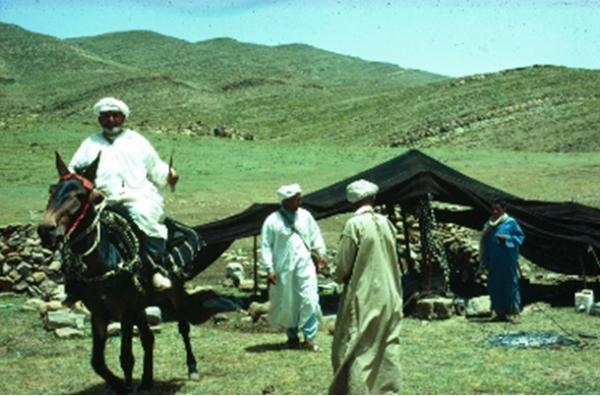
(Semi-)nomadic life is a strong collective organization. It is heavily guided by social norms and time honoured practices regulating seasonal movements according to altitude, tent agglomeration and position, keeping of animals at night, ploughing plots for winter crops etc. The Jmaa council is attended by notables (experienced warriors or fathers of several boys) each year after the harvest and designates a head, "the amghar", in charge of enforcing decisions. With the agreement of the "Jmaa" the "amghar" decides the date of transhumance, planting and harvesting and administers justice.
|
| Critical functions | - |
| Critical variables | - |
Main LEDD problems and responses
-
Policy context
AK: to check that implementation, impacts and effectiveness of selected policies are discussed in this text. Look at D242 to see if there is any additional information.
--
Properties of the system
AK: to check if there is any further relevant information in D233
Natural capital: --
Economic captial: --
Social capital: --
Socio-ecological resilience
AK: to be added, source: D233
Socio-ecological fit of the dominant response to LEDD
AK: to be added, source: D233