
Study sites in cropland
Study sites in grazing land
Study sites in forests
Evolution of the Canyoles River Basin SES
| Authors: | Artemio Cerdà, Félix González-Peñaloza |
| Coordinating authors: | Constantinos Kosmas, Giovanni Quaranta |
| Editors: | Alexandros Kandelapas, Jane Brandt |
Editor's note 20Mar14: Source D132-10.1.
Two major state or transitions of the Canyoles Watershed SES have been identified:
Traditional crops (1950 to 1985)
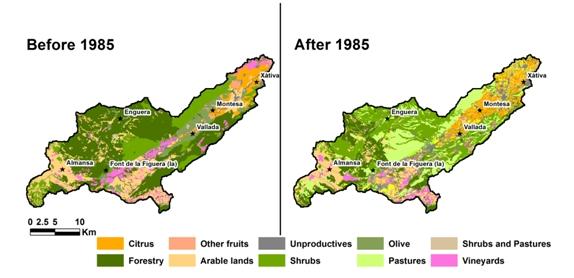
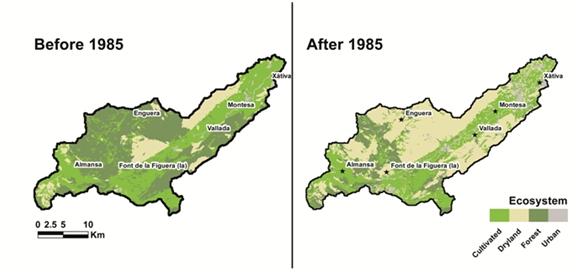
The period between 1950 and 1985 is characterized by the intensive production of the traditional Mediterranean crops (olive, cereals and vineyards) along with the expansion of citrus orchards. Although agriculture in the area had been intensive and export-led since the 19th century, during the period it intensifies as irrigated citrus orchards begin to be established. Population declines during the 1950s and 1960s, due to migration towards cities and the coast, but thereafter stabilizes and increases mainly in the area's main city Xàtiva, which attracts 83.6% of all economic activity in the area.
Implementation of CAP and extension of citrus orchards (1985 to date)
1985 to date characterized by the implementation of the CAP and the extension of the Citrus orchards. The period is dominated by the spectacular transformation of the northeastern lowlands by the expansion of irrigated fruits (especially citrus) orchards, at the expense of olive tress and other crops. Depletion and pollution of surface and groundwater, soil sealing and soil erosion also intensifies.
| More details ... each period is fully described in the following articles |
Traditional crops (1950 to 1985)
Implementation of CAP and extension of citrus orchards (1985 to date)