
Study sites in cropland
Study sites in grazing land
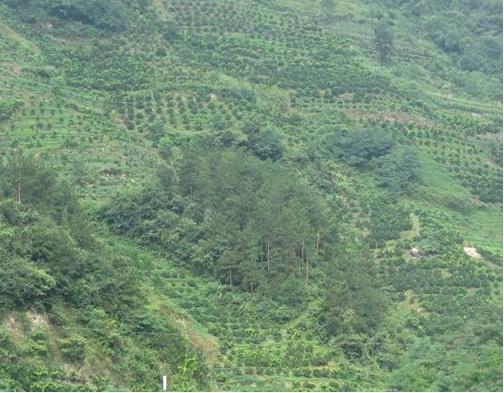
Study sites in forests
Growth of industry (1998 to 2000)
| Authors: | Pingcang Zhang, Honghu Liu, Jiang Min |
| Coordinating authors: | Constantinos Kosmas, Giovanni Quaranta |
| Editors: | Alexandros Kandelapas, Jane Brandt |
Editor's note 20Mar14: Source D131-17.2.2
Assessment of natural, economic and social capitals
| Natural capital | |
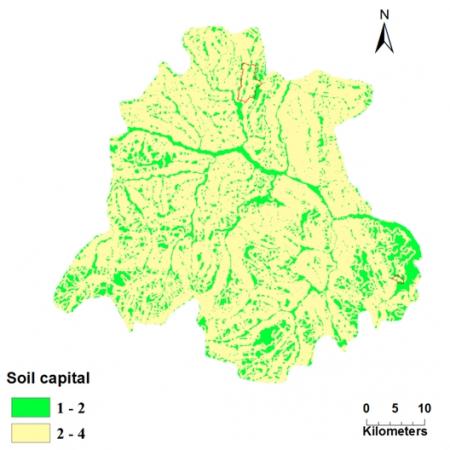
| Assessment | Based on the the second soil survey data in China, soil depth in Zigui is moderately deep, ranging from 30 cm to 45 cm. Slope gradients are more than 15%. These two factors mean that soil capital is moderate, with less than 18% low.
The Yangtze River and eight tributaries flow through Zigui County. Urban and industrial expansion along the rivers leads to a deterioration in water quality of two rivers. Vegetation capital in Zigui County is high.
|
| Critical functions | In this period, several water conservation projects are implemented, particularly relating to ground water. Although 16 drought disasters occur between 1979 and 2005, their effects are limited. Crop productivity has not been measured directly. During the period, area under grain cultivation is reduced, but the yield per ha and total grain yield rise sharply, owing to chemical fertilizer use and the enthusiasm of local farmers to labour. The yield per hectare of the oil crops (rapeseed, sesame, peanut) shows great variations owing primarily to climate conditions.
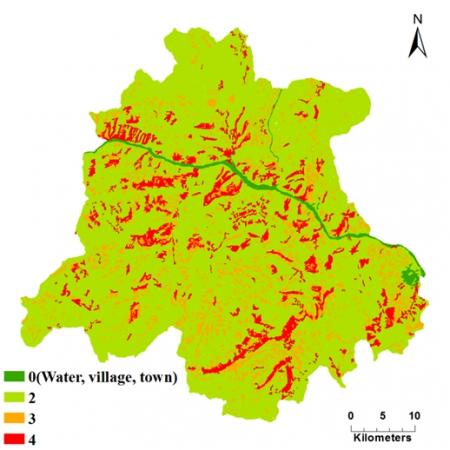
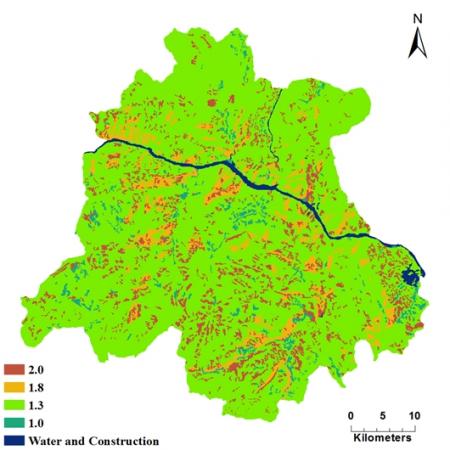
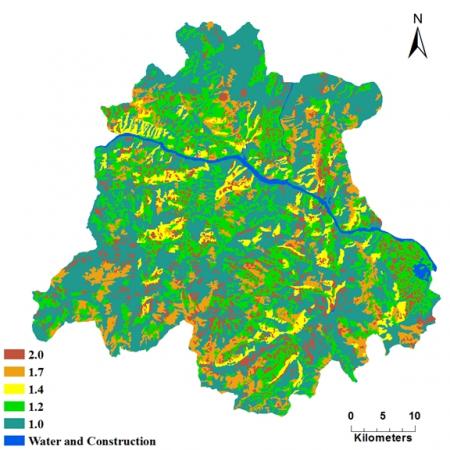
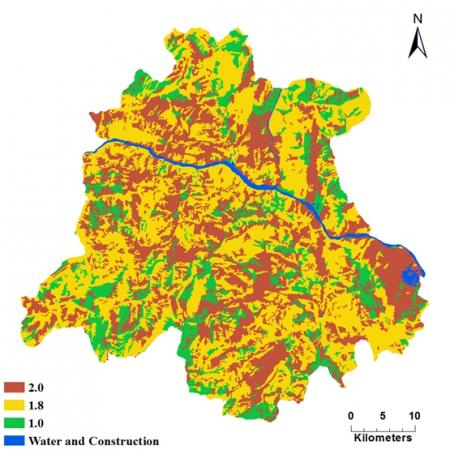
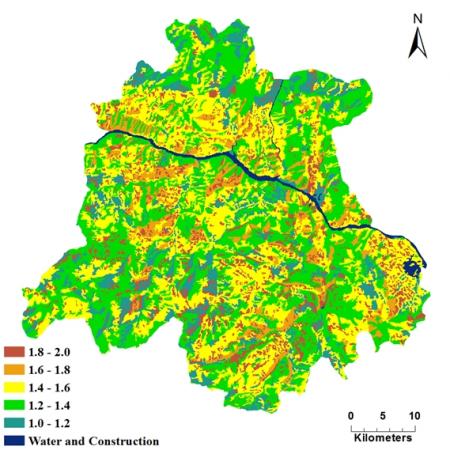
Erosion protection index is about 1.3 (78 %. of the area). The drought resistance index is between 1.0 and 1.2 for more than 70% of the study site, while plant cover index shows greater variability.
|
| Critical variables | - |
| Economic capital | |
| Assessment | This period is defined by the growth of industry, from 46.18 million RMB in 1985 to 124 million RMB in 1990. In 2000, the proportion of three sectors of the economy (agriculture: industry: services) is 26.66: 17.81: 55.53. The main export goods include orange, cow leather, goat leather, yellow weasel leather, mixed leather, bristles, sheep and pig casing, Osmunda japonicaand silkworm silk and cocoon. After 1990, the types and number of the export goods decreases, although silicon acquires a prominent role.
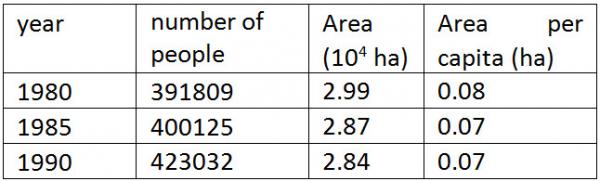
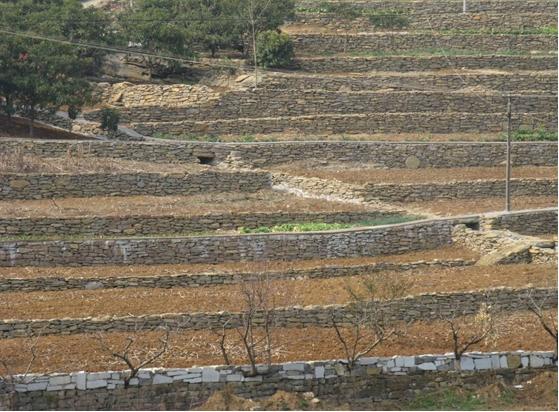
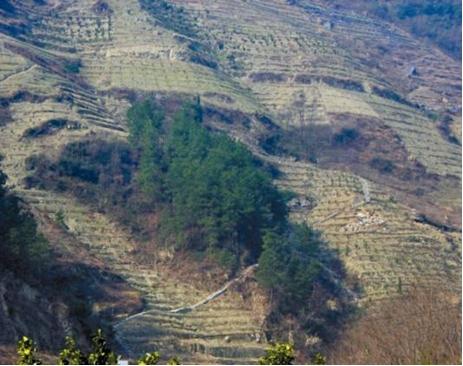
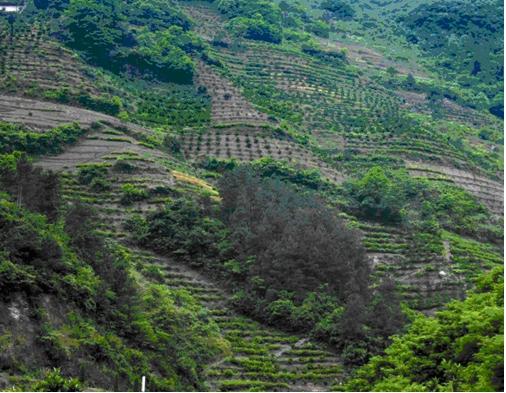
Agriculture remains the main productive sector in Zigui County. In terms of financial capital, during 1980-1992, subsidies for farms are low and after 1992 grain price also decrease. Economically speaking, the protection for farms is meaningless. In 1985, the bank deposits of local people have more than 7.27 million RMB, seven times more than 1979. In 1985 landesque capital comprises a terraced area covering 19.6 thousand ha. During 1994-1998, 3520 hectares of new terraces are built. During 1980-2000, the population increases while arable land area decreases, hence the arable land area per capita decreases. In 1985, the area covered by citrus is 3133.3 ha. From 1983 to 1995, the area covered by tea increases from 1152.27 ha to 2338 ha. The number of pigs increases while sheep decrease from 68.7 thousand in 1981 to 27.2 thousand in 1985. Fertilizer use reaches a peak in 1990. Until 1995 use fell, increasing again to reach 19698 t, in 2000. In 1980, some insecticides including DDT are eliminated. In 1985, the comprehensive prevention and control measures are adopted in the whole county. In 1985, 432 tractors are in use. Telephone use expands greatley after the 1980s while, the first narrowband dial up internet service opens at the post office in 1998. |
| Critical functions | - |
| Critical variables | - |
| Social capital | |
| Assessment | Population peaks in 1990 and decreases thereafter as family planning policy began to show results.
The farm production responsibility system is implemented in Zigui County in 1982. This fully mobilizes the enthusiasm of local farmers to plant. As mechanisation is relatively, tillage mostly depends on the manual labour. Sometimes, in the busy farming season, the workers of different families help each other. Trust and cooperation between them is strong and the local exchange of goods is very frequent throughout the 1990s. This period is marked by the shift from agriculture to industry, services and trade. In addition, some adults leave home to work abroad, mainly performing physical labour. In general migration is higher during the early stage of the period with some returns noted towards the end. |
| Critical functions | Population increases in the beginning of the period and then decreases. Out-migration is strong and the number of people leaving to find employment rises to 15% in the year 2000.
Efforts at education take place, addressed to all ages (children, adults, old people) Although trust and cooperation generally persist, water conflicts over paddy irrigation begin to emerge. |
| Critical variables | - |
Main LEDD problems and responses
Soil erosion is very severe in Zigui County. In 1982, an area of 2148.7 km² (88% of total area of the county) was subject to erosion. Severely eroded areas (erosion modulus 8.000-15.000) account for more than 37% of the county. In 2000, the area under erosion falls to 1335.92 km² (55% of Zigui county). Soil loss is estimated at 4.208 million tons under erosion modulus of 3150 t/ km² per year.
Natural characteristics of the area and its climate (high mountains, steep slopes, broken terrain, uneven temporal distribution of rainfall) contribute to high erosion risk, as do inappropriate land management practices (lack of water conservation, deforestation particularly in steep slopes, down slope cultivation, mining, road and factory construction). In 1950, the forested area in Zigui County covered 40% of the area, whereas in the 60s, 70s and 80s forested area cover 34.8%, 25.9% and 21% respectively.
Floods in the area can be devastating: in 1982 alone, there are512 large rock fall landslides (240 million m³), covering 152 villages and 28 large landslides (100 million m³).
Drought can be equally severe: in 1990 there are 87 days of drought during summer and autumn (total rainfall 16.9 mm). During this period 16 towns and 466 villages were affected by drought. The economic disaster from the lost production of grain, orange and other agricultural products is estimated tobe over 58.84 million Yuan.
Soil acidification is also present, particularly in Yichang and Wushan. The pH of the soil increases with soil depth, with the rate of change being greater in the first 0-40cm . However, there is a certain buffering capacity in the area of soil to acid. Meanwhile, the acidification of soil water is also obvious in Yichang and Wushan. Soil acidification caused by the increase of total aluminum in soil water leads to aluminum toxicity in plants and is one of the important causes of forest decline. Soil acidification is aggravated by acid rain in the mountains of Wushan County, Chongqing (altitude 1780m) which drains into the Yangtze river.
Mining wasteland refers to land which cannot be used in the mining process. It includes: waste rock piles of stripped topsoil, low-grade ore and mined rock fragments; waste land after elected concentrate; abandoned land after mining operations, mechanical facilities, mine auxiliary buildings and road traffic. Wastelands entail the occupation and destruction of large amount of arable land resources as well as other serious environmental impacts. Wind and water erosion pollute the environment and affect the growth of crops and human health. Large amounts of sediment go into the river or reservoir in rainstorms, water is polluted, water conservancy facilities are affected, flood hazards is also exacerbated. The impact of surface and groundwater often leads to the decline in soil quality, ecosystem degradation and loss of biodiversity. Mine wastes, particularly tailings ponds often contain a variety of pollutants (heavy metals, cyanide residues) which, when mismanaged, threaten livelihoods, property and health downstream.
Land degradation is very serious in Yangtze River Basin. Soil erosion is the most important reason for land degradation and desertification. In the red soil region, “red desertification” is caused by water erosion. In the southwestern rocky mountain region, “stone desertification” is also caused by water erosion. These two are the most serious land degradation phenomena in the Yangtze River Basin. Local farmers nevertheless continue to plough for crop production, intensifying soil loss and land degradation.
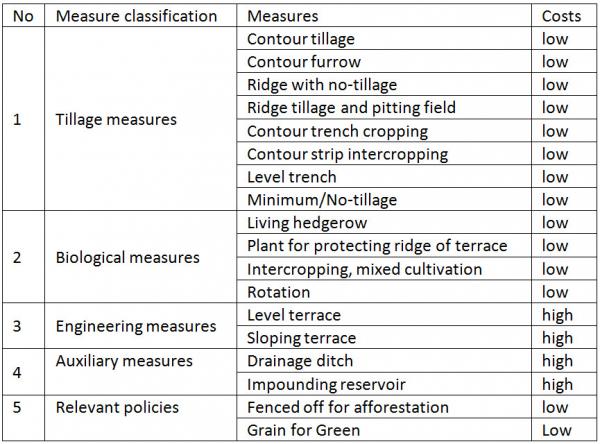
Responses to LEDD problems centre around the Central Government's focuses on local policy planning the area of Gezhouba Dam and Three Gorges reservoir through the creation of an ecological barrier. From 1983, the Gezhouba Dam and Three Gorges projects create the opportunity for large-scale soil and water conservation. Several soil and water conservation measures are adopted in Yangtze River Basin.
Policy context
AK: to check that implementation, impacts and effectiveness of selected policies are discussed in this text. Look at D142 to see if there is any additional information.
Several policies combine to encourage excessive farmland conversion, even in areas where the central government has made farmland preservation a top priority. Policies influencing government finance, residential construction, and urban land transactions combine to create a high demand for land. Policies governing payment for land make farmland conversion the most attractive means of meeting the demand. The current policy environment therefore generates incentives for local governments to convert farmland to urban uses.
The allocation of urban land takes place through a combination of administrative, quasi-market, and market mechanisms creating substantial arbitrage opportunities for private enterprises and for government entities. State and non-profit entities receive a land allocation without specific time limits. Municipal governments may also lease land to private enterprises (40 years for commercial enterprises, 50 years for industrial enterprises, and 70 years for residential uses).
The secondary markets create incentives for excessive conversion of rural land, which can be purchased by local governments for re-conveyance in return for yet another administratively set compensation package that is typically considerably less than the conveyance fee. Conveyance fees, formerly divided between various government levels, now go entirely to local governments. Revenue from land transactions is therefore major source of funding for local governments. As a result, local governments have strong incentives to expand into rural areas in order to finance their obligations and/or expansion.
Current housing regulations also make it more attractive for local governments to provide housing for growing populations by expanding into rural areas rather than increasing density within existing urban boundaries. Redevelopment of existing municipal land requires governments to pay compensation to current tenants and to cover resettlement expenses.
Other economic growth policies contribute to degradation: in the context of policy emphasis on industrial development, local governments acquire and set aside land for industrial development in the hope of attracting industrial investment. Much of that land has remained idle.
Land allocation is under the authority of the village committee or economic organization, under oversight by township, provincial, and, in some cases, state organs. Farmland is leased to households under contractual arrangements in which the household pays a fee (typically including a grain quota) to the collective in return for a residual claim on the products of the land. The contract may contain other stipulations (e.g. requirements that the land be farmed and maintained in good condition). However, committees retain the right to reallocate land and in many villages, reallocations have occurred frequently enough to deter investment in land productivity. Studies have found that farmers facing a greater risk of land reallocation invest less in organic fertilizer and that farmers in villages with a policy of no land readjustments for population changes were more likely to invest, and invested more, in agricultural improvements. Farmers with land-transfer rights were similarly more likely to invest in agricultural improvements.
Such concerns lead the Chinese government to experiment with lengthening the duration of farmland contracts between households and the collective from 15 years in 1984 to 30 years in 1998 and more recently to experiment with even lengthier contracts (60 years). In addition, rules on subcontracting have also been relaxed since the mid-1980s.
Nevertheless, tenure security remains a thorny issue as it limits the power of the collective and may force the state to rely more on market mechanisms to ensure adequate grain supplies. Enhanced tenure security may also result in less equitable land allocations. Local authorities show widespread non-compliance on tenure rights issues. Village leaders have been known to expropriate land from farmers to lease to rural enterprises or to sell to local governments, often without paying compensation and in many cases pocketing the returns themselves. Illegal land development of this kind has become a national scandal.
Industrial and urban growth policies also fuel migration: 80% of young males in in Pinghu worked in industries in nearby cities; in Jingzhou, with a lower level of industrial development, the figure is 20%. Lack of urban residency rights keeps these families tied to the land but since their main source of income is non-agricultural, they have little incentive to invest in maintaining and enhancing land productivity. Moreover, limitations on labour time and capacity may induce them to leave some land uncultivated.
Prohibiting conversion of land designated as basic farmland also constrains site selection for economic development projects. These constraints increase the price of land and thus raise the cost of doing business. They also create an ad hoc land development process, which results in a chaotic and uncoordinated land development patterns, less efficient utilization of existing infrastructure, and higher costs for local government provision of urban services. These problems are exacerbated by the differential treatment of basic and non-basic farmland. Farmers whose land is designated basic farmland are penalized by a denial of access to urban land markets, even if their farms may enjoy a location advantage. Farmers from areas not designated as basic farmland are not similarly constrained. This inequitable treatment makes it difficult for local governments to implement effective land management tools and creates social tensions that make the land acquisition process more difficult, lead to chaotic and uncoordinated development, and encourage the development of hidden or informal land markets.
Inadequate implementation of irrigation and drainage management may also function as a LEDD driver through lack of clearly delineated and enforced use-rights for water, inadequate financing of water delivery infrastructure, and failure to price water at its opportunity cost.
Properties of the system
AK: to check if there is any further relevant information in D133
Natural capital: Rain seasonality shows little variability and good suitability for plant growth. Average overall temperature and overall potential for change remain stable.
Since the mid-1990s the implementation of soil and water conservation measures begin to show results, redundancy and robustness to drought increase significantly. The Diversity index remains relatively stable.
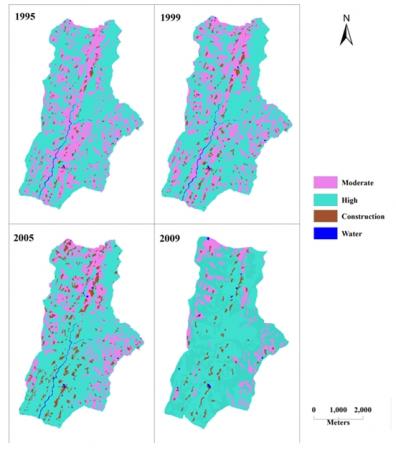
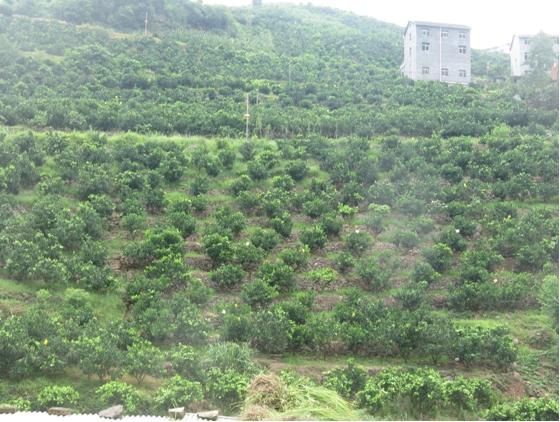
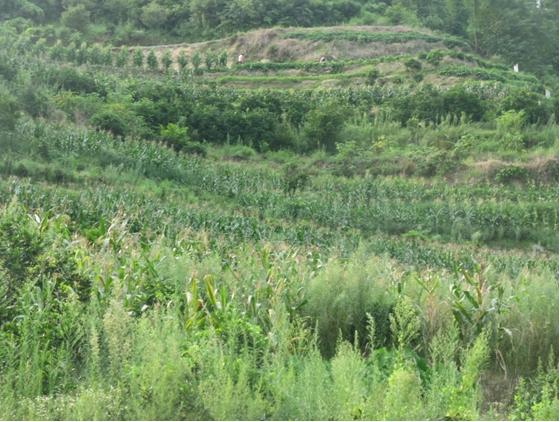
Openness is increased to moderate as intensive agriculture and production for the market dominate. Use of (imported) chemical fertilizer rises by more than 80% between 1978 and 1985.
Economic captial: In this period, the Zigui County government actively develops the local economy and infrastructure. Local GDP and disposable income of local farmers increase.
Social capital: Population numbers increase then decrease. Growth rate becomes negative after 1996, demonstrating the effectiveness of family planning policy. Human capital is high compared to activities prevalent in the period. Important reforms in the governance of China government are introduced, particularly with regard to economic development.
Socio-ecological resilience
AK: to be added, source: D133
Socio-ecological fit of the dominant response to LEDD
AK: to be added, source: D133