
Study sites in cropland
Study sites in grazing land
Study sites in forests
Factory of the world (2001 to date)
| Authors: | Pingcang Zhang, Honghu Liu, Jiang Min |
| Coordinating authors: | Constantinos Kosmas, Giovanni Quaranta |
| Editors: | Alexandros Kandelapas, Jane Brandt |
Editor's note 20Mar14: Source D131-17.2.3
Assessment of natural, economic and social capitals
| Natural capital | |
| Assessment | Soil capital in Zigui County in 2007 is mainly moderate.
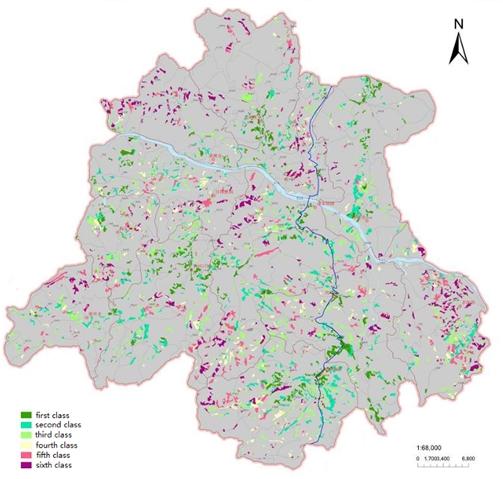
Overall, water capital in Zigui county demand is 0.732 ×10⁸ m³ and water consumption is 0.4899 ×10⁸ m³. The WC/WD ratio is 0.67. Water quality is moderate to low. Vegetation capital increases. Area under forest cover increases from 24.6% in 1985 to 61% in 2009. |
| Critical functions | Although, yield per hectare of oil and grain crops increases, due to the reduction of plant area total grain yield decreases. Drought isnot a problem during the period, after the completion of several water conservation projects |
| Critical variables | - |
| Economic capital | |
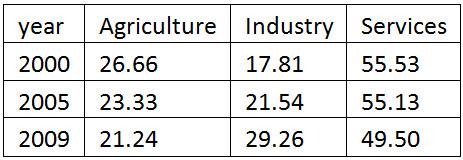
| Assessment | The contribution of agriculture and services to the economy (GDP) decreases while that of industry rises sharply. Canned food and silicon remain the main export goods. Nevertheless, agriculture remains the main source of employment (67%) followed by services (20%) and then industry (13%).
In the financial capital, small subsidies and compensations exist for grain (0.28 RMB/kg), wheat disease (75 RMB/ha), rape disease (150 RMB/ha) as well as subsidies for agricultural machinery. The ratio of present population + immigration/resident population decreases from 0.95 to 0.77. Bank deposits increase from 177.4 million RMB in 2005 to 448.14 million RMB in 2009. Disposable income per capita also increases from 5820 RMB in 2000 to 10515 RMB in 2009. Considering landesque capital, in 2005 there are 20 water reservoirs with a total capacity of 38.251 million m³ and effective capacity 27.017 million m³. The area under irrigation is 1.739.8 ha. A further was 2466.7 ha is irrigated by 3228 ponds (11.9417 million m³) and 1026.4 ha by 45500 pools (2.5826 million m³). As far as physical capital is concerned, the “Changzhi project” contributes to the construction of 1542.3 ha of new terraces. Total arable land is 26.2 thousand ha in 2005 (0.07 ha per capita). The area of citrus is 10200 ha and the tea 2157.77 ha. Since 2000, the numbers of pigs continues to increase (from 525.7 thousand in 2000 to 640.5 thousand in 2005). In technology capital, chemical fertilizer use shows a small decrease between 2000 and 2005. Total agricultural machinery gross power in 2005 in the county s 127.4 thousand KW. Internet use has been increasing exponentially since 2003. |
| Critical functions | During the period, GDP and added value of sectors increases very quickly as more and more of the population became employed in industry and services. Bank deposits and disposable income rises dramatically. At the same time, many water conservation projects are built (terraces, ponds). Within a period of 15 years, communication forms change from telegram to telephone and internet. Traditional agriculture is gradually converted to the economic plantations (fruit). |
| Critical variables | - |

| Social capital | |
| Assessment | In this period, population declines continuously with a negative from 2000 to 2005. More recent data however (2010-2012) shows a slight increase.
Agriculture has lost its attractiveness as a profession, with farmers seeking employment in other sectors (salaried) or other places. Cooperation is declining. Junior high school education becomes mandatory and levels of education are increasing with more young people pursuing high level education. |
| Critical functions | - |
| Critical variables | - |
Main LEDD problems and responses
Soil acidification and acid rain persist, affecting approximately 27200 km² of arable land. The county has 986.67 km² (3.6% of farmland) of acid or alkaline low-yield farmland, of which 826.67 km² (3% of farmland) is peracid (soil pH < 5.0). The Three Gorges reservoir area continues to be a natural disaster-prone area, with frequent landslides. Use of wastewater for irrigation affects farmland, forests and grasslands, particularly in the region of Yichang City. Wastewater includes municipal sewage, petrochemical sewage, industrial mining sewage and urban mixed sewage. The content of heavy metals in urban sewage is small, but due to the rapid development of China's industrial and mining enterprises, not segregating industrial from urban sewage and the use of this mixed wastewater for irrigation, there is an accummulation of heavy metals in the soil. This is exacerbated by pesticide and fertilizers applications of agricultural measures. Road construction has also become an important LEDD issue.
The dominant response to LEDD problems continues to be a combination of measures under the "Grain-for-Green" project and related watershed management efforts. Since 2000, the Zigui Government implements the "Changzhi Project" as a pilot project under Grain-for-Green in the upper and middle reaches of the Yangtze River. Between 2001 and 2004, the County Forestry Bureau increases forest coverage from 43.2% to 52.3% and oversees the afforestation of 13.85 hectares. The county also stops all commercial logging in natural forests. During this "consolidation phase", the County Land Resources Bureau implements unified management including upland and abandoned farms.
The projects receive strong support from the central government: between 2000 and 2005, over 48.000 farmers receive a total of 44.735 million Yuan to, amongst other things, plant 2100 ha of economic forest. However, after 2005, Grain-for-green incentives provided by the state are reduced as management is handed to local government. From 2008, natural forests in Maoping, Jiulingtou forest are included in the natural protection forest district.
The tourism industry grows, employing increasing numbers of traditional agricultural populations.
Overall the green area continues to rise nearing the levels of the 1960s. The comprehensive management of Zigui creates significant improvements in the living environment.
Policy context
AK: to check that implementation, impacts and effectiveness of selected policies are discussed in this text. Look at D142 to see if there is any additional information.
China's growth, supported by national policies for industrialisation, regional development and urbanization serve as significant drivers for LEDD problems. The impact of these policies are rapid and dramatic. In contrast, conservation policies are not as quick in achieving results. From the 1990s, several laws and regulations governing land use are advanced, including the New Land Administration Law (1998), the Basic Farmland Protection Regulation (passed in 1994, revised and enforced in 1998) and the policy to Maintain both Economic Development and Land Resources Conservation (2003).
However the conversion of cultivated land to industry and urbanisation largely increases in the 1998–2003 period, leading to a decrease in agricultural land. From 2000, the area of high quality cultivated land in the eastern and particularly southeastern China greatly decreases due to urbanisation and agricultural adjustment. During 2001–2005, the total area of cultivated land decreases by 6.16 million hectares, a much higher amount than during 1996–2000.
As a response the government enacts the "Urgent Notice on the Improvement and Rectification of Land Market and the Enhancement of Land Management". The policy strictly controls the total area of developed land and suspends approval of requests for land conversion. In addition, the "Evaluating Method on the Equilibrium of Requisition-Compensation of Cultivated Land (2006)" require that any loss of cultivated land be compensated by the generation of a similar area of cultivated land from other land-use types. Although cultivated land continues to decrease, as it has since 2003, the rate of conversion of cultivated land to other land-use types gradually decreases. However, there is significant geographic variation in cultivated land and high quality cultivated land that is lost is often replaced by new but low quality land.
Land policy continues to expand to include "Strict Cultivated Land Protection and Developed Land Control" and support of the administratiion to control illegal use of land resources. In 2008, in order to overcome global economic crisis, China’s land policy is adjusted to so-called "double maintenance strategy", i.e. to maintain both economic development and land resources conservation or "Maintain both Development Rate and Red Line". The red line refers to the minimum area of cultivated land that China must maintain.
The effectiveness of these policies is seen in grain production. Grain production was 0.512 billion tons in 1998, decreased to 0.431 billion tons in 2003 but increases again to 0.529 billion tons in 2008.
Over these years it is increasingly recognised that government allocation of land resources (policies of Cultivated Land Protection and Control of Developed Land) may be insufficient to solve land-use conflicts and the that reforming user rights may be a better way to manage land and improve efficiency. The establishment of the Chinese agricultural land transfer system takes place through:
- the “Rural Land Contracting Law” (2003), under which land contract management rights can be transferred through subcontract, rent, exchange, assignment or other means;
- “Regulations on Transfer of Rural Land Management” (2005) establishing a framework for local governments to deal with agricultural land transfer systems pursuant to their respective situations;
- the "Decision as to Several Significant Problems in Promoting Rural Reform and Development” (2008) of the CPC Central Committee, advocating stronger supervision of land contract management rights and the establishment of the market of land management rights. The document puts forward three principles of land contract management rights
- The collective ownership of agricultural land cannot be changed
- The use of agricultural land cannot be changed
- Contracting farmers' rights cannot be harmed.
Properties of the system
AK: to check if there is any further relevant information in D133
Natural capital: Rain seasonality shows little variability and good suitability for plant growth. Average overall temperature and overall potential for change remain stable. Orange groves are moderately connected while tea garden and perennial crops are loosely connected. Openness remains moderate as imports of fertiliser continue but grain exports decrease. Redundancy and robustness to drought remain high, while the diversity index slightly decreased. Orange groves are characterized by low rapidity in recovering whereas traditional cropping system by high rapidity.
Economic captial: The period is characterised by security in the food supply and the expansion of horticultural trees. All lower lever properties show an overall improvement
Social capital: Population decreases at first then gradually increases. Institutional changes in the central government play an important role in economic construction. Local trust and cooperation are reduced and largely replaced by formal employment relations.
Socio-ecological resilience
AK: to be added, source: D133
Socio-ecological fit of the dominant response to LEDD
AK: to be added, source: D133