
Study sites in cropland
Study sites in grazing land
Study sites in forests
Population boom (1949 to 1979)
| Authors: | Pingcang Zhang, Honghu Liu, Jiang Min |
| Coordinating authors: | Constantinos Kosmas, Giovanni Quaranta |
| Editors: | Alexandros Kandelapas, Jane Brandt |
Editor's note 20Mar14: Source D131-17.2.1
Assessment of natural, economic and social capitals
| Natural capital | |
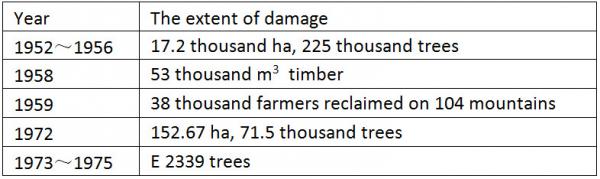
| Assessment | Official soil data for the period before 1979 is scarce. However, the period includes extensive land reclamation and deforestation that cause serious soil loss.
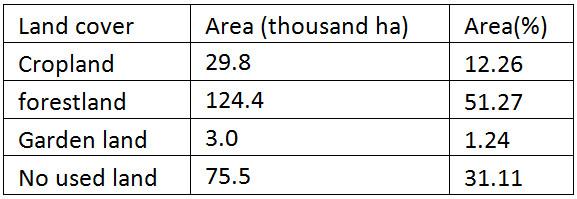
Water is of high capital value, average runoff depth is 758 mm and the average surface water is 1837 million m³. Ground water quantity is 857 million m³. Most water is bicarbonate water with the dissolved solids less than 0.5g/L and pH about 7~8. In the late 1970s, 12.26% of Zigui county is cropland, while more than 50% is forest and 12,4% garden land. Increased population results in the demand of food and local farmers are encouraged to convert forest to cropland. 60-70% of cropland is paddy. After the paddy is harvested, wheat and peanuts are planted. Other crop types included potato, sweet potato and maize.
The average temperature ranges between 6 to 18°C. The average temperature in Guizhou town is 18 °C. The average temperature in the warmest month is 28.9 °C and in the coldest is 6.4 °C. The rainfall ranges from 950 to 1590 mm, with an average of 1439.2 mm. |
| Critical functions | Accounts from local farmers report permanent water flow in streams, indicating that soil infiltration capacity and soil water storage capacity is adequate. However there is some indication of land and vegetation deterioration in the area. Between 1959 and 1985, there are 63 drought disasters.
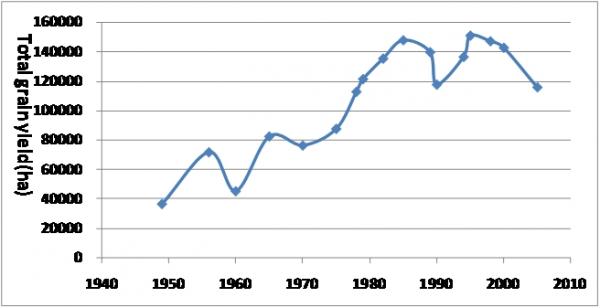
In the early part of the period, crop production depends on rainfall. Later, chemical fertilizer, upgrade of low-and medium-yield farmland and technological improvements increase grain yield per ha.
|
| Critical variables | - |
| Economic capital | |
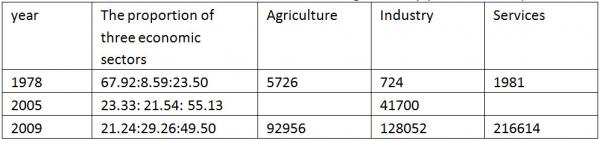
| Assessment | In 1978 the proportion of three sectors of the economy (agriculture: industry: services) is 67.91:8.59:23.5. GDP added value for each in 1978 is 5726×104 RMB, 724×104 RMB, 1981×104RMB respectively.
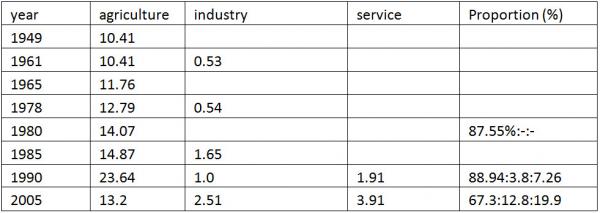
The main exported goods include orange, cow leather, goat leather, yellow weasel leather, mixed leather, bristles, sheep and pig casing, Osmunda japonica and silkworm silk and cocoons. Before 1990, the export goods are agricultural products. In fact, agriculture is the main economic sector and source of employment in Zigui county.
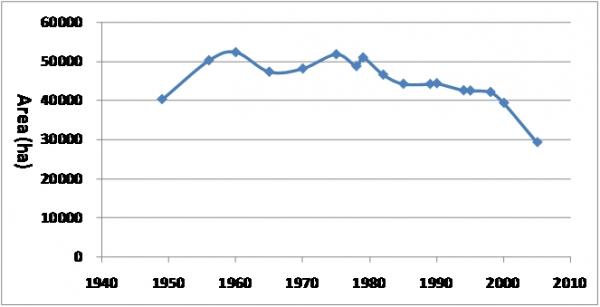
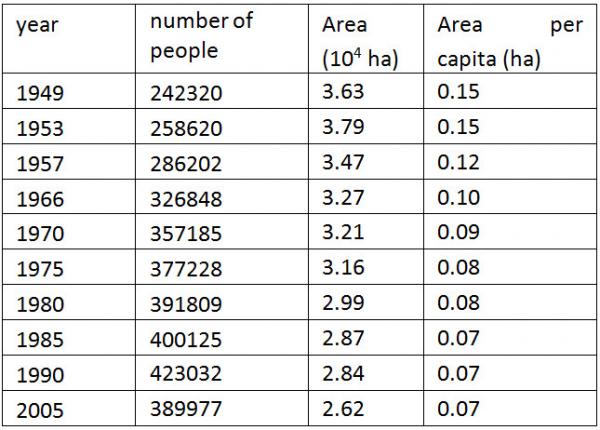
In 1979 landesque capital comprises 3080 ponds, irrigating 1733 ha of cropland, as well as 12 small irrigation tanks with 2702.66 m³ irrigation capacity covering a further 4413.3 ha. In 1965, irrigation water volume in the whole county is 9.78 million cubic meters. In 1955 citrus orchards replace cereals in terraced land. After 1959, the high construction rate of terraces results in the deterioration of their quality, In terms of physical capital, in 1949, arable land in Zigui County is 36.3 thousand ha (0.15 ha/capita). In 1953 the total area increases, but per capita area remains constant. During 1953-1980, total area and area per capita decreases. In 1980, the total arable land is 29.9 thousand ha and the area per capita is 0.08 ha. Before 1954 there are no pigs in the area, whereas after 1954 their population starts increasing, reaching about 640 thousands in 2005. However, during 1960 – 1963 a natural disaster causes the reduction of their population. Sheep population also increases from 1949 to 1985. In 1953, 400 kg of the chemical fertilizer ammonium sulfate is used for the first time. In 1978, the total amount of chemical fertilizer is 12699 t (N 8551 t, P 4148 t). Since 1953 the county has used more than 60 kinds of chemicals and biological pesticides. After 1970s a lot of efficient, low toxicity and residue pesticides gradually replace older toxic pesticides. Agricultural mechanisation is introduced in 1959. After 1976 the government subsidizes the market for agricultural power machinery, giving the opportunity to every village to possess equipment. In 1980 there are 2145 agricultural machines. |
| Critical functions | Local farmers from all villages are divided into several production teams, working and living under similar conditions. |
| Critical variables | - |
| Social capital | |
| Assessment | During the period 1953-1957 natural growth rate is 25.36%. This is the first birth boom period after the new China government. In 1959-1961, natural growth rate falls to -11.77% because of serious natural disasters. After 1962, the natural growth begins to increase again. A second population boom period comes between 1966 and 1970, with an annual population growth of 7861 and a rate of 26.93%. Family planning is implemented after 1970, after which the growth rate starts decreasing from 15.57% in 1971 to 9.66% in 1976 and 6.51% in 1980.
During 1949-1979, farmers are organized in groups of 80–100 people, collectively involved in infrastructure works (building roads, canals etc.), or in agricultural works (e.g. tillage). In 1966 the Great Proletarian Cultural Revolution begins, lasting until 1976. During the period, party cadres and intellectuals are affected, but production activity persists. |
| Critical functions | Organization in small groups and collectivisation of production are the prevailing social characteristics. |
| Critical variables | - |
Main LEDD problems and responses
The origins of LEDD problems during the period may be traced to high birth rates and rapid population growth, creating pressures to increase food production.
The main response to these issues is to implement large scale land reclamation in order to ensure crop production and food supply. This causes a lot of vegetation destruction and severe soil loss particularly during 1958-1960 (the Great Leap Forward). These responses contribute to the 1961 severe drought. After the Cultural Revolution, a large number of citrus groves are planted along the Yangtze River and the citrus industry grows rapidly. More positive responses are implemented at the county and micro-level. In 1961 the County Government issues a strategy of “taking grain as the key link to develop” although little of it is implemented before 1976.
The awareness for forest protection is an important guarantee for Zigui Forestry Development. Some non-governmental cooperatives actively afforest, planting economic forests to improve forestry output. However, due to the use of single species forests, understory cover is reduced, limiting seedling survival rate and preventing efficient soil conservation.
Local government organizes farmers to build terraces and the construct small-scale irrigation and water conservancy projects by self-financing, without state assistance. Some farmers spontaneously dig small rainwater water cellars in the fields around their lands.
Policy context
AK: to check that implementation, impacts and effectiveness of selected policies are discussed in this text. Look at D142 to see if there is any additional information.
After 1949, land reform (Tu Gai) wi launched in a bid to reduce social inequality by confiscating land from the rich (landlords) and then redistributing it to the poor. By 1958, all land is either state- or collectively owned. Urban land is state-owned whereas farmland is collectively owned, with a few exceptions. This type of land ownership structure persists for the coming decades.
Some collectively owned land in rural areas is converted to state-owned land through land acquisition. Instead of paying market prices, the state provided a compensation package that includes urban residency licenses (Hukou), employment, housing compensation and compensation for the loss of crops. Although peasants are not paid market prices, they are willing to give their land to the state. The Hukou license also makes former farmers eligible for medical insurance, pension and retirement plans and better school access.
The Hukou system helps to tightly control rural–urban migration, to limit labour mobility and to prevent some urban growth problems. On the other hand, it creates a dichotomous urban–rural structure where urban residents have a much higher standard of living and satisfaction.
Properties of the system
AK: to check if there is any further relevant information in D133
Natural capital: The potential for change of cereal and citrus cultivation, estimated on the basis of average air temperature and rain seasonality, is moderate overall. Robustness, in terms of resistance to drought is low. From 1959-1985, there are 63 drought disasters, of which 29 are partial, 21 moderate and 13 severe. Droughts with a duration of 6-9 months have the most severe effect on agricultural production. Redundancy however is relatively high. Paddy coveres about 70% and wheat and potato about 30% of Zongui county, ensuring continuing function in cases of disruption.
Most cropland is planted for grain and much less for economic trees. Plantation characteristics suggest that species are moderately connected, and that the area is characterized by a high connectedness index.
Economic captial: Robustness is low and redundancy high. The Zingui economy is characterized by a strong degree of subsistence. Farming is the dominant occupation, almost all grain is allocated locally while some is handed over to the government. Fertilizer inputs are organic, not chemical.
Social capital: Population increases dramatically. All workers follow collective productive activities, organised in production teams. Trust and cooperation are present.
Socio-ecological resilience
AK: to be added, source: D133
Socio-ecological fit of the dominant response to LEDD
AK: to be added, source: D133