
Study sites in cropland
Study sites in grazing land
Study sites in forests
Semi-intensive agriculture society (2000s)
| Authors: | Barhdadi Abdelali, Hajar Bouchikhi, Ahmed El Aich, Ouail Hrich, Zineb Koumya |
| Coordinating authors: | Concepción L. Alados, Giovanni Quaranta, Rosanna Salvia |
| Editors: | Alexandros Kandelapas, Jane Brandt |
Editor's note 20Mar14: Source D232-4.2.3
Assessment of natural, economic and social capitals
| Natural capital | |
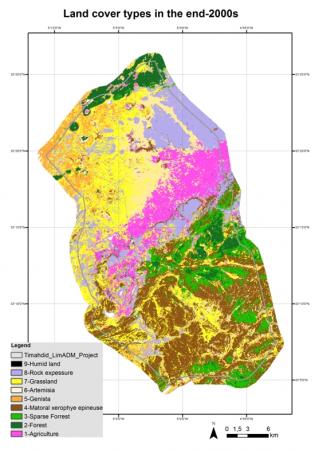
| Assessment | Almost 38% of land is occupied by matorral, primarily the xerophyte espinouse with less pastoral value. This mattoral increases from 21% to 23% since the mid-1980s. Forest area declines from 16% to 13%. Agricultural area occupies 10% of the study site and grasslands 22%.
Species richness (expressed in number of species) is higher in the research station where stocking rate is controlled. There, 80 are found, containing those with high pastoral value (Poa bulbosa, Genista pseudopilosa, etc). In contrast, grazing areas with moderate grazing pressure contain an average of 50 to 55 species. Those where grazing pressure is high have an average of 40 species with a predominance of those with low pastoral value. |
| Critical functions | -- |
| Critical variables | -- |
| Economic capital | |
| Assessment | Livestock remains the major economic capital and in 2009 there are 130,000 sheep, 12,000 goats and 1,800 cattle. Livestock is the center of the family economy, but is mainly a form of savings, “standing capital on legs”. The old pastoral system is becoming more and more sedentary.
Herd management is often undertaken contractually. All contracts are oral and done in presence of witnesses. The most common contracts are :
While the economic logic of contracts is clear (employment, income), their toll on rangeland is heavy as they lead to an increase in the number of livestock and, therefore, increase the stocking rate dramatically. There is a large disparities in monthly incomes which vary from 850 to 40.000 dirhams depending primarily on herd size The farming system is diversifying. Small farms of less than 5 ha dominate (52%) while large farms of more that 50 ha represent less than 5%. In general, almost 38.5% of the farms have less than 20 ha. The main crops grown are cereals (56%), forage (24% ) and fallow (17.2%). The main changes in agriculture concern gardening and horticulture. Indeed, more farmers cultivate potatoes, which have been recently introduced, for the increased revenue they generate compared to cereals. More than 200 ha of potatoes are grown, 22% of the crop in the province of Ifrane. Horticulture starts too; in the Timahdit area, 20 ha is planted with apple trees. |
| Critical functions | -- |
| Critical variables | -- |
| Social capital | |
| Assessment | In 2002, the population of the Ait Arfa du Guigou is 7,200 with 39% less than 15 years old. 8.45% are older than 60. Average household size is 6.2 persons. Conflict about the right to graze on collective rangelands between the descendents of Ait Arfa du Guigou) and the incomers continues. Development of professional organizations are expanding and include approximately 1,302 people in productive or water management associations. Herdsmen are having trouble finding herders to take care of flocks, as salaries are going up as herders demand more pay, constituting a real constraint for grazing livestock. |
| Critical functions | -- |
| Critical variables | -- |
Main LEDD problems and responses
The population of the Ait Arfa du Guigou has almost tripled within the last 70 years.
In parallel with population growth, the number of animals increases significantly despite the gradual reduction of rangelands engaged in cultivation, especially in the lower parts (azaghar). This narrowing of pastoral areas has contributed to over-exploitation of rangelands and forests. As agriculture is concentrated in the irrigated plains (market gardening and arboriculture), rangelands are becoming increasingly unable to ensure reproduction of livestock. Even if the rangeland area itself is not decreasing, the number of people holding grazing rights is increasing.
Sedentarisation in the summer rangelands of the Ait Arfa du Guigou is a consequence of the breakdown in the double transhumance that regulated the use of the resources and which, in turn, resulted from the conversion of the lowlands to agriculture. Consequently, herders reduce their mobility and settle in the summer high grazing lands increasing the grazing pressure here. Consequences on vegetation resources are: (1) a decrease in vegetation diversity, 2) decrease in perennial species and vegetation cover, (3) a change in land cover.
The diversity of plant species is significantly lower in areas where grazing is intense (at water points and Bouanguar). Higher numbers of settlements result in a higher degree of degradation and bare soil is associated with higher grazing pressure. In contrast, there is more litter in the places where grazing pressure is not intense. The percentage of rock cover 15% in Bouanguer where grazing pressure is about from 5 to 6 ewes per ha. In Touna Research Station where the stocking rate does not exceed 1 ewe per hectare, grasses are more abundant.
Changes in land cover tend to follow the overexploitation of resources. The amount of forest is decreasing; matorral (especially xerophitic matorral) is increasing, grassland is increasing marginally and rock exposure is increasing. To cope with the consequences of degradation and the demand for more and more external feeds, farmers are cultivating lands for a dual purpose: to produce more feed and for new added value crops to diversify their revenue.
Policy context
AK: to check that implementation, impacts and effectiveness of selected policies are discussed in this text. Look at D242 to see if there is any additional information.
Properties of the system
AK: to check if there is any further relevant information in D233
Natural capital: --
Economic captial: --
Social capital: --
Socio-ecological resilience
AK: to be added, source: D233
Socio-ecological fit of the dominant response to LEDD
AK: to be added, source: D233