
Study sites in cropland
Study sites in grazing land
Study sites in forests
Franco Regime (1939 to 1975)
| Authors: | Michiel Curfs, Anton Imeson |
| Coordinating authors: | Constantinos Kosmas, Giovanni Quaranta |
| Editors: | Alexandros Kandelapas, Jane Brandt |
Editor's note 20Mar14: Source D132-14.
Assessment of natural, economic and social capitals
| Natural capital | |
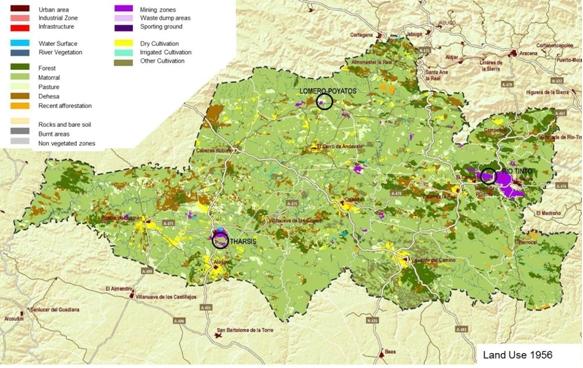
| Assessment | For this period, Western Andévalo has moderate climate capital on NW, NE slopes and low on SW, SE slopes. The rainfall regime is typical for the Mediterranean. There is broadly moderate soil capital (Eutric Regosol, slope 8-15%, moderate depth (40 - 80 cm)). It is a cereal landscape with Dehesa and matorral in the northern part. Other vegetation found includes olive, fig and carob trees.
|
| Critical functions | Low primary production is the main ecological function and is highly dependent climatic conditions. |
| Critical variables | Land use and land management change is a fast variable. There is a shift from dry to mechanized agriculture, with great increases in productivity. |
| Economic capital | |
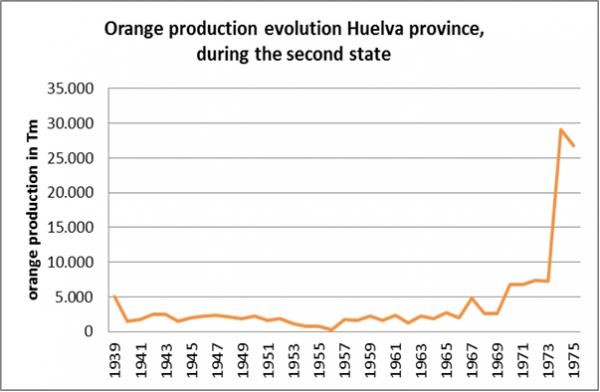
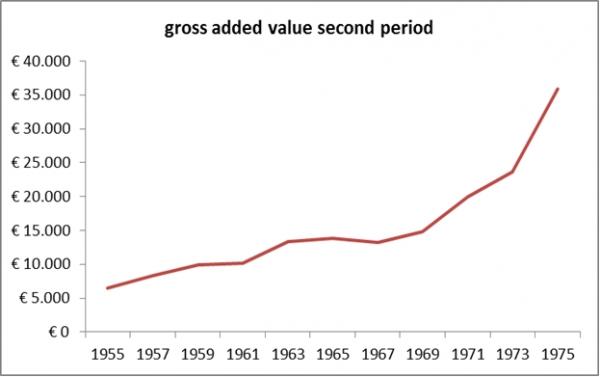
| Assessment | Produced capital focuses on agricultural production. The end of the period is marked by the rapid expansion of citrus production and the increase in value added by agriculture.
|
| Critical functions | The basis of the rural economy is subsistence agriculture with a poor rural population, little infrastructure and isolation of villages. Economic opportunities are further diminished as the mines close. Flour production based on dry agriculture persists while increasing mechanization encourages increase in production despite the limited number of agricultural workers. Industry and tourism are greatly encouraged and increases with the stabilization plan from the year 1959, to mark an impressive change in economic policy. |
| Critical variables | The different cultivation techniques introduced due to mechanisation and innovation are fast critical variables including irrigation. This contributes to the increase of productivity and to the economic independence of local farmers. |
| Social capital | |
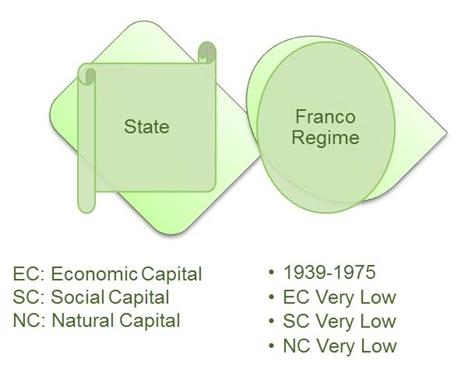
| Assessment | The most critical component is the political regime which operates at the national and higher SES level. It dominates and overshadows all aspects of social and economic life. The political focus is put on making the transition form an agrarian to an industrial state. Rural Western Andévalo witnesses a great exodus and cities grow. However, after the closure of the mines, the economic condition is very poor and the low natural capital set strict limits on possible income from agriculture.
Participation is believed to be high, but not out of free will. Trust is generally low. The rise of a contraband economy in a few villages is a demonstration of local trust-based networks.
|
| Critical functions | This period is marked by the dominance of the dictatorial political regime. The aim and direction of the government in all layers of society is to increase production. |
| Critical variables | The introduction of new agricultural practices (a fast variable), gives farmers the chance to become less dependent on local bosses. Modernization and innovation in agriculture, lead to significant changes in agrarian hierarchical social power structures. The forced shift from an agrarian to an industrial state has further adverse effects upon living conditions in rural villages. |
Main LEDD problems and responses
The main LEDD problems in the area during this period are agricultural decline, soil erosion and deterioration and loss of biodiversity. The introduction of the national "agricultural stabilization plan" in 1959 leads to intense competition between regions, with few opportunities for Western Andévalo and causing land abandonment, which is the the dominant unplanned response (negative). A further, more planned response, is the the establishment of eucalyptus and pine plantations.
Soil erosion and deterioration is related to the land use changes in the rural area and the heavy expandion of industrialization mainly near of the capital and along the coast. Mechanical means for reforestation and logging have a negative effect on soil and contribute to loss of biodiversity. Increasing industrialization also leads to more contamination and pollution.
Policy context
AK: to check that implementation, impacts and effectiveness of selected policies are discussed in this text. Look at D142 to see if there is any additional information.
The 1959 stabilization plan acts as major force for land abandonment. In addition, national economic planning in the 1960s leave a long-lasting mark in the area: Huelva is identified as a site for paper pulp production creating a big incentive for reforestation to provide the plant with resources. The new pine and eucalyptus plantations create massive land use changes while also being are highly susceptible to erosion and causing biodiversity loss. Both policies are therefore considered as LEDD drivers.
Properties of the system
AK: to check if there is any further relevant information in D133
Natural capital: The dominant crop is cereals. Robustness is low while redundancy (subsistence agriculture with mixed production) is high. Connectedness of cereal production is low that while of subsistence agriculture is moderate. Rapidity is estimated to be high. Diversity for natural capital in croplands is estimated qualitatively: for cereal crops (monoculture) diversity is low. For the traditional small scale subsistence farming, diversity is higher with many different crops to sustain the local population.
Economic captial: Robustness of economic capital for cereal production is low.
Social capital: Due to a lack of qualitative and quantitative date it is difficult to assess the lower level properties.
Socio-ecological resilience
AK: to be added, source: D133
Socio-ecological fit of the dominant response to LEDD
AK: to be added, source: D133