
Study sites in cropland
Study sites in grazing land
Study sites in forests
Mining state (until 1955)
| Authors: | Michiel Curfs, Anton Imeson |
| Coordinating authors: | Constantinos Kosmas, Giovanni Quaranta |
| Editors: | Alexandros Kandelapas, Jane Brandt |
Editor's note 20Mar14: Source D132-14.
Assessment of natural, economic and social capitals
| Natural capital | |
| Assessment | From the scarce data available regarding climate in Western Andévalo, it can be seed that the climate capital component is moderate on NW, NE slopes and low on SW, SE slopes. Higher rainfall than is later seen is recorded at least for the period 1931-1955.
Soil capital value is moderate and soils do not change over the coming decades. Water capital is from moderate to low, and there are no dams. Concerning vegetation, it is a cereal landscape based upon subsistence agriculture and the Dehesa ecosystem. Olive, fig and carob trees are also found although much of the area is covered by matorral vegetation. |
| Critical functions | The main ecological function is primary production of wheat and cereals. Although based on traditional means (dry agriculture) there was sufficient for the local population. |
| Critical variables | Climate is a slow critical environmental variable, as rainfed crops are the norm. |
| Economic capital | |
| Assessment | There is not sufficient data to comment on financial capital, landesque capital, physical capital, technology or animal capital. Overall economic capital is of very high value, based on the strength of the mining industry.
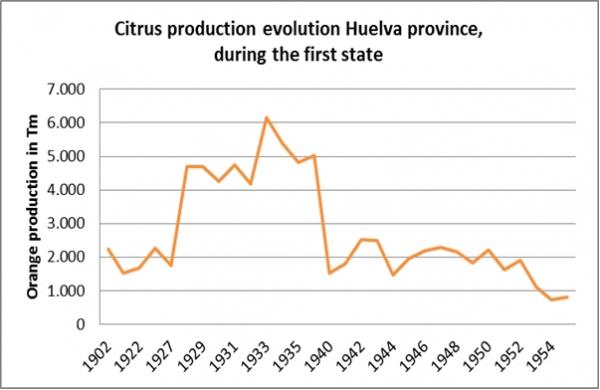
With regard to produced capital however, the agricultural production of citrus may serve as an indicator. Orange production peaks in the 1930s and rapidly declines as the civil war breaks out.
|
| Critical functions | The main economic function and main source of income in the area during this period is mining activities. However, mining practices have serious consequences for the environment, such as contamination and massive deforestation. |
| Critical variables | The dominant fast variables are market demand and regulations concerning mining activities. Once it becomes more attractive to mine in other continents outside Europe, mining activity declines rapidly and suddenly, bringing down the built up economic values. |
| Social capital | |
| Assessment | The dominance of mines in the economy also influences social and economic capital: population is steadily rising, schools, education, infrastructure, housing, hospitals and jobs are available and of good quality. Working conditions often are not of high standards, but there are hospitals and doctors that have not been present in the area before.
In terms of the adaptive cycle it can be argued that the study area is at its highest resilience in the 1940s. |
| Critical functions | |
| Critical variables | A social slow descriptor variable is the "mining mentality" phenomenon. By this it is meant that social memory mechanisms foster the expectation that a (foreign) big company will come and solve local needs and problems. |
Main LEDD problems and responses
The main LEDD problems in the area are loss of biodiversity, soil contamination and deforestation. Mining processes during this period cause serious contamination, resulting in the loss of biodiversity. Furthermore, due to increasing production and population, there is increasing demand ifor charcoal and wood, further fuelling deforestation. No specific responses to these problems arises during the period.
Policy context
AK: to check that implementation, impacts and effectiveness of selected policies are discussed in this text. Look at D142 to see if there is any additional information.
The dominant economic and governance force is the mining industry, partly exploiting lack of regulation. New labour legislation in the early 1950s leads to companies leaving the area.
Properties of the system
AK: to check if there is any further relevant information in D133
Natural capital: The dominant crop is cereals. Robustness is low while redundancy (subsistence agriculture with mixed production) is high. Connectedness of cereal production is low while that of subsistence agriculture is moderate. Rapidity is high. Estimating qualitatively, diversity for cereal crops (monoculture) is low. For the traditional small scale subsistence farming, diversity is higher with many different crops to sustain the local population.
Economic captial: Robustness of economic capital for cereal production is low.
Social capital: -
Socio-ecological resilience
AK: to be added, source: D133
Socio-ecological fit of the dominant response to LEDD
AK: to be added, source: D133