
Study sites in cropland
Study sites in grazing land
Study sites in forests
Service-based society (post 1980s)
| Authors: | Federico Fillat, Ricardo García-González, Maite Gartzia, Paz Errea |
| Coordinating authors: | Concepción L. Alados, Giovanni Quaranta, Rosanna Salvia |
| Editors: | Alexandros Kandelapas, Jane Brandt |
Editor's note 20Mar14: Source D232-2.2.2
Assessment of natural, economic and social capitals
| Natural capital | |
| Assessment | The five vegetation cover types present in the last period (forest, shrub, dense grasslands, sparse grasslands and meadows and cultivated areas) persist, albeit with significant increase in forest and decline in both grasslands and shrub.
In terms of fragmentation and connectivity of the grassland patches, the study site includes 43,979 has of grasslands in 405 patches. Patches have a mean extension of 109 ha and perimeter of 10 km, with a high standard deviation attributed to different grassland size in different elevations.
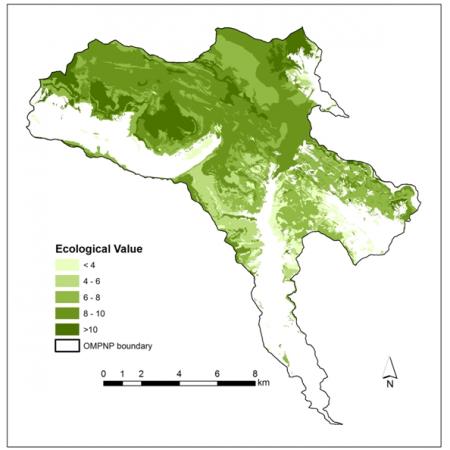
The ecological and pastoral value of grasslands communities are significantly negatively correlated. Areas with a higher ecological value, mainly associated to the higher altitudes and rocky soils, have lower pastoral value (lower biomass and nutritive value) than the more rich communities of the lower altitudes. The grassland communities of OMPNP have an ecological value ranging between 0 and 11, which is higher in the upper parts than in lower parts, attributable to rarity and endemism.
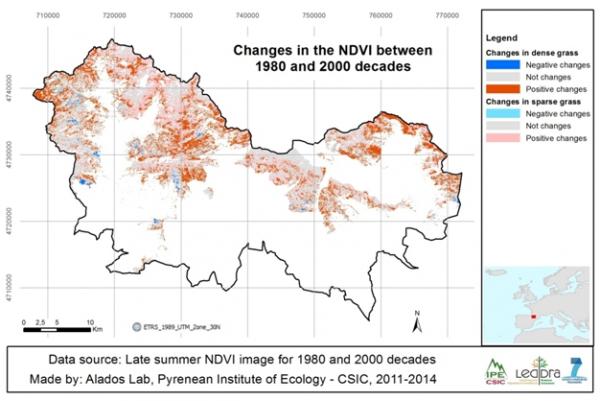
There is a predominantly positive change in grassland communities for Normalized Difference Vegetation Index (NDVI index). Positive changes between the 1980s and 2000s) is more accentuated in high elevation ranges than at low elevations. In some lowland areas pressure by livestock and humans increases in the last decade, while increase in NDVI can also be related to climatic changes. |
| Critical functions | - |
| Critical variables | - |


| Economic capital | |
| Assessment | Livestock species composition changes drastically in the decade after 2000. Sheep are largely replaced by cows and equine species are almost completely absent. These changes have important consequences for grassland management and vegetation dynamics. Livestock numbers range from 1815 cows and 5430 sheep in Biescas to 103 cows and no sheep in Yésero. In general, the number of livestock increases in the valley bottom (Biescas and Broto) in comparison with municipalities, like Fanlo or Panticosa, at higher elevations.
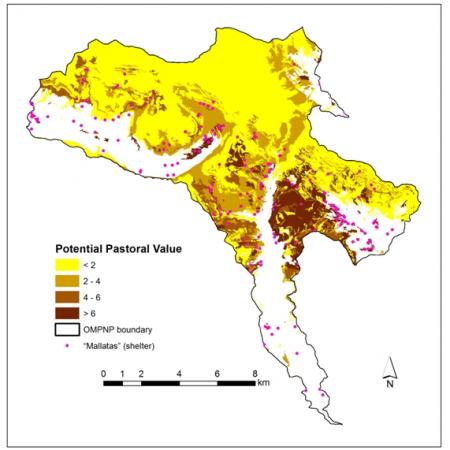
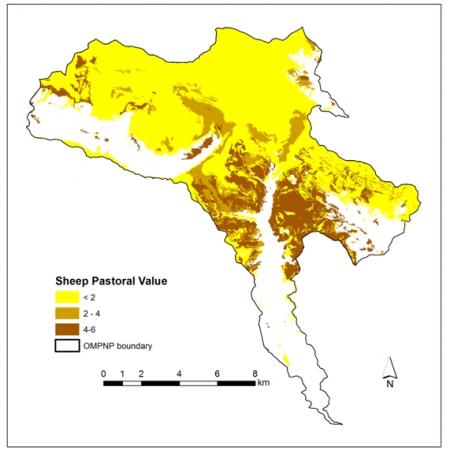
Pastoral value is been calculated based on its value as forage (biomass, nutritive quality, herbivore preference). Lower areas have the highest value, also coinciding with the “mallatas” (shelter) location, where the animals are concentrated during the night. Sheep and cattle use the pastures differently, hence the pastoral value depends on the livestock species. Cattle prefer the lower and less step areas than sheep which are able to use higher and steeper terrain.
The Gini-Hirschman coefficient shows a decline in the spatial concentration of construction sector (post crisis) as well as a concentration of the service sector around the most touristic areas. The Location Quotient has also changed demonstrating a notable increase in construction and services in most municipalities. Agriculture remains more relevant than is general in Aragón province: the less populated municipalities are also those with larger agricultural activity. Industrial activity remains imperceptible. The Diversification Coefficient increases considerable during the last 30 years in all municipalities |
| Critical functions | - |
| Critical variables | - |


| Social capital | |
| Assessment | Of the 86 population centres existing in 1950, 28 have disappeared by 2011. Population concentrates in a few municipalities in the Gállego valley bottom, where there are is a good communication network. The eastern population centres are smaller in size than in the Gállego valley and are also located along the main roads.
The number and proportion of secondary homes increases considerably during the these decades. There are less than 1.5 inhabitants per house in the majority of the study area, with more than 50% of second homes concentrated in four municipalities. |
| Critical functions | - |
| Critical variables | - |


Main LEDD problems and responses
Spain's entry into the EEC (1986) and adoption of the Common Agricultural Policy (CAP) lead to major shifts in production: from cereals to maize or sunflower, and from milk to meat products. Agricultural changes and tourist initiatives (rural tourism) are widespread. Spain experiences an major development associated with the increase in the standard of living in Spain.
Important socio-economic changes in the Central Pyrenees are related to the abandonment of villages, decline in livestock and human pressure, and consequently the transformation of grasslands into shrublands and forest. The forest already present in 1980 are preserved, but more than 13,000 ha of shrub is transformed into forest. Also, more than 7,000 ha of forest or shrub become grasslands. The most important LEDD problem affecting vegetation cover changes is shrub encroachment in the dense and sparse grasslands. Woody encroachment affects primarily dense grassland (close to 20%) and sparse grassland (less than 10%).

The probability of woody encroachment between 1980 and 2000 depends on the distance to woody vegetation in the previous period. The proximity to woody community favours the transition from grasslands to shrub or forest. Most of the transformations from grasslands to woody vegetation take place in the first 90 meters from next woody patch. Woody encroachment on grassland takes place mainly at lower altitudes. Dense grasslands are more affected than sparse grasslands. The rate of encroachment between 1980 and 2000 follows similar trends, when analysis takes into account relative contribution rather than absolute values.
Most (83%) of the study area is public land, managed by the council or the regional government, and only 17 % is private land. The proportion of woody encroachment in grasslands is larger in private than in public lands in both dense as in sparse grasslands. However in public lands, the rate of woody encroachment is similar. In municipalities with depopulation lower than 50% since 1900, woody encroachment of grasslands is lower. While the most depopulated areas are more encroached. This effect is bigger in dense grassland than in sparse ones.

Grasslands invaded by woody vegetation result in a loss of 368 ha of grassland (7%) between 1980 and 2000. As a consequence, grassland fragmentation also increases and the number of patches rises from 380 to 405. Average patch size declines to 16 ha.
Policy context
AK: to check that implementation, impacts and effectiveness of selected policies are discussed in this text. Look at D242 to see if there is any additional information.
The main policies affecting the Central Pyrenees are agricultural and rural development policies.
The Law for the sustainable development of Rural Areas (2007-2013) and the Program of Rural Development of Aragón 2007-2013 (PDR) are the main instruments to distribute aid for rural development of Aragón, with co-financing by the European Agricultural Fund for Rural Development (EAFRD), the General Administration of the State (Ministry of Agriculture, Feeding and Environment) and the Government of Aragón. Programs are directed to economic diversification and the improvement of services to the rural population. Project development and implementation takes place through Local Action Groups, located in the counties (“comarcas”). There are 33 counties and 20 Groups of Local Action in Aragón as a whole, while the Central Pyrenees study site includes two counties and two Groups of Local Action, Jacetania and Alto Gallego, and Sobrarbe-Ribagorza.
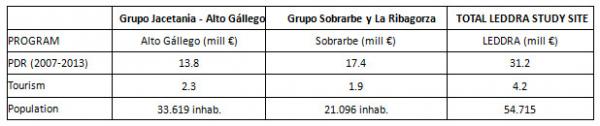

Common Agricultural Policy (CAP) entails price policy and direct aid for agricultural or cattle farms. The Aragón Rural Development Program is first implemented in 2002-2006. Local Action Groups in Aragon are instrumental in delivering employment generation in rural areas and supporting small entrepreneurs to complement primary sector activity. LAGs have guaranteed the monitoring, diffusion and technical support of Rural Development in Aragón.
Properties of the system
AK: to check if there is any further relevant information in D233
Natural capital: --
Economic captial: --
Social capital: --
Socio-ecological resilience
AK: to be added, source: D233
Socio-ecological fit of the dominant response to LEDD
AK: to be added, source: D233