
Study sites in cropland
Study sites in grazing land
Study sites in forests
Subsidized husbandry state (mid 1980s to circa 2010)
| Authors: | Aikaterini Kounalaki, Mina Karamesouti, Eleni Briassouli, Minas Metaxakis, Vassilis Detsis, Thanasis Kizos, Theodoros Iosifides, Alexandros Kandalepas, Constantinos Kosmas |
| Coordinating authors: | Concepción L. Alados, Giovanni Quaranta |
| Editors: | Alexandros Kandelapas, Jane Brandt |
Editor's note 20Mar14: Source D232-5.1.2
Assessment of natural, economic and social capitals
| Natural capital | |
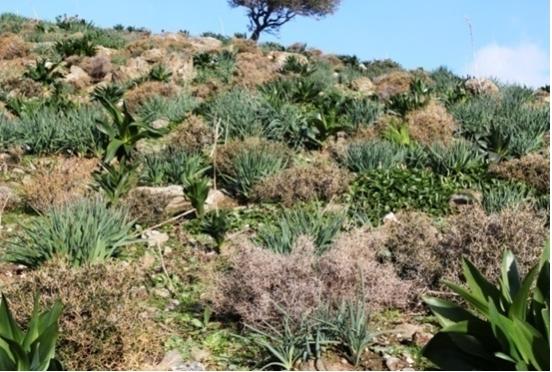
| Assessment | Soil capital continues to be low due to high degree of degradation in the past. The soils of low capital cover 69.8% of the area, and 30.0% it is moderate. Low soil capital is attributed to the dominant characteristics of the area, namely shallow soils and steep slopes. Water capital continues to be low due to absence of water resources. Nevertheless, surface water runoff is classified as high capital value. Wells for drinking water and irrigation have been drilled in flysch/limestone areas in the southern part of the site.. Vegetation capital continues to be moderate and to consist of natural shrubby vegetation, except in parts with olive groves and few vineyards (6.5%). Ecological value of the mountains, assessed after a floristic inventory is relatively high. Pastoral value, assessed based on the plant production, quality and palatability of existing plant species, is primarily low. Climate capital continues to be moderate although a decrease in rainfall and increase in air temperature are observed. Climate capital is low in the south (and south facing) part of the site. |
| Critical functions | Critical ecological functions include (a) regulation of hydrological processes, and (b) regional surface energy balance. With regard to (a), the ability to regulate hydrological processes decreases from the 1950 to mid-1980s. This is clearly attributed to the degradation due to overgrazing and soil erosion resulting in reduction of the ability of the land to support adequate perennial vegetation. Regional surface energy balance also deteriorates between the two periods. Again, decrease in plant cover is attributed to overgrazing and to soil erosion reducing soil water storage capacity for supporting perennial vegetation during the dry period. |
| Critical variables | Environmental variables are generally the same, namely (soil depth and plant cover, both slow variables). Frequency of fire is a fast variable that is introduced in this period |
| Economic capital | |
| Assessment | Produced capital. During this period, Crete GDP jumps from 83% of the national average in 1981 to 106% in 1994 to 101% in 2009. However, more than half of this value is concentrated in Heraklion and the tertiary sector, reflecting the rise of tourism. The share of the primary sector decreases at the same time. In Asteroussia, however, the primary sector persists with a 67% of total employment in 2001, falling by a small 4% since 1991. The number of farms decreases from over 2,200 in 1961 to 1,810 in 2000. Average farm size is stable at around 8.0 ha. At the same time, the number of goats and sheep has almost doubled since 1961. The study site also has high rates of empty (abandoned) houses.
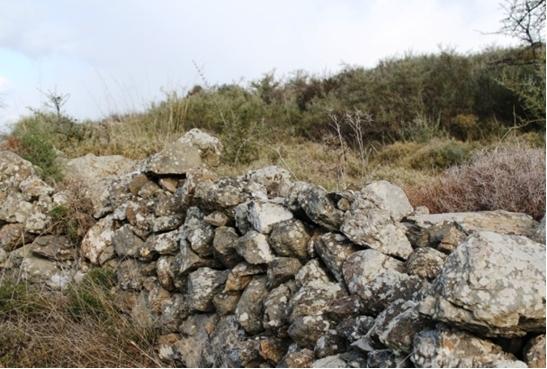
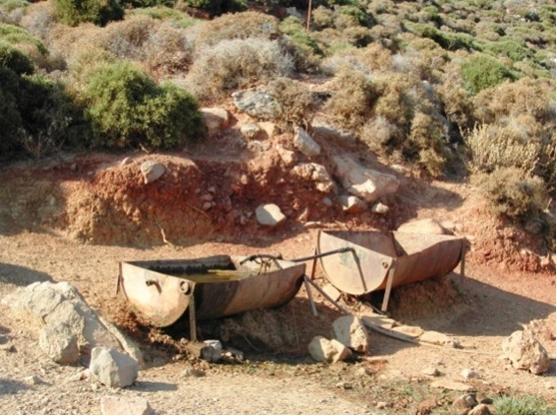
Financial capital increases dramatically during this period primarily due to agricultural subsidies. The rationale of national, regional and local authorities was “not to lose money” that could be paid to farmers in the area, utilising to that end a variety of social networks. The mobilisation of the (state) Agricultural Bank provides affordable credit to cooperatives for investments in manufacture (especially olive mills). Along with cash from tourism, total savings, total deposits and disposable income more than double between the years 1980 and 2000 (in Heraklion Prefecture). Availability of credit for (agricultural) investments through EU funds as well as the WIDER banking sector also increases dramatically from the mid-1990s. Landesque capital is tranformed during the period from traditional stone constructions to concrete, metal and wood and the dominance of wire enclosures. Irrigation infrastructure expands significantly in the form of private, small scale infrastructure. It is composed exclusively of small electric powered pumps that operate after a drill has found underground water in the field. Water is then transported with plastic tubes. Official permits are required for drills, but there is an unknown number of illegal drills and management is difficult if not impossible. Physical capital, such as factories and other productive infrastructure remain scarce, with the exception of a number of small agri-processing units for raw and processed products. Major points of entry to Crete (port and airport) are in Heraklion. The small port of Tympaki (just outside the limits of the study site) serves local needs. Transport infrastructure (road networks) and connections with Heraklion vastly improve during the period although maintenance of the mountain roads remains problematic. The number of primary schools doubles from the 1980s although for senior high school students need to move to neighbouring Messara. Family relocation for better schools is not uncommon. Two rural clinics are in operation from the 1980s. Health centers are located in Tympaki and Moires, and hospitals in Heraklion. Most residents own their houses and foreigners rent some of the older buildings. Many older houses are not used anymore and a number of buildings are used only seasonally as their owners live in Heraklion or not on the island. From the 1980s, credit through EU funds and imports render agricultural technologies much more available. Basic machinery (e.g. tractors) is now widely available. The period sees a rise in self-employed agronomists, related retail shops as well as spare parts manufacturers (the latter now defunct). Basic irrigation technology is also widespread. Animal (livestock), plant and forest capital. The number of sheep and goats has almost tripled in the last fifty years. The highest increase is recorded from 1991 to 2001 (by 91%) when the former system of per head subsidy was still in use. |
| Critical functions | The most important critical economic function is the wide availability and affordability of credit. Again interrelated with CEF: soil depth and water quantity and quality. |
| Critical variables | Production capital increases at high rates, as does physical capital, albeit with a slower pace. Financial capital is generally available throughout the period, while landesque and plant capitals remain more or less stable. |
| Social capital | |
| Assessment | Demographic capital continues to be weak with no signs of dynamism: population ageing and low population density prevail. The small proportion of young, active and dynamic labour limits the prospects for adopting collective and innovative methods for production, value creation and income generation as well as long-term land and environmental conservation policies. The period also sees an increase in immigration in the area.
In terms of human capital, around 70% of Asteroussia inhabitants are graduates of primary education. The percentage of inhabitants with no formal education falls below 10% during the 1990s. Low levels of formal human capital together with the weakening of local knowledge create an unfavourable environment for the development of long-term land conservation and sustainable production management practices. Very little training regarding land and herd management is available to stockbreeders and practically none is sought. The same applies to more modern skills such as production planning, sales and marketing. This is extremely important, as social and cultural devaluation of this social group creates social and institutional distrust, cooperation difficulties and non-compliance to formal norms. Social and cultural capital in Asteroussia and in most mountainous stockbreeding areas of Crete, are closely intertwined. The dominant form of social organization is the extended family and kinship network, a form of extremely strong bonding social capital. It is accompanied by the strength of personal connections and identities based on common places of descent. Individuals from the same village or area form kinship relations and set boundaries (with other groups) which foster rigid, conflictual and antagonistic relations. In this context, animals are not a simple asset subject to ‘rational management’. They embody symbolic meanings which in turn affect management. The status of the extended family and kinship group is partly dependent on the volume of the herd (and on the number of sons and size of the kinship group). Status competition among kinship groups survives, sometimes taking the form of complete rupture of social relations or even violent conflict and crimes between opposing families. Prospects for developing wider social trust among different groups are narrow and limit the chances of engagement in collective action. "Bridging" social capital based on wider trust, social cooperation, and mutual respect between different social groups and spatial units and between social groups and local/regional institutions is generally absent. The lack of this type of social capital and the persistent forms of social and inter-personal competition critically affect natural resource use. Kinship networks have remained strong well into current times and are informally incorporated in "modern" governance (e.g. party politics, subsidies) and market structures. In fact, subsidies have fuelled existing processes, such as competition for large herd sizes. Social distrust has also been reinforced through competition for available subsidies as well as party politics. The social/cultural emphasis on number of animals has also hampered individual or collective responses to market demand for dairy or meat products (farm modernisation, marketing). In this context land management, long-term productivity and sustainability remain marginal concerns. Antagonism also prevails with neighbouring Messara Valley with competition for access to resources (land, water) undermining older forms of tolerance (if not cooperation) such as transhumance. This period represents a significant departure from previous periods in terms of institutional capital, albeit not without continuities. EU accession in the early 1980s is followed by continuous regional/local administrative reforms during the period (introduction of a regional government, consolidation of communities into municipalities, regional elections). Although decentralisation is introduced with optimism, its functionality is limited. Corruption, clientelism, lack of social trust, civil service deficiencies and lack of innovative initiatives from local/regional authorities persist. Top-down politics and policies remain strong often assisted by informal network. Trust towards regional and local institutions is still extremely limited. Primary producers in Asteroussia have limited trust in formal institutions, including their own cooperatives. It is safe however to add that institutional representatives exhibit the same distrust towards citizens, and stockbreeders in particular. In this context, family and kinship based social networks and patron-client relations between stockbreeders and institutional representatives form an integral part of formal institutions. |
| Critical functions | Cooperation networks between farmers and shepherds stop completely. Distrust grows and makes cooperation very difficult. At the same time, the subsidies and how they will be distributed disrupt and erode former networks and set up new in their placed centered on the subsidies. The importance of these networks grows with other sectors of the political and social life. These developments change the properties of the social capital of the area. |
| Critical variables | Social variables manifest the effects of slow changes of the previous period and are dominated by an ageing agricultural population. Administratively, local actors have more power in terms of planning and implementing policies, although central control remains important. CAP subsidies transform older bonding networks based on kin into new ones based on subsidies. |
Main LEDD problems and responses
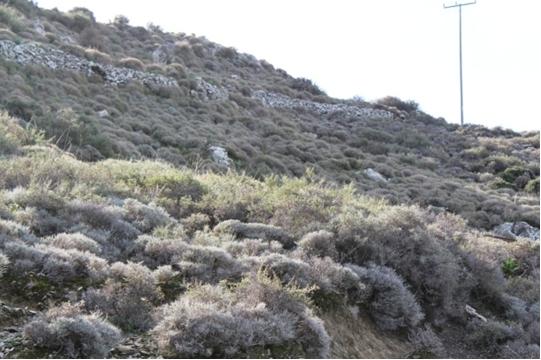
The main LEDD problems during the period are soil erosion, water stress and land desertification. While during until the 1950s the majority (87.6%) of the area was characterized by low rates of soil erosion, soil erosion rates gradually increase after 1950s and become worse after the mid-1980s. Areas with low erosion rates have decreased to 48.5% of the total area while the area with erosion rates greater than 5 t ha-¹year-¹ has increased to 40.5%. This is mainly attributed to overgrazing.
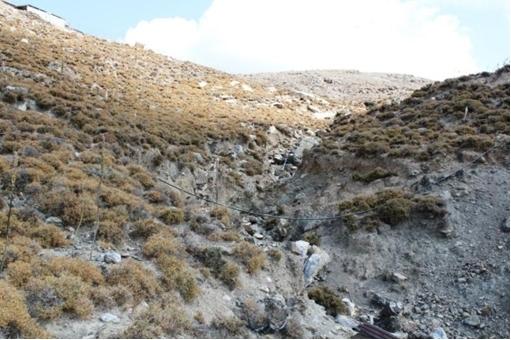
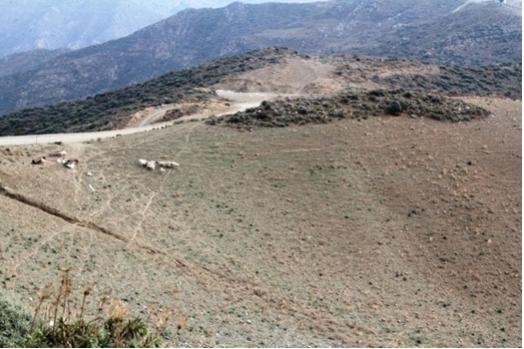
Land desertification constitutes a severe problem for the area with fragile areas covering 55% of the total area and environmentally sensitive areas (ESAs) covering 43%. Such areas are mainly found in the south-facing slopes. Compared to the previous period, a large proportion of the area has moved from the fragile to the critical category. This trend is bound to continue under the existing land management practices.
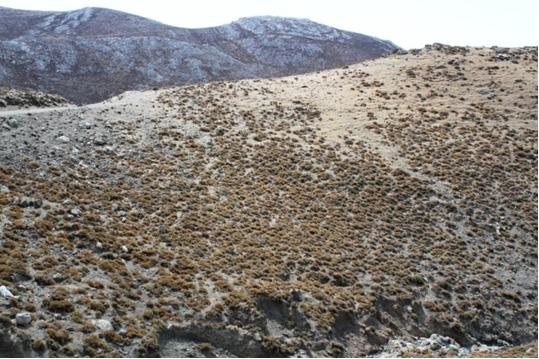
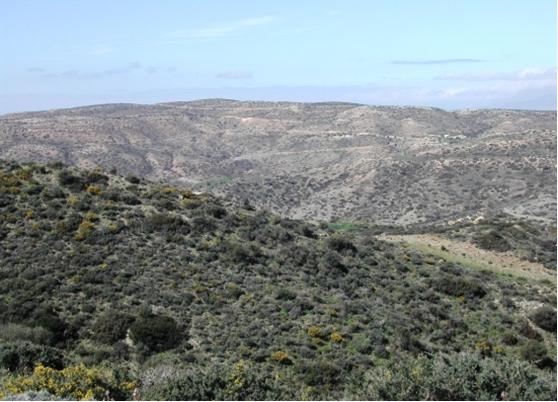
High water stress for plants is typical in the study site and reduces significantly available palatable biomass for grazing animals (a long dry period of at least six months, no rain, high air temperatures, strong dry winds, high evapotranspiration rates). Low soil water storage capacity is crucial in this respect: rain water stored into the soil during the wet period can feed the growing plants for no more than one month during the dry period. Farmers have to transfer hay or grain from other areas to support their animals during the dry period.
Responses to LEDD problems consist of the following:
- Integrated land management (positive) consists of formulating and applying an appropriate grazing plan. In case of excessive animal numbers, provisions have to be made for increasing forage supply, providing alternative feed resources or reducing the number of animals.
- Fires in natural vegetation (negative) increase during the last decades as they are propagated (illegally) by farmers in order to generate palatable biomass production for grazing animals. Removal of plant cover favours high soil erosion rates. Fire risk has also generally increased due to increased biomass (through abandonment) and other factors (increased technology and road accessibility).
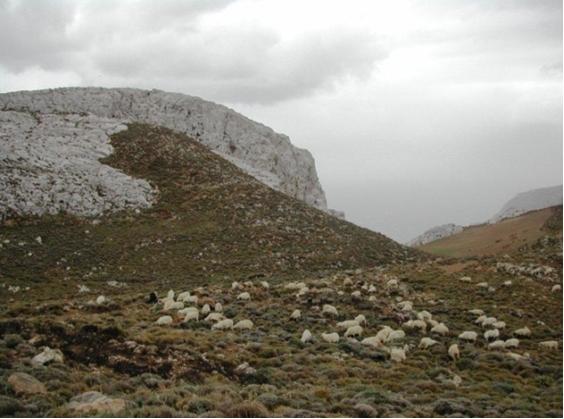
- Overgrazing (negative) is the dominant response. During the mid 1980-2010 period, the animal population doubles, natural, economic and social capital characteristics combine with EU subsidies resulting in unprecedented (and unsustainable) animals numbers and associated overgrazing and erosion problems. The number of animals increases despite loss of available grazing lands in neighbouring Messara (transhumance) due to increased availability of feed, improved transport networks, cash availability (credit and subsidies). Overgrazing negatively affects biodiversity, the regulation of hydrological processes and surface energy balance. Overgrazing causes severe soil erosion problems increasing the vulnerability of the land to desertification.
The main responses to water stress:
- Protection of terracing land (positive) positively affects regulation of hydrological processes and surface energy balance. In a terrace, adsorption of water by the soil increases during heavy rainfall events and soil erosion is reduced. Water runoff from the upper side of the terraced interval is held within the terrace, infiltrating and being stored into the soil. The higher amount of soil water favours plant growth and vegetation cover reducing soil temperature extremes and regulating surface energy balance, soil water evaporation and microbial activity.
- Water harvesting (positive) generally includes reducing surface water runoff and increasing soil infiltration rates. For example, presence of adequate shrubby or annual vegetation cover, construction of terraces, concentration of runoff water in small ponds and retarding runoff and keeping plant residues on the soil surface.
Policy context
AK: to check that implementation, impacts and effectiveness of selected policies are discussed in this text. Look at D242 to see if there is any additional information.
The period from the late 1980s is marked by peace and parliamentary stability, unprecedented in the history of Greece as well as of Crete and the study site. The period is dominated by the political projects of the European Economic Community / European Union such as the single market (1992), the monetary union and trade liberalization. Liberalization of credit markets and low interest rates also form a decisive influence upon economic development. Various reforms lead to gradual devolution including establishment of regional governance and the reorganization of village communities: municipalities are reduced from over 50 to 9 (in 1997) and then to 4 in 2010.
Development policies, primarily tourism, dominate during the period. During the 1990s tourism consolidates its position as the major economic activity in Crete extending to the Messara coast and is complemented by construction of second homes for affluent Cretans and other Greeks. It also becomes evident that Heraklion, if not Crete as a whole, is quickly approaching its limits as a destination. Successive revisions of the investment law gradually limit investment incentives.
Agriculture/rural development policies also dominate by providing income to the rural population and raising the general standard of living. However, at the same time financing rules make it almost unavoidable to abandon traditional husbandry practices, and to some extent, the entrenchment of the quota system prevents demand-driven restructuring. Although the introduction of the Code of Good Agricultural Practice remains non-enforced at the ground level, it does provide an overall limit upon the number of animals per hectare, thereby providing a cap upon final subsidy received. Rural development policy since the mid-1990s leaves its mark in rural Crete although it has made little inroads into the remote areas of the Asteroussia Mountains.
The importance of EU regional policy (structural funds) cannot be overstated: large scale investment in infrastructure takes place (roads, ports, telecommunications, schools, hospitals, universities). Although investment is concentrated in the main cities (Heraklion), there is a general improvement in connectivity and available services. Public works executed by central, regional and local governments are unprecedented. Road works are the main recipient of EU support in Heraklion (drawing from both the Regional Development and Rural Development fund), followed by steadily rising percentage of investment support for small and medium-sized enterprises.
Environmental policies begin to be implemented in earnest in the 1990s. Water policy is of particular importance: technological improvements, credit availability and rising water demand lead to a proliferation of groundwater extraction without however general water management plans. Horizontal environmental policy, whose main instrument is the approval of environmental terms of operation based on an environmental impact assessment, is also introduced in the mid-1980s but has little application in the study site except for abattoirs and new facilities for sheltering sheep and goats. Strategic environmental assessment has only recently been implemented with regard to the Operational Program 2007-2013. Although the document highlights road construction as major threat for the Cretan environment, all evidence shows that road construction remains the main activity to be financed by the ERDF in Crete and the Asteroussia mountains. Biodiversity policy is also relevant in the study site which is included in the NATURA2000 network. Although no management measures have achieved regulatory status yet, sensitization of the population is taking place, prompting a drastic decline in intended poisoning and a general recovery of the fragile vulture population. Local demands for the implementation of biodiversity policy have increased in the face of proposals for large scale renewable energy installations throughout the mountain range. Attempts at the implementation of a (soil) policy to combat desertification at the national level have a limited influence upon the study site, despite its identification as an area under extremely high desertification risk.
Policies as LEDD drivers
Unprecedented growth during 1990-2010 is a major LEDD driver in Asteroussia. This growth is the combination of several long-lasting development policies or strategies as well as the general availability of public and private financial resources.
- The greatest LEDD driver during the period is the CAP, fuelling a growth in the number of animals and abandonment of local farming practices, in an attempt to maximize milk production.
- Increasing EU and global trade drastically improves the availability and deployment of agricultural supplies and machinery. These products and methods however are often unsuitable for fragile rangelands such as the Asteroussia Mountains. For example, the use of tractors on hilly slopes is a major factor for erosion, or imported animals may be unsuitable for the mountain without large amounts of feed and medicine.
- The same trade dynamic also puts increasing pressure for competitiveness and intensive resource use upon breeders who are particularly exposed to high feed and low milk prices.
- The national emphasis on tourism and construction has functioned as an indirect driver by making alternative sources of employment more attractive and prompting the rural exodus.
Policies as responses to LEDD
A host of environmental policies are introduced at the national and EU level from the 1990s as responses to environmental degradation. The Asteroussia study site is largely unaffected by these policies as their implementation has been inadequate.
Attempts at water management instigated by the Regional Water Directorate throughout the 1990s largely fall through, resulting in escalating scarcity and prompting a general ban on all new water extraction in 2008/2009. At the same time, one should note that rural development policy has allowed the emergence of new actors and methods of collective organization in Heraklion which may have a lasting influence. New forms of pooling of resources emerge both in the public (municipalities forming development agencies) and private (producer groups in organic farming or extrovert cooperatives) sectors. While it is true that these forms of cooperation are facilitated and motivated by access to EU funds, their social mechanisms may be easily replicated and/or deployed in other fields or for the achievement of wider local objectives.
While local demand for policy responses to LEDD is limited due to the perverse incentive posed by CAP subsidies, towards the end of the period the issue of rangeland management emerges as a legitimate bottom-up objective, with possible solutions being sought through the application of rural development and to some extent biodiversity policies.
Properties of the system
AK: to check if there is any further relevant information in D233
Natural capital: The area is consistently robust in the production of woody Mediterranean macchia (soil depth greater than 30 cm on flysch parent material). Diversity of livestock (based on the Shannon index) ranges between 1.0 and 1.2, covering 62.9% of the total area; a significant decrease since the last period. Plant cover diversity is greatly related to soil depth but the majority of the study site falls is within (Shannon index) 1.8 - 2.0.
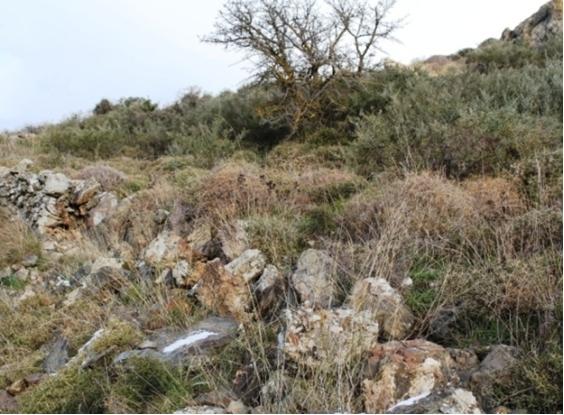
Land used for grazing continues to dominate the landscape, forming a continuous matrix within which minor land cover types are embedded (limited cultivations although fewer and larger compared to the previous period). Woody encroachment by shrubs leads to decreased connectivity as well as loss of grazing land. Potential for change from shrub to forest vegetation is greatly limited by the climatic conditions and soil characteristics and is generally low.
Economic captial: Economic capital is influenced by
- the shift from a subsistence to a more open and market-oriented state: cooperation networks and practices between herders in the site and farmers in Messara (cereal cultivation – fallow) are disrupted;
- the slight shift from occupation in the primary sector to services;
- population decline and ageing;
- CAP subsidies providing cash and livelihood options for farm households;
- credit from banks and investment programs.
All the changes transform the economic system of the area into a much more open and market- oriented system that is relatively robust, diverse and redundant, albeit relying on external economic inputs (subsidies, credit).
Social capital: Social capital is affected by changes originating in the previous period. Cooperation network between farmers and shepherds stops completely and is replaced by distrust and resource competition (both land and subsidies). New networks, revolving around subsidies, begin to dominate in political and social life, operating in parallel or in conjunction with cultural values and identities (familial units, kinship networks, localism). The institutional structure is characterised by the general tendency towards decentralization, but with a low level of trust in formal institutions at least traditional patronage networks persist.
Socio-ecological resilience
AK: to be added, source: D233
Socio-ecological fit of the dominant response to LEDD
AK: to be added, source: D233