
Study sites in cropland
Study sites in grazing land
Study sites in forests
Mediterranean semi-arid husbandry state (1950 to mid 1980s)
| Authors: | Aikaterini Kounalaki, Mina Karamesouti, Eleni Briassouli, Minas Metaxakis, Vassilis Detsis, Thanasis Kizos, Theodoros Iosifides, Alexandros Kandalepas, Constantinos Kosmas |
| Coordinating authors: | Concepción L. Alados, Giovanni Quaranta |
| Editors: | Alexandros Kandelapas, Jane Brandt |
Editor's note 20Mar14: Source D232-5.1.1
Assessment of natural, economic and social capitals
| Natural capital | |
| Assessment | Soil capital in the Asteroussia Mountains is a slowly changing variable. The majority of the area (61.3%) during this period, is characterized by shallow soils (soil depth class 15-30 cm). Moderately deep soils (soil depth 30-60 cm) cover 29.9% of the total area. Soil capital is mainly low due to a high degree of degradation further in the past.
The area does not have significant water resources, with surface water runoff restricted to occurring during the wet period (November – February). The Anapodaris River, the longest river of Crete with a flow of about 40 million cubic meters, crosses the eastern part of Asteroussia Mountainous area. However, water quality is high and therefore of high capital value. The greatest part (91.7%) of the area is covered by natural shrubby vegetation that is characterized as moderate vegetation capital. High and very high vegetation capital (olive groves, arable crops) cover only 7.9% of the area. Most of the area is characterized by moderate climate capital, attributed to high aridity. The south part of the mountains is subject to lower rainfall and therefore low climate capital. |
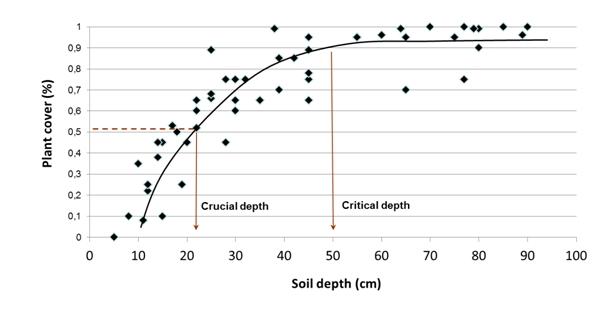
| Critical functions | Critical ecological functions are the regulation of hydrological processes and the regional surface energy balance. Both functions are related to soil depth and plant cover. Under the climatic and soil conditions here, below a critical soil depth of 50 cm, plant cover rapidly decreases and consequently surface water runoff significantly increases.
|
| Critical variables |
|
| Economic capital | |
| Assessment | Produced capital. While data on (regional and local) GDP are scarce, during this period Crete is recovering from a decade of wars (WWII, Civil War). Dependency on the primary sector and the economy of subsistence leads to significant migration until it is gradually replaced from the late 1960s by a tourism cash economy. Until the 1970s well over 60% of the active population of Asteroussia are farmers.
Financial capital is extremely limited to remittances by migrants and later from foreign exchange by the tourism industry. Data on the disposable income are not available. Landesque capital includes husbandry infrastructure and infrastructure for cereal production and processing. Husbandry infrastructure included stables, storehouses, milking pens, and enclosure walls or fences (stone constructions often dating from the pre-Minoan civilizations). These constructions are gradually replaced by concrete, metal and wood and new wire enclosures separate grazing lands. The lack of older enclosures indicates an open type landscape in the past. Infrastructures for processing cereals (wheat and barley) are a component of the landesque capital from the past The harvest was threshed in threshing floors (circular level structures paved with stones) and seeds were then taken to local water mills, none of which remain. Physical capital. No productive infrastructures (e.g. factories) are present, excluding small cheese making units. Transport infrastructure is concentrated at Heraklion (port, roads, airport). Primary and secondary schools are established in the 1960s and clinics in the 1970s. Technology. Lack of credit does not appear to restrict the spread of tractors in the area. Animal (livestock), plant and forest capital. The larger part of Asteroussia consists of grazing lands (60% of the area, 94% private and 6% common). Number sheep and goats in the 1960s is half what it will be come by 2010. |
| Critical functions | For this period, the most critical economic functions are lack of credit and limited cash availability. Linkages with the critical social functions in the area for this period, which include the high density and importance of bonding type small networks, are important: the social and economic systems in the area remain highly interrelated. |
| Critical variables |
|
| Social capital | |
| Assessment | During the period the demographic capital of Asteroussia steadily weakens. Losses take place mainly due to some major and wider socio-economic changes and processes, notably urbanization on local/regional and country levels which leads to mass outmigration to other regional settlements, large cities and especially Athens and internationally. This decline leads to an enhanced degree of population ageing.
Human capital can be characterised as relatively or very poor, in terms of formal education and skill credentials. However, informal human capital (local knowledge) is very much alive and significant. As this knowledge progressively declines it is not replaced by systematic formal education and training (for example, of stockbreeders). Social and cultural devaluation of the stockbreeding profession is rapid. Cultural capital together with social capital are some of the more stable characteristics of local and regional communities (slow variables). Persisting cultural and identity characteristics include strong communal organization, the importance of place and descent for forming identities, strong familial and kinship organization, social status according to the number of animals and sons in each extended family. Cultural meanings that stockbreeders ascribe to their activities and profession are also important: naturalness, freedom and the emotional connections and links with nature and animals still persist during this period. Research participants report that during the 1960s social relations were less conflictual and competitive and more cohesive. Institutional capital is generally weak. Despite administrative changes institutional capital displays characteristics of slow variable. Institutional structure is highly centralized and local administrative structures are characterized by extreme segmentation, clientelism and “partitocracy”. Accordingly, trust in institutions is extremely limited to their clientelist functioning. |
| Critical functions | The most important critical social functions are the powerful and dense social networks based on kinship, either families or extended families and the christening of children (koumparies). Farmers maintain working and family relations (especially of the koumparies type) with farmers in the plain and move their livestock (sheep and goats) into the plain in the winter from their summer grazing lands. These transhumance networks provide networks with localities outside the geographical limits of the mountains, mostly of the bridging type of social capital that appear to transcend partly or interweave with these networks. |
| Critical variables |
|
Main LEDD problems and responses
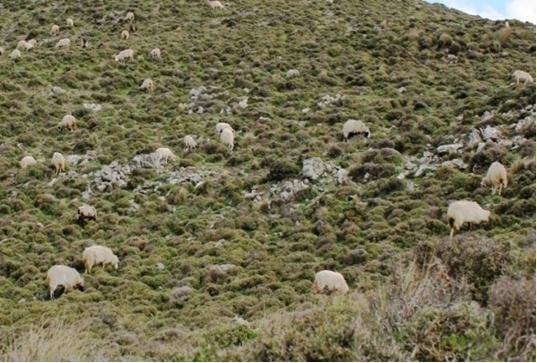
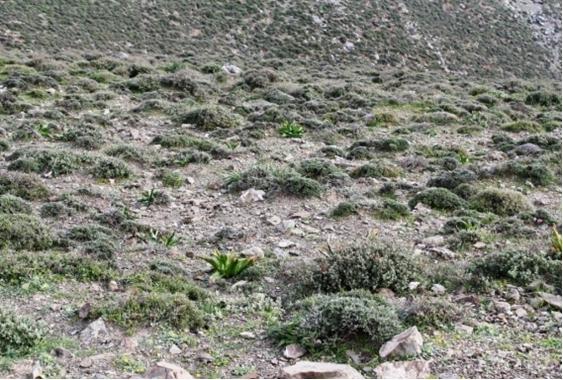
The main LEDD problems during the period are soil erosion and land desertification. Their severity gradually increases after the 1950s due to decreased plant cover caused by the increasing number of animals grazing the area, with problems particularly severe in the south-facing slopes.
The main responses are:
- Land use change (positive): cereal cultivation in sloping areas is abandoned and fields converted to pastures by allowing the natural vegetation to grow, with positive effects on critical ecological functions. The whole process however is part of the wider social and economical abandonment.
- Fires in natural vegetation (negative) by farmers in order to generate palatable biomass production for grazing animals. It is characterized as a negative response since removal of plant cover for a short period favours high soil erosion rates. Fire risk also generally increases due to increased biomass (through abandonment) and other factors (increased technology and road accessibility).
- Sustainable grazing/over-grazing (positive/negative) are two opposite responses. In the first instance, animal population remains low, often due to out-migration of local population. In contrast, some farmers re-organize their activities by increasing the grazing land and the number of animals and overgrazing the land, often employing wildfires as a tool to increase pallatable biomass.
Policy context
AK: to check that implementation, impacts and effectiveness of selected policies are discussed in this text. Look at D242 to see if there is any additional information.
The main policies in effect are development policies focused primarily on the growth of tourism through support in transport (ports, airports) and cultural (museum, archaelogical excavations) infrastructure. While tourism in the Asteroussia Mountains is practically non-existent, the rapid growth of Heraklion and the northern coast of Crete bring about the growth of a series of related industries such as construction, transport and services which prove significant sources of employment and pluri-employment for rural populations.
The post-war efforts of the Greek government to modernize agriculture affect the Asteroussia mountains only indirectly but adversely. Modernization, mechanization and specialization led to the gradual conversion of the Messara plain to olive groves and horticulture, leading to a practical cessation of cereal cultivation and traditional transhumance practices. Therefore, the 1970s and 1980s see an unravelling of centuries-old farming systems prompted, not by policies implemented inside the study site, but in the neighbouring Messara valley. No specific policies with regard to (extensive) grazing are formulated or implemented. Environmental policies are gradually introduced from 1974 but with limited implementation and imperceptible effects during the period.
During the latter part of this period (mid-1970s to mid-1980s) several policies act as drivers of LEDD, most notably:
- tourism, the dominance of the construction sector and the (lack of) spatial planning policy facilitate land-use change. Although tourism growth is extremely limited within the study site, its growth and potential for employment prove a powerful source of attraction for young people.
- Agricultural policy through the introduction of specialized olive monoculture (1970-1981) and the consolidation of this specialization through CAP subsidies (post 1981). Although this process takes place mainly in Messara, it affects Asteroussia breeders relying on Messara grain for feed and forces them to turn to feed importers, mainly based in Heraklion.
- The application of the CAP quota system acts as a fairly straightforward LEDD driver, partly through its inherent design as a complement to northern European husbandry systems. Subsidies are given on a quantity basis, fuelling a race to increase short-term animal productivity, through increased inputs such as imported feed, medicine and intensive grazing. Predictably, the number of sheep and goats in the Asteroussia Mountains rises dramatically.
These well-financed policies empower actors such as policy implementers and "gatekeepers" of public money (e.g. unions of agricultural cooperatives, political party networks). The emphasis of the CAP on farming and modernization leaves traditional breeders without technical support or specialized instruments and contributes to the thwarting of collective efforts on their part.
During the 1970s and early 1980s a body of legislation is introduced as a response to wider environmental degradation, mainly pollution. These policies, stemming from the 1975 constitution, include water, biodiversity and environmental licensing. Their contribution to addressing LEDD problems in the Asteroussia Mountains is marginal to say the least.
In a similar vein, the provisions of article 24 and law 998/1979 (forests), are seen by many rural residents and farmers to impose undue constraints on private property. As a result, there is general tendency to actively prevent any growth of woody species (excluding planted trees such as olives) on private property as it might lead to its classification as forest land. The above tendency is further aided by the lack of a central land registry.
Properties of the system
AK: to check if there is any further relevant information in D233
Natural capital: Livestock diversity (Shannon index) is between 1.2-1.4 over74.2% of total surface. Grazing is the dominant land cover type, forming a continuous matrix within which minor land cover types are embedded (enclaves of various types of cultivations).
Economic captial: The economy is characterized by a strong degree of subsistence. Sheep husbandry is the dominant occupation of most households although pluri activity is widely practiced out of necessity. In this sense, the system is characterized by a high degree of redundancy. Although economic diversity can be considered to be very low (due to dominance of primary sector), in reality, non-monetized activities contribute to an economically diverse system. Although the potential available for change in the produce and financial components of the property of the system are low, for the rest of the components this potential can be considered as higher.
Social capital: Social capital during the period is characterized by powerful and dense social networks of the bounding type (kinship, (extended) families, christening of children (koumparies)). The dominant economic organization (subsistence farming, husbandry) favours the importance of the strength these networks in terms of local politics, land management and social relations. These networks also include farmers in the Messara plain and support transhumance patterns. In terms of the demographic capital, an important decline of the population is observed and the population ages.
Socio-ecological resilience
AK: to be added, source: D233
Socio-ecological fit of the dominant response to LEDD
AK: to be added, source: D233