
Study sites in cropland
Study sites in grazing land
Study sites in forests
Land abandonment transition (2000 to date)
| Author: | Rosanna Salvia |
| Coordinating authors: | Constantinos Kosmas, Giovanni Quaranta |
| Editors: | Alexandros Kandelapas, Jane Brandt |
Editor's note 20Mar14: Source D132-5.1.
Assessment of natural, economic and social capitals
| Natural capital | |
| Assessment | The Climate Quality Index (CQI) is equal to 1.40 (moderate) and has stable value throughout the SES. Average annual precipitation levels (2000-2010) are around 1062.61 mm. Average temperature is around 15.91°C and does not show much variation from the previous periods.
A wide diffusion of collapsed terraces means that soil capital is lower. Soil aggregate stability (ranging from 0 weak to 5 very stable) has changed since 1960. The extent of soils previously classified at 2 has decreases, with a corresponding increase in classes 3 and 4 as a result of spontaneous recolonisation of abandoned agricultural areas. In contast, the extent of the most stable areas decreases because of contraction of pasture and meadows in favour of recolonisatin by shrubs.
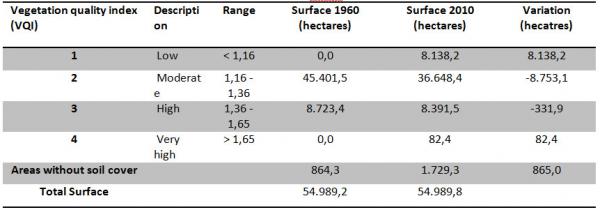
The value of water capital is very high with regard to both quantity and quality. Vegetation capital attains relatively high values as woodlands expand as macchia (shrub) re-colonises abandoned olive growing areas. |
| Critical functions | Primary production is dominated by olive production. Depending on climatic and soil characteristics of the area and also on agronomic practices and crop treatment, there is a great variability of agricultural production, ranging from 7,000 to less than 1,000 kg/ha.
Regional surface energy balance (classified according to vegetation quality index) is primarily moderate although the increase in Class 1 (low) is indicative of changes of land use since 1960.
|
| Critical variables | The period's most rapid environmental variable is still land cover due to the continuing decline in utilized agricultural surface, which contracts to 15.000 ha, half of the surface registered in the previous period. Soil capital, although intrinsicly slow, shows dramatic dynamics in this period. |


| Economic capital | |
| Assessment | In 2009, value added (VA) is €732.56 million (€16,352 per inhabitant), about 5,000 higher than in 1991. The contribution of agriculture to total value added is low (5%) although almost double that for the Campania region (2.8%).
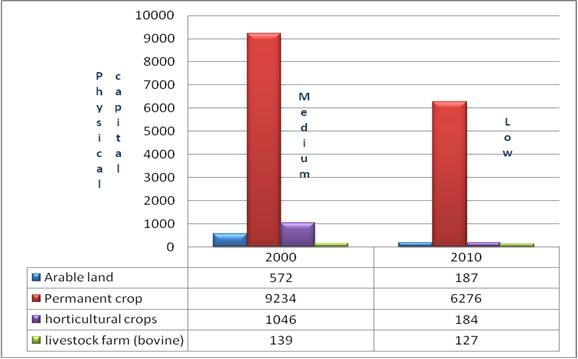
Financial capital is moderate; levels of subsidies remain relatively constant under the single payment scheme, accompanied by measures under the Regional Rural Development Plan and in particular Measure 216 (terrace re-construction). Landesque capital significantly deteriorates due to collapsing terraces. Intervention to re-construct terraces affect a very small percentage of the territory. Physical capital declines to low value due to a decline in the number of farms with permanent crops and, especially, those with horticultural crops. The level of technology remains constant although the reduction in horticultural farms indicates that it is a sector in decline, with further investment in technology forthcoming. Animal capital remains almost stable with just few adjustment in livestock. |
| Critical functions | Agricultural production and its associated economic value shows a decreasing trend. Land abandonment has resulted in a lowered production quantity and the general drop in prices causes a contraction in the value generated by the sector. Compounding these problems there is a lack of processes of valorisation in the local olive farming sector.
The change from coupled to decoupled government subsidies leads to an overall reduction in agricultural surface and a greater concentration of production in the areas best suited to intensive farming (irrigated flat land which allows use of agricultural mechanization). Production is becoming more intensified (in terms of density of machinery, mechanization, irrigation, variety) in areas of irrigable flat land. |
| Critical variables | Produced capital associated with the agricultural sector continues to decline rapidly, as does Landesque capital. The state of dry stone terraces also declines because of the continued abandonment of ever greater areas of land. Plant capital is also reduced as a consequence. |
| Social capital | |
| Assessment | Although population remains relatively constant, analysis shows immigration from surrounding highlands and migration of the young and better educated towards larger cities.
The level of education has increased substantially but possibly also levelled off; interviews with local stake-holders indicate reluctance to pursue university education because of the lack of jobs. Human and cultural capital continues to be characterised by the re-discovery of cultural identity. Various initiatives by young people, in the agri-tourism sector and in high-quality agricultural production, are signs of cultural change as much as economic change. In addition, a collective vision seems to be emerging, slowly displacing entrenched individualist mentality. The establishment of a territorial bio-district network linking organic farms (around 400), producer organisations, local administrations, bio-restaurants, eco-tourism operators and consumers (via the GAS Gruppi di Acquisto Solidale – Solidarity Base Purchasing Groups) is a good case in point. Social and institutional capital are also undergoing mutually reinforcing qualitative changes. As the territorial planning is strengthened (Territorial Pacts, PIRAP, PIF, LEADER program) so is collective decision making fostering new networks, better communication between stakeholders and inter-community relations. Nevertheless, the SES is characterised by a complex and intricate structure of governance involving a high number of small institutional bodies to complement formal administrative units (Region, Province, Town Councils). The overall political structure is a labyrinth of actors and overlapping jurisdictional zones. In addition, as pointed out in stake-holder meetings, Alento remains under-represented in regional politics due to current election laws and the main cities (principally Naples) attract most, if not all, public expenditure. |
| Critical functions | A crucial indicator of the social role of the agricultural sector in the Alento is the negative rate of generation change in farming, which is only recently beginning to see positive signs of growth. |
| Critical variables | The demographic variable that shows a little change is the age structure of the population living the area, while the most of the other remain practically unchanged. The fluctuations and characteristics of migratory flows are signs of instability in the SES and the inability to find solutions to the problems relating to unemployment and alternative production. |
Main LEDD problems and responses
The problem of collapsing terraces is one of the principal cases of soil erosion in the SES. Regional studies based on Wischmeier and Smith's Empirical Soil Loss Model (USLE) and on large scale applications of the PESERA model prove erosion is wide-spread and increasing, especially in the terraced land nearest residential areas. According to the application of the PESERA model, half of Alento's land surface is eroded by more than 0.5 ton/ha, almost 12% of which is over 10 tons per hectare.
Landslides can be used as a further indicator of soil erosion; active landslides affect 2,407 hectares of land surface in the Alento area, in 1322 sites.
Positive responses targeting the problem of soil erosion are: (1) subsidies to restore disrupted terraces and (2) initiatives aiming to increase olive oil profitability. The negative response is land abandonment, whereas mechanization and management of oil-mill waste water are considered as both negative and positive measures for soil erosion processes.
The biggest challenge facing plains and coastlines is soil sealing, reducing the surface area available for uses such as agriculture and severely impairing, or even preventing ecological soil functions. Soil sealing, especially on the plains, is dependent on three interconnected processes. The first is a flux in population moving from inland areas to areas with greater socio-economic opportunities, better infrastructure, and more services. The second is the intensification of agriculture through building of greenhouses and the third is the expansion of the tourist industry.
The positive response to soil sealing is the implementation of a regional law fixing the maximum amount of agricultural land that could be covered by greenhouses, whereas the duration of sealing (i.e. the decision to keep covered the greenhouses all over the year) is considered as a negative response.
Policy context
AK: to check that implementation, impacts and effectiveness of selected policies are discussed in this text. Look at D142 to see if there is any additional information.
The main policies in effect are:
- the Single Payment Scheme: decoupling of subsidy payments from production to the producer allows a stability of payments but may fuel land abandonment; farmers abandon production as they receive subsidies irrespective of harvest.
- Rural Development Plan Measures (mainly measure 216 financing (non-productive) capital works on land): stone terrace re-construction and maintenance initiatives aiming at increasing olive oil profitability including the PDO scheme, quality assurance, agri-tourism and farmer markets.
- Oil mill waste water regulations establighing procedures for disposal.
- The regional law for greenhouses, imposing a limit of 70% of the total surface of the farm.
Properties of the system
AK: to check if there is any further relevant information in D133
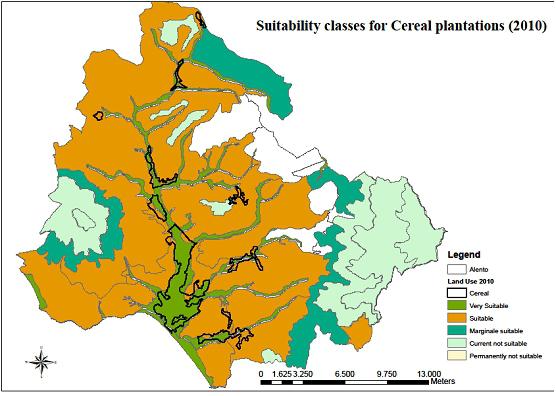
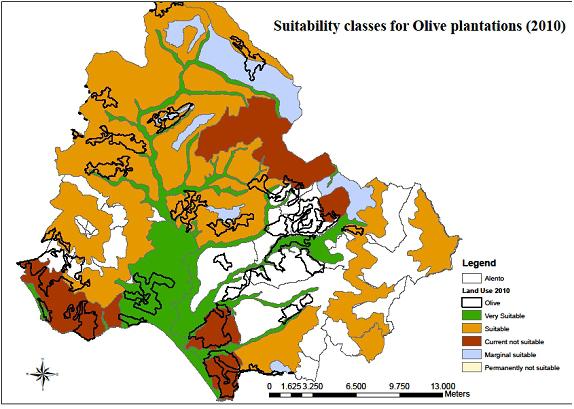
Natural capital: The potential available for change in the Alento is assessed comparing the requirements of specific land uses (cereals, olive, orange, vines) and the natural capital components available. More than 50% of the area is suitable or very suitable for olives and cereals, whereas, the largest part of the area is not suitable for oranges and vines.
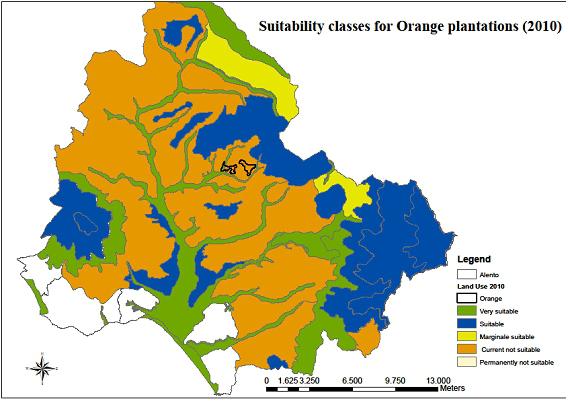
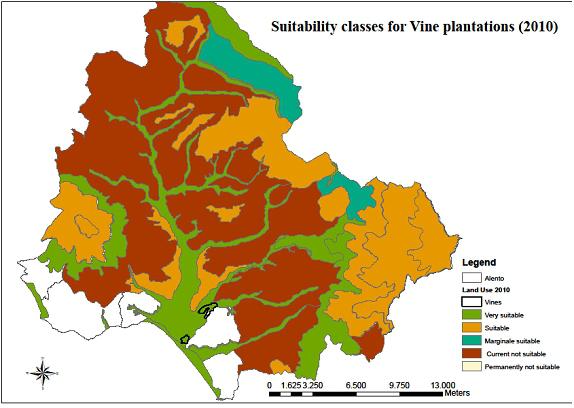
Robustness also remained predominantly moderate.
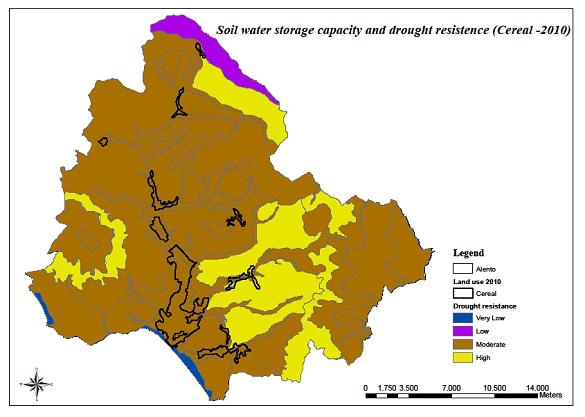
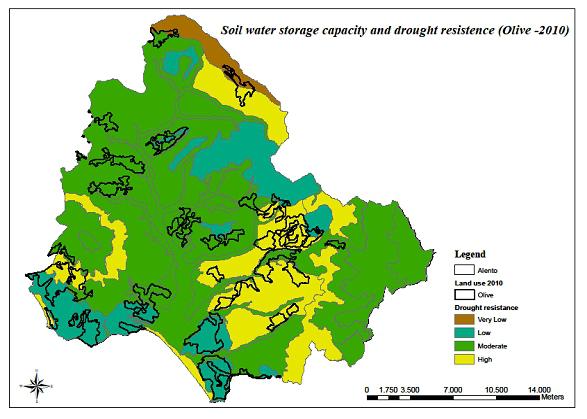
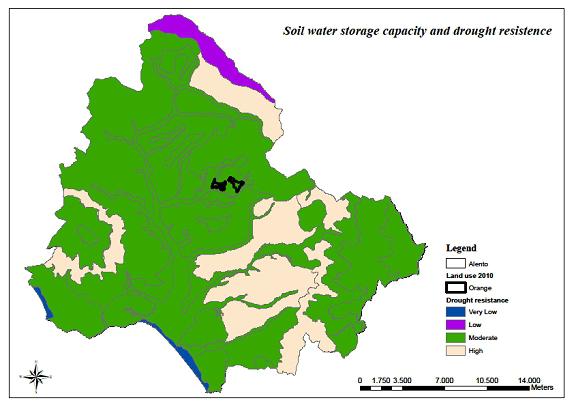
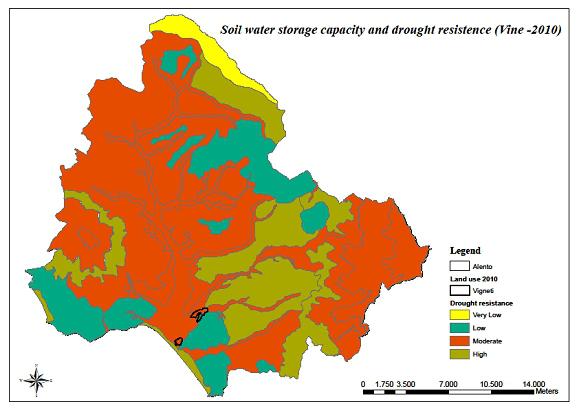
Diversity based on Shannon's Index varies from from 0.08 (2000) to 0.2 (2010).
Redundancy in the form of farms with mixed cropland/husbandry systems declines dramatically; only 75 out of 5,136 farms have such a system while the vast majority specialise in permanent crops. Connectedness follows a similar trend with the prevalent agriculture system being "loosely connected". Moderately connected areas, with olives + vegetables under low planting, remain predominately in the areas nearest inhabited centres (hobby agriculture).
Openness is relatively high as producers rely on external markets for both agricultural inputs (e.g. fertilizers, manure etc) and outputs as the principal crops (olive, fruit, vegetables) are mainly destined for export markets.
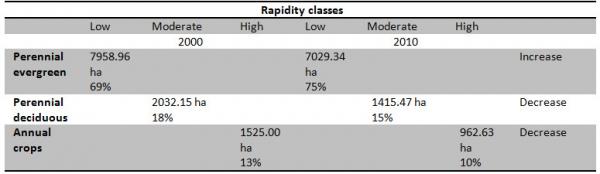
Rapidity is generally low, but with significant variations between land cover.
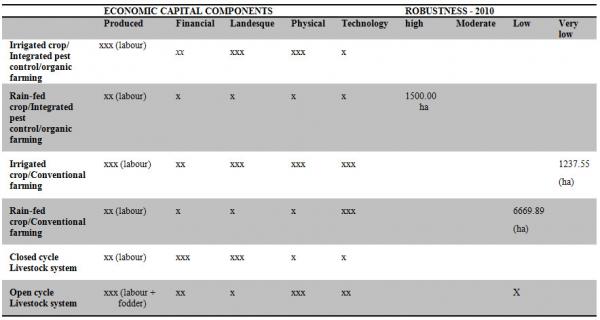
Economic captial: The Alento agricultural system continues to show a low degree of robustness due to the need for external inputs (fertilizers, pesticides mechanization). However, stake-holder interviews would suggest that robustness is slowly increasing thanks to the positive effects of cross-compliance measures linked to Single Payment Schemes which imposes a certain degree of environmental conservation (Landesque capital and physical capital mainly) and also the diffusion of organic farming practices in the area. The degree of robustness can, therefore, be considered as medium.
Social capital: Regarding potential available for change, a substantial recession in the socio-ecological system as a whole seems to be taking place. All the capitals show a worsening trend. The robustness of the SES is not sufficient to counteract the processes in motion. Despite the increased diversity of the system (especially in terms of institutional capital) the overlapping levels of governance in the prove to be insufficient to solve its problems. Also the redundancy and connectedness of the SES seem to be increasing (multiple activities within farms and the construction of networks like the bio-district) but, again, these initiatives prove very vulnerable to internal and external changes to the SES and cannot go far enough to counteract the negative trends.
Socio-ecological resilience
AK: to be added, source: D133
Socio-ecological fit of the dominant response to LEDD
AK: to be added, source: D133