
Study sites in cropland
Study sites in grazing land
Study sites in forests
Migration and efficiency imperative transition (1950 to 1970)
| Author: | Rosanna Salvia |
| Coordinating authors: | Constantinos Kosmas, Giovanni Quaranta |
| Editors: | Alexandros Kandelapas, Jane Brandt |
Editor's note 20Mar14: Source D132-5.1.
The starting point for analysis of the SES Alento is the economic, social and environmental situation of the immediate post Second World War period. At the end of the 1940s the local territory had remained relatively un-changed since the previous century, especially in terms of infrastructure and modernization of economic activities. Cilento was an isolated and marginalized area in economic, civil, cultural and social stasis.
Assessment of natural, economic and social capitals
| Natural capital | |
| Assessment | The climate capital is characterized as moderate (CQI=1.44) and uniform thoughout the SES. From 1950 – 1980 the average precipitation levels are around 1,200 mm a year, whereas, temperatures vary from a maximum of 35 °C to a minimum of -5 °C. Average temperature is around 16 °C.
The estimate of soil capital is therefore carried out by intersecting the GIS soil map with the slope gradient map. Only 16% of the study area's surface is characterized by soil capital values that are "high" and "very high", whilst 43% of the surface area falls in the "moderate" class. The value of water capital is moderate (=2) accounting for water scarcity of water in the summer months but also good quality.
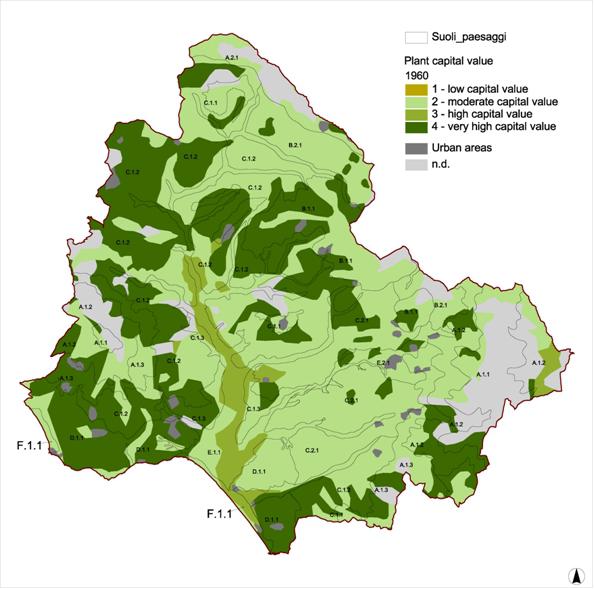
In absolute terms Alento loses almost 22% of its managed land. However, in relative terms, the remaining land shows a higher quality. The weight of very high capital increases in the period while moderate capital declines. The share of high vegetation capital, instead, remains unchanged. The combination of these two opposite trends informs the assessment of the vegetation capital as moderate. |
| Critical functions | Although there are no available data for different crops, the great progress in farming technology (fertilizers, pest control, mechanization) which is seen in this period suggests that there is significantly increased production. Regional surface energy balance (assessed based on VQI) is characterized by a moderate vegetation quality index. |
| Critical variables | Soil capital, water capital and climate capital change very little. The critical environmental fast variable for the period is land use. Surface dedicated to agriculture is reduced. |

| Economic capital | |
| Assessment | Farms are highly fragmentized and provide little profit beyond subsistence. Employment in the agricultural sector decreases. The number of farms remains fairly stable but utilized agricultural surface (UAS) drops by almost 50%.
During this period, Alento sees a considerable urban expansion, largely as a result of processes started in decades before (continued reclamation of marshland, the eradication of malaria, the expiration of various leasing agreement contracts affecting large areas of land in the study site and the investments in construction made by those local residents that had emigrated). The value of produced capital in this period is considered quite high. Financial capital is high. Substantial financial resources are channeled under the Marshall Plan and the Cassa del Mezzogiorno (Fund for the South). Subsidies for the agricultural sector are high (olive and cereals). Landesque capital is also high owing to the large number of terraces present. Landesque capital however, starts to decline as the agricultural sector begins to shrink. Positive water resource management in the area also leads to significant improvements to the irrigation network, albeit in the form of small, rudimentary man-made canals ("levata").
The value of physical capital in agriculture is moderate, based on the degree of complexity of cropping systems, ranging from simple systems (e.g. arable land), to livestock production and intensive horticulture. Physical capital in infrastructure rises significantly as The Cassa del Mezzogiorno (Fund for the South) undertakes major public investment in schools, aqueducts, sewers and other essential sanitation works. Mechanization is introduced but only becomes consistently used in the mid 1970s. |
| Critical functions | Production is affected by contrasting drives: the contraction of cultivated surface area and increased yield of production and market integration. |
| Critical variables | All the economic variables behave more or less as fast variables during the period with the exception of landesque capital and animal capital. Produced capital changes radically, especially because of the reduction of the agricultural sector both in terms of surface area and numbers of employees. Subsidies tied to the introduction of CAP, huge investment entering the country for post-war re-construction and the increase in remittances all contribute to the rapid and significant increase in financial capital. Physical capital also varies significantly because of the large-scale re-construction and modernization of the road network. The SES sees a substantial increase in use of technology as part of the drive towards increased productivity which characterizes the period. |
| Social capital | |
| Assessment | Population decreases as emigration is supported by policy; the rural exodus is seen as a remedy for the economic difficulties of the countryside and even necessary for national development.
The drive for literacy and primary education in rural areas which began in the 1930s was brought to fruition by the 1950s and now plays an important role in rural exodus trends. This period is characterised by strongly centralised, top-down policies with minimal bottom-up participation. |
| Critical functions | - |
| Critical variables | All components of social capital change rapidly, with the exception of institutional capital. Demographic, human, cultural and social capital variables are transformed as overall population declines, urban population increases and population distribution by altimetry varies significantly (with out-migration affecting the upland areas particularly). Improvement in literacy contributes to rural depopulation. Institutional capital changes at a much slower pace. Central decision-making bodies, supported by state policies for intervention works and the application of the CAP, are no different from the political structure which characterised the previous period and are managed by the same social actors, mainly wealthy land-owners. |
Main LEDD problems and responses
Soil erosion is not a significant problem as the abandonment of olive groves and arable crops and the expansion of wooded areas provide ample vegetation cover. Documentation and literature available, particularly for the 1950s, mostly cite the problem of land availability and poor access to land.
Responses to soil erosion, relating to lack of agricultural land follow two principal lines. On one hand emigration is encouraged and, on the other, a reformation of land distribution is promoted under Agrarian Reform and economic development favoured by interventions financed by the Cassa per il Mezzogiorno (Fund for the South). These responses are not connected to a LEDD problem per se but rather to the economic and social poverty of the area but have contributed in large part to the re-structuring of the agricultural sector and to the abandonment of traditional farming systems.
Soil sealing emerges as a problem as urbanization intensifies. The period contains the beginnings of two phenomena which would later intensify: the diffusion of tourism activities and new forms of housing (independent family villas instead of traditional apartments and communities of houses in town centres).
Policy context
AK: to check that implementation, impacts and effectiveness of selected policies are discussed in this text. Look at D142 to see if there is any additional information.
Main policies affecting the area revolve around agriculture and agrarian reform. A series of legal changes between 1944 and 1952 cover:
- (unsuccessful) attempts private and public land concessions to farmers in cultivated or insufficiently cultivated lands, on the condition that beneficiaries create cooperatives.
- re-distribution of land previously held by wealthy land owners to farmers with modest plots, aiming aimed at a fairer re-distribution of land and increasing productivity. The reform is partly funded by the Marshall Plan and includes increased access to capital to buy machinery, irrigation equipment etc although these provisions remain non-implemented in the Alento due to increased farm fragmentation.
Similar policies are continued and expanded after 1957 in the context of the EEC's Common Agricultural Policy. During the 1960s a series of plans focuses on works to improve the local territory, on land capital/Landesque capital and on technology capital.
The 1950s also see the beginning of important policies to fund public investment to improve economic and social development in the South of Italy. The basic means of intervention is the Cassa per il Mezzogiorno (Fund for the South) in 1950 operating in parallel with agrarian reform. Although previously unprecedented investment occurs in the agricultural sector (modernisation, new technologies) resources are directed to selected "strong areas", with already completed land reclamation projects and irrigation networks. "Weak areas", like the Alento, receive little, unstructured and poorly focused support.
The Committees for "Un-employment" and "Greater qualifications, higher education and occupational training of un-employed workers" are set up in 1946 and 1947 respectively. Poor results lead, in 1948, to the creation of a new Central Commission for "Job Creation and Assistance to the Un-employed" that is in charge of educational and training programs for the un-employed, focusing on forestry, farming, re-forestation and construction of public works. These programs are spread throughout the local Alento area, especially construction projects in the coastal areas and re-forestation programs inland. The programmes produce little lasting impacts, do not go much beyond their function of social assistance and also fuel a form of patronage.
In 1970 the Italian regions are granted extensive regional autonomy, beginning a long process of acquiring increased competence for regional councils. Competence for agriculture is granted in 1977. This reform brings a broadening of the political scene with the arrival of new subjects and the adoption of programming procedures.
Properties of the system
AK: to check if there is any further relevant information in D133
Natural capital: Potential available for change in the Alento area has been assessed by comparing the requirements of specific land uses (cereals, olive, orange and vines) to natural capital components available. Furthermore, for each crop identified the areas where the various crops are cultivated are shown, outlined in black.
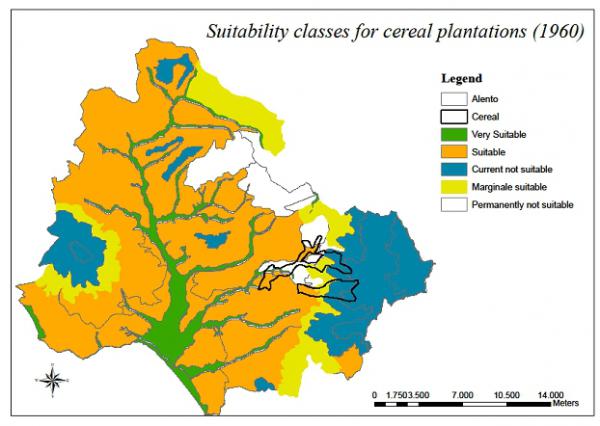


With reference to drought disturbance, robustness is assessed as generally moderate, although areas with vines and olives include more surfaces with low and very low resistance compared to cereal fields and orange groves. The assessment of diversity was carried out though the calculation of the Shannon's index using land cover types. The values of the index are: 0.2 (1960); 0.07 (1970); 0.17 (1980).
In the beginning of the period, the continuation of the traditional mixed cropland/husbandry system signifies a redundant system. This property nevertheless diminishes as previously pluri-active farmers abandon their farms or convert to monoculture.
Connectedness follows a similar pattern. From agricultural systems which vary between tightly connected, where traditional farming systems olive groves + husbandry are diffuse, to moderately connected, where olive groves and vegetable crops under low planting are diffuse, to loosely connected agricultural systems, seen on the plains.
The degree of openness of the agriculture system in Alento varies during this time. Taking into consideration the nutrient balance of inputs (e.g. fertilizers, manure) and outputs (commodities transported outside the system) a degree of openness is found in the plains in the first part of the period, although it varies moving from the plains inland.
Economic capital: As traditional agricultural systems are replaced by new systems with extensive use of external inputs (fertilizers, pesticides, mechanisation) robustness falls from high in 1960 to low in 1980. With regard to diversity, the Herfindall index for the local units within the SES show decreasing values and a lack of concentration of industry, predominately in productive sectors.
The agro-industry component of the economic system (one of the most important in the area and linked with cropland) is low redundant as one type (olive processing) represents 78% of the sector in 1970. The tourism sector shows an increase in redundancy from low to moderate. Openness is high due to high emigration rates and improved trade.
Social capital: In terms of potential available for change, a substantial part of the population chooses emigration as the main life option. The SES shows a low degree of robustness in terms of its ability to find a solution to its main problem, namely disparities in land resource distribution. In order to calm social unrest, higher level instruments (agrarian reform) and models (modernization of agriculture) are implemented with limited effectiveness, resulting in a lowered redundancy.
Diversity increases, particularly in the form of younger generations leaving the traditional family-centered societal model and land management regime to pursue more "modern" lifestyles. It is crucial in the transformation of the region and the definition of responses within the SES to the problem of poverty. The departure from traditional rural models also brings a reconfiguration of connectedness in the study site; tight community ties (bonding social capital) are profoundly changed by the new organisation of the local job market and the rural exodus which modifies the demographic structure (mainly affecting males).
Socio-ecological resilience
AK: to be added, source: D133
Socio-ecological fit of the dominant response to LEDD
AK: to be added, source: D133