
Study sites in cropland
Study sites in grazing land
Study sites in forests
Joining the EU (1986 to date)
| Authors: | Michiel Curfs, Anton Imeson |
| Coordinating authors: | Constantinos Kosmas, Giovanni Quaranta |
| Editors: | Alexandros Kandelapas, Jane Brandt |
Editor's note 20Mar14: Source D132-14.
Assessment of natural, economic and social capitals
| Natural capital | |
| Assessment | During this period, climate capital is moderate. Water capital is moderate to low: while the construction of the Chanza dam provides water for domestic and industrial use in the capital Huelva, water quality in the area deteriorates. Soil capital is low. With regard to vegetation, there is an increase of cultivated ecosystems which is the result of changing from dry to cultivated lands. |
| Critical functions | Primary production of citrus is the main ecological function. The amount of farms and surface cover of the four crops, citrus, olives, cereals and vines shows the dominance of citrus fruit production and land use change within the wider SES, the province of Huelva. For all crops, the quantity of farms is declining in numbers. The only crop which surface area is expanding is the citrus fruit. |
| Critical variables | Soil aggregate stability is low during the establishment of citrus plantations and gradually increases, nevertheless it remains lower than the aggregate stability of original landscape. |
| Economic capital | |
| Assessment | Produced capital increases rapidly alongside orange production which quadruples between 1986 and 1999. Financial capital also increases, aided by EU co-financing. Landesque capital also increases: the Chança and Andévalo dams are constructed in 1985 and 2003 respectively. Large scale plans to provide irrigation to extensive new citrus plantations remain unrealised. Physical capital also increases through infrastructure improvement as well as the new citrus plant. |
| Critical functions | Citrus farms are intensive agriculture, highly mechanized and irrigated. Their productionis mostly aimed at the international market. |
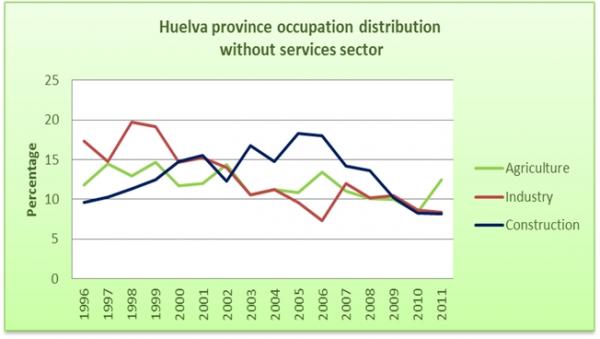
| Critical variables | The rural landscape changes into a periphery that is kept alive through subsidies. Although accession to the EU creates new economic wealth, it also increases dependency on external means of production and public resources. Arguably, the most direct and striking effect is found in the decline of traditional farming as a source of livelihood, substituted by highly modernized forms of agriculture. Although large orange plantations influence employment opportunities, little of the profit that is made by the large orange producers remains in the area. |
| Social capital | |
| Assessment | - |
| Critical functions | - |
| Critical variables | Welfare arrangements become an important source of income for many of the inhabitants. The availability of welfare benefits and the improvement of infrastructure result in a seasonal migration of many workers from the area, instead of long-term departure. Wind energy is also present. The area hosts one of the biggest wind turbine parks in Europe. The park is under criticism for not providing local employment and energy.
|
Main LEDD problems and responses
The main LEDD problems are soil erosion, desertification, loss of biodiversity and reduced productivity. Soil erosion is a serious problem, with areas losing more than 100 t ha-¹ yr-¹. However, the number of areas with such high erosion rates appears to have be decreasing during the last decade. There are little to no responses to try to tackle the issue of erosion. An indirect negative response could be argued to be the expansion of citrus orchards where few control measures are included in the design of the newly converted plantations. It is estimated that 24% of primary production loss is due to land use conversions in Spain, extremely high in comparison to the estimated average value of 5.2%-6% for Western Europe.
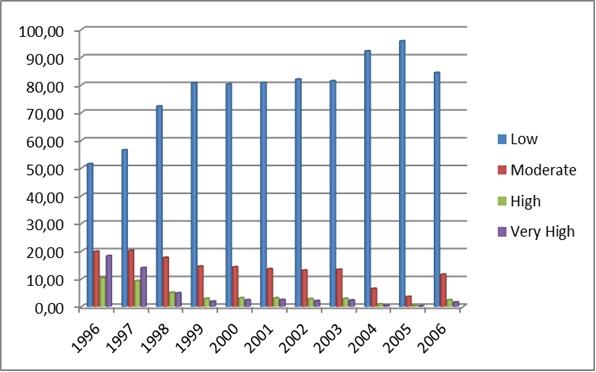
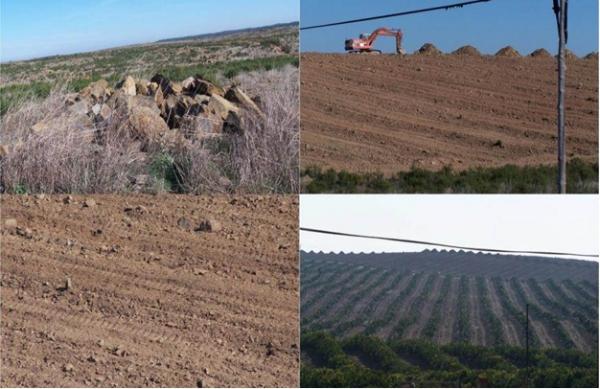
Land desertification is a significant issue according to the Map of Environmental Sensitivity Areas to desertification (ESA). On the basis of these findings the whole area is vulnerable to desertification. However, desertification is not perceived as a main problem. No direct evidence of desertification, mitigation or implementation of measures related to the NAP have been found in the study area. This can be considered as "no action" and thus a negative response to the problem.
The creation of the Beturia commonwealth (formally in 1993) is a human capital response (social network) to natural capital. The movement emerged as response to the perception that the then newly constructed Chanza dam would not benefit the area.
Policy context
AK: to check that implementation, impacts and effectiveness of selected policies are discussed in this text. Look at D142 to see if there is any additional information.
The most recent changes in relation to policies in effect on the rural landscapes are related to the Common Agricultural Policy (CAP) w hich has had a clear impact on with amassive increase in forest plantations: more than 30,000 has are first cleared then replanted during the 1990s under regulation 2080.
Properties of the system
AK: to check if there is any further relevant information in D133
Natural capital: Robustness is low for cereal agriculture, and low for mono culture plantations such as citrus. Diversity is low for both cereal and citrus plantations. Redundancy is also low, particularly so for citrus. Both cereal production and citrus cropping systems are loosely connected (dense planting of annual and perennial crops respectively). Rapidity is estimated to be high for cereals and low for citrus plantations.
Economic captial: The main crop is still cereals, which under the rain fed crop systems, can be classified as having low robustness. The rise (and later dominance) of irrigated citrus plantations mark a shift towards very low redundancy.
Social capital: Potential for change, robustness, diversity and redundancy are low. Connectedness is moderate.
Socio-ecological resilience
AK: to be added, source: D133
Socio-ecological fit of the dominant response to LEDD
AK: to be added, source: D133