
Study sites in cropland
Study sites in grazing land
Study sites in forests
General description of San Silvestre de Guzman
| Authors: | Michiel Curfs, Anton Imeson |
| Editors: | Alexandros Kandelapas, Vassilis Koutsoukos, Jane Brandt |
Editor's note 1Mar13: Source D131-5.5
Location and history
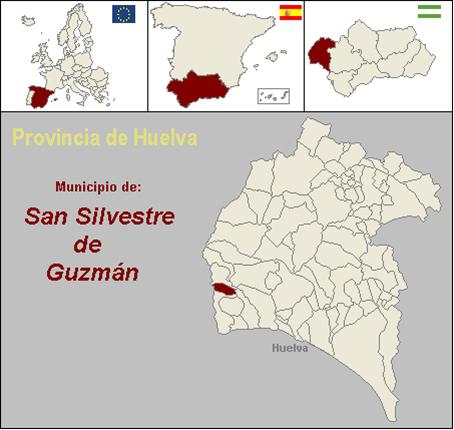
San Silvestre de Guzman is situated near the border with Portugal, at the Eastern side of the river Guadiana. It is the most western part of the Huelva province and occupies 49.1 km².
Despite its past as a stable rural community, with 1155 inhabitants in the early 20th century, San Silvestre de Guzman was hit hard by the civil-and post-war hardshipsand the decline of extensive farming activities. During the 1960s and 1970s, San Silvestre de Guzman was depopulated.
In recent years the town´s main activities include agriculture, due to the advent of irrigated areas and the cultivation of oranges and the service sector.
Geology, climate, topography and soils
The biggest part of San Silvestre de Guzman is of carboniferous origin. It consists of shale, slates and greywacke, which depict a fluvial origin. The area has a characteristic Mediterranean climate with long, dry, hot summers. Although the average precipitation is about 500 mm/year, the records show extremes from more than a 1000mm/year to less than 200 mm/year.
Elevation level does not exceed 200 m.a.s.l. The study area can best be described as sloping land with a dissected low to medium level undulating to rolling landscape.
The main soils in the area are, Leptosol, (Eutric) Regosol and (Eutric) Cambisol. The soils in general are shallow, low in nutrients and organic matter. Soils of sedimentary origin take up 46% and 54% are of metamorphic origin.
San Silvestre de Guzman borders with the river Guadiana.
 |
 |
Land use
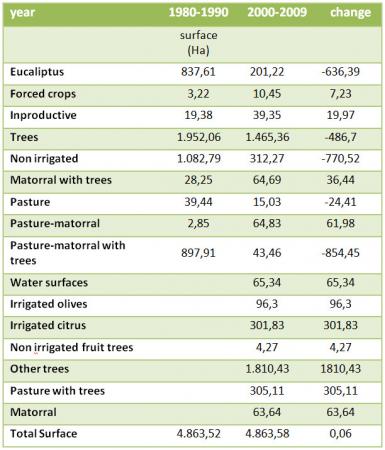
Changes in land cover since the 1980s have been significant with approximately 40% of the area being converted to irrigated citrus orchards ("other trees" category).
Population and land ownership
Population is relatively stable at around 700 inhabitants. The educational profile of San Silvestre de Guzman in 1996 is rather low compared to regional and national profiles: 93% of the population have received only primary education.
San Silvestre de Guzman is governed by a city council with seven members. Most land is private property (81.7%) and 54.1% of agricultural holdings are smaller than 5 ha and owned by older people.
Particular LEDD issues in San Silvestre de Guzman
The main LEDD problems in semi-arid croplands such as Western Andévalo are related to water and soil (organic matter). In order to sustain, maintain or increase available water and necessary nutrients for agriculture to compete on the global markets, modern agricultural practices have been employed to meet the needs of specific crops. Extensive application of chemical fertilizers and pesticides to assure crop yield are causing soil depletion and dependency upon mineral fertilizers, a fundamental step towards biophysical desertification. Mechanisation also leads to reduction in employment opportunities, primarily seasonal.