
Study sites in cropland
Study sites in grazing land
Study sites in forests
Huelva Region Socio-Ecological System (SES)
| Authors: | Michiel Curfs, Anton Imeson |
| Editors: | Alexandros Kandelapas, Vassilis Koutsoukos, Jane Brandt |
Editor's note 28Feb13: Source D131-5.2
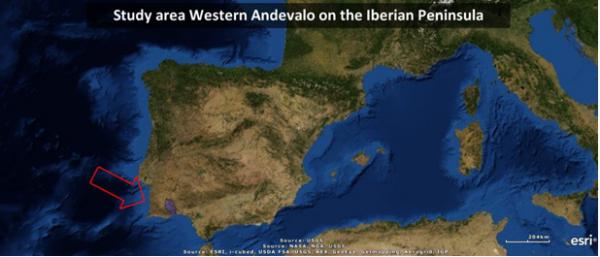 |
The Western Andévalo study site area is located in Huelva, the westernmost province of Andalucía, Spain. It borders with Portugal on the west and the province of Seville to the East. To the north lies the Extremadura, and to the south is the Atlantic Ocean. |
Traditional crops in the Huelva were cereals, olives, vineyards and non irrigated oranges. Since the 1960s, and after the first experiments near the city of Huelva, strawberry cultivation has been expanding: in 2009 it was taking up about 6500 ha of land in the Huelva province. More recently, this model of highly technological and intensive agriculture, has expanded to include raspberries, blueberries and oranges, supported by official plans called “regadíos del Andévalo” (the irrigation of the Andevalo). This new way of farming is highly mechanised and practiced in bigger sized farms, aiming for the international market. Related food processing activities (pork, strawberries and especially oranges) are taking a great leap.
Nevertheless, agriculture in the bigger part of Western Andévalo is based on the traditional use of the Dehesa, in small scale farms.
Huelva is one of the poorest provinces of Spain and has always had among the highest unemployment rates of the country. The main sources of employment are the tourist industry and other services sectors, taking over after the decline of industry in the city of Huelva.