
Study sites in cropland
Study sites in grazing land
Study sites in forests
Middle Atlas Region Socio-Ecological System (SES)
| Authors: | Ahmed El Aich |
| Editors: | Alexandros Kandelapas, Vassilis Koutsoukos, Jane Brandt |
Editor's note 5Mar13: Source D231-3.2
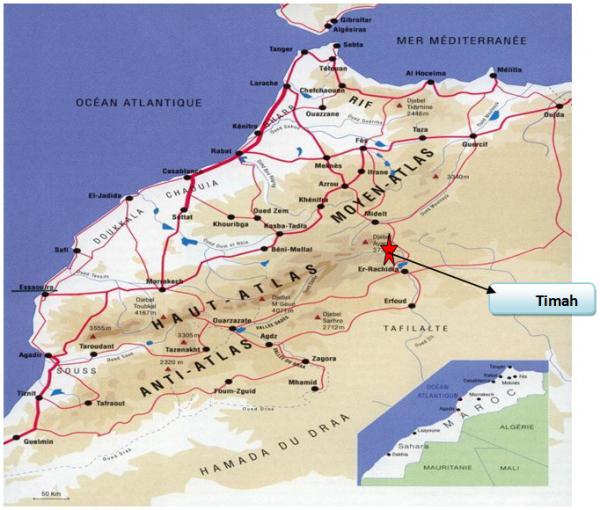 |
Location The Morocco grazing study site is the province of Ifrane in the region of Meknes Tafilalet. The size of the province of Ifrane is about 3 537 km² and it is located in the Central Middle Atlas region, with an elevation ranging from foothills in the Northwest to high summits in the Southeast with a peak of 2409 m at Jbel Hyan. |
Climate
The climate is Mediterranean, characterised by a rigorous winters and cool summers. Differences in altitude result in important differences between the mountains and the plain with a bioclimatic succession from humid and semi-arid. Rainfall varies annually between 350 mm (Southwest) and 1100 mm (Northeast). Snow occurs sporadically from December to April with variable heights ranging from 20 cm to 60 cm. The maximum and minimum temperatures recorded during the last 10 years were respectively 37 °C and -24 °C.
Geology and hydrology
The Middle Atlas is characterized by a wide range of geological types from different geological ages, ranging from Quaternary basalts and Triassic clays to primary shale, alluvium and colluvium.
The province has rich water resources, which earned it the name of the "water tower". These are estimated to be around 700 million m³ (300 million m³ as superficial water and 400 million m³ as deep water). The province extends over an area of 357,550 ha, divided into 83,000 ha of arable land (of which 19,200 irrigated), 116,000 ha of forest and 158,550 ha of rangelands.
Land use
Agriculture is characterized by the fragmentation of agricultural property (54% of farms have less than 5 ha).
The number of livestock exceeds 745,500 and is composed of 648,700 sheep (87%), 70.400 goats (9.5%) and 26,400 cattle (3.5%). Sheep-breeding, predominantly of the "race-mahdite Ti" is the main economic resource of the rural population.
Population
The population of the province consists of three major tribes (BeniMguild, BniM'tir and AitSeghrouchen). The size of the population is 143,380 inhabitants, 49% of which live in rural areas. Annual rate of population increase is 1.2%, increasing by 57% between 1971 and 1994. Almost half of the population has an age comprised between 15 and 59 years and 91% of the population is younger than 60 years, with an equal percentage of men and women.
Administration and infrastructure
From an administrative point of view, Ifrane province is divided in eight rural communities (Ben Smim, Tigrigra; AinLeuh, Sidi El Mokhfi, et OuedIfrane, Timahdite, DayetAoua et Tizguite).
The settlement network in the Middle Atlas consists of small and medium towns, located on routes leading to larger towns, at small distances. Ifrane and Azrou are the biggest urban agglomerations in the study area.