
Study sites in cropland
Study sites in grazing land
Study sites in forests
General description of Fanlo, Torla, Broto
| Authors: | Alados Inma, Erea Paz, Fillat Frederico, Gartzia Maite |
| Editors: | Alexandros Kandelapas, Vassilis Koutsoukos, Jane Brandt |
Editor's note 5Mar13: Source D231-2.4
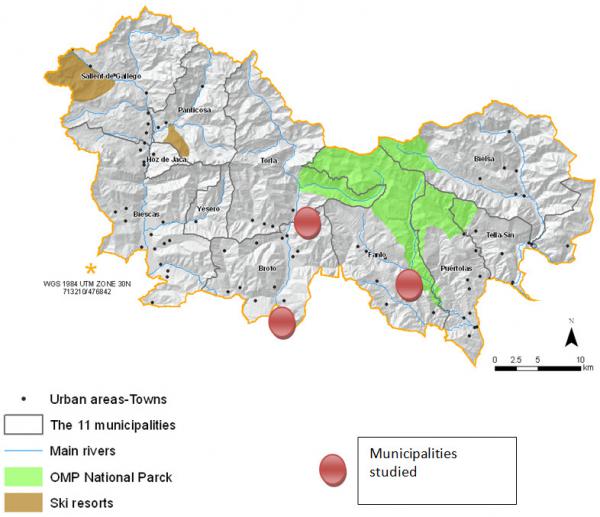 |
Location Torla, Broto and Fanlo are 3 of the 11 municipalities included in the study area of the Central Pyrenees. |
Climate and topography
Annual rainfall exceeds 1500mm (40% and 20% of the municipalities of Torla and Fanlo respectively) at high altitudes around 2200 m. Broto, with lower altitude land (with no lands higher than 2200 m), has less than 1200 mm of annual precipitations in the 80% of its territory. These conditions are similar to 35% of the area of Fanlo.
 |
 |
Land use
The topographical and climatic conditions are reflected in the land cover of the municipalities, where Broto has fewer amounts of high altitudinal pastures in contrast to more forest and agricultural zones of the low lands. In Torla and Fanlo with more surfaces higher than 2200 m, (more than 50%) the most of the land cover occupied the natural's pastures, dense and sparse ones.
 |
 |
Population, employment and education
All three municipalities are characterized by demographic decline, more dramatic in the case Fanlo and Broto, although they have slightly recovered during the last 10 years. Broto is favored by better communication infrastructure and proximity to population centers with services such as education and health and exhibits population density similar to the study area as whole. Torla is the main entrance to national park that received a thousand of tourists during the year, with can be the cause of the lower decline of the population. Fanlo, is the more isolated municipality in the study area.
Evolution of employment follows the general trend, with dramatic declines in agricultural employment and increase of service sectors related with the tourism attaching the national park. Fanlo is the municipality with the lowest GDP in the area, close to the poverty line. The majority of the population has received some form of education, and around 60% arrived to do the second grade (for the 2001 year) in Torla and Broto and 55% in Fanlo. Only 1% of the population is illiterate.
Administration land ownership and infrastructure
Forest and higher areas (grasslands over 1500 m) are generally public property while the valley bottoms are privately owned.
The municipalities are part of the "Sobrarbe" administrative unit of the Central Pyrenees. Responsibility and management of most social services rests with the central town in Ainsa (biggest town in the area). Road density and public services are sparse particularly in Fanlo as it has the biggest distance from the regional centre.
Tourism-related infrastructure dominates and is the most important source of revenue in the area. Broto has a large number of hotel rooms and apartments. Torla, however, receives the most visitors as it provides better access to the National Park of Ordesa and Monte Perdido. In Torla, tourism infrastructure is focused on summer tourism; camping and sports. Although this form of tourism is more respectful towards nature and has less environmental impact, its economic revenue is also lower than in the close municipalities that the economy is based in sky resorts. Fanlo has almost no tourism infrastructure.
Particular LEDD issues in Fanlo, Torla and Broto and responses made
As in the entire study area, the biggest environmental problem of these municipalities is the abandonment of the rural areas, with the depopulation and the transition from the agro-pastoralism to work in the service sector, with the consequence of the woody encroachment of the lands.
The general proposal by farmers is to increase livestock pressure in alpine and subalpine pastures to improve the grassland quality and reduce the shrub expansion. Increase the number of sheep number, or even equids, would help in that direction as they are more efficient in combating woody vegetation expansion. The possibility to use prescribed fires or woody removal for shrub control is also widely raised. Improvement of road infrastructure is also highlighted.