
Study sites in cropland
Study sites in grazing land
Study sites in forests
General description of Sanlúcar de Guadiana
| Authors: | Michiel Curfs, Anton Imeson |
| Editors: | Alexandros Kandelapas, Vassilis Koutsoukos, Jane Brandt |
Editor's note 11Mar13: Source D331-3.4
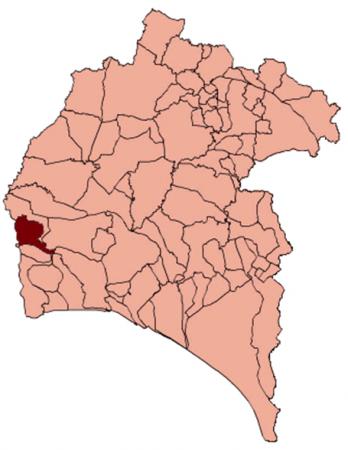 |
Location, climate and history Sanlúcar de Guadiana is situated at the border with Portugal, at the Eastern side of the river Guadiana. It is the westernmost part of the Spanish Huelva province and occupies 96.5 km². It is 34 m a.s.l. Annual and monthly rainfall, air temperature and potential evapotranspiration (ETo) is the same as Western Andevalo. Sanlúcar de Guadiana's current nucleus has its origin in the second part of the 13th century, when Sancho II of Portugal conquered the land of Muslims. The town's strategic position because on the navigable river Guadiana has contributed to its historical role as a trade center as well as its turbulent history. The town has also been affected by the river's flooding. |
Geology and topography
The town of Sanlúcar de Guadiana is situated on carboniferous material of volcanic origin (Tuff, lavas, acid breccias, quartz). The surrounding area is of carboniferous origin but consists of shale, slates and greywacke of fluvial origin.
The largest part of the area (65%) has a 15% angle, with 32% having a 30% angle. Soils are of primarily sedimentary (66%) or metamorphic origin (34%).
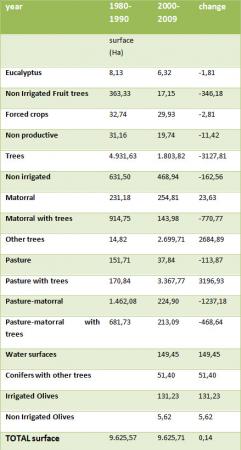 |
Land use Land cover changes since 1980s have been significant due to the increase in the categories Other Trees and Pasture with Trees. Population and employment The population has been stable at around 400 inhabitants since 1991 (down from 845 in 1981). The dependency ratio is rater high, with 76.6% of the population is dependent on 21.4%. Population seems to be growing while foreigners are more than locals. An 88% of the population has not received secondary or higher education. Population density is extremely low, less than 5 inhabitants/km². Until 50 years ago, the population relied exclusively on agriculture. Transition of employment to services is almost complete although the necessary infrastructure is deemed inadequate. Population ageing and lack of economic resources, which makes it difficult to create platforms for new opportunities. |
|
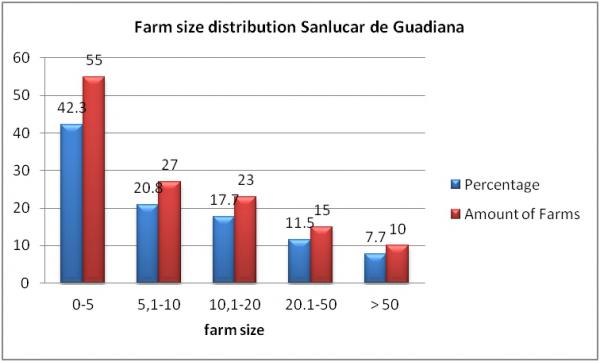
Administration, land ownership and infrastructure Sanlúcar de Guadiana is governed by a city council of seven. Land ownership is predominantly private property (95.85%). Most farms are small and generally owned by older people, with 42.3% of agricultural holdings smaller than 5 ha. Sanlúcar de Guadiana has a local educational center (Public College San Blas) and one health centre. Medical emergencies have to be addressed in Villanueva de Castillejos approximately 25 km away. The nearest hospital is in Huelva, 80 km away. |
 |
Particular LEDD issues in Sanlúcar de Guadiana and responses made
Awareness of land degradation and desertification issues is low and overshadowed by economic and social problems.
Responses to LEDD are therefore primarily of a social or economic nature, focusing in increasing tourism and related work positions. Sanlucar de Guadiana now has a tourist office and has invested in mountainbike trails. Other efforts include the creation of a fluvial beach, playgrounds and the restoration of the old castle.