
Study sites in cropland
Study sites in grazing land
Study sites in forests
Baixo Guadiana Region Socio-Ecological System (SES)
| Authors: | Michiel Curfs, Anton Imeson |
| Editors: | Alexandros Kandelapas, Vassilis Koutsoukos, Jane Brandt |
Editor's note 11Mar13: Source D331-3.2
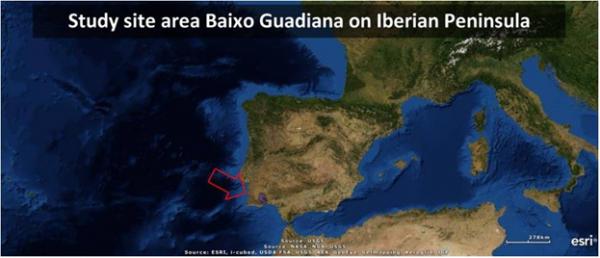 |
Location and climate The 'Baixo Guadiana' represents and summarizes most of the aspects and characteristics of the Mediterranean areas with a high severity of climate, environment and socioeconomic components. The area has the marked characteristics of Mediterranean climate with long, dry periods and high temperatures during summer, associated with a trend of decreasing average annual rainfall that falls in more irregular showers. |
This has negative influences on the ecophysiological efficiency of forests and their phytosanitary status, and can trigger increasing erosion rates.
Ecosystems and land use
Shrub and herbaceous formations are the main land use form in the Baixo Guadiana, representing 42% of the total territory area.
In the Baixo Guadiana area, 35% of the territory has undergone changes in land use between 1990 and 2006. Nearly 30,000 ha of farmland have become forested areas, of which 20,500 ha have become agro-forestry.
Matorral with trees has also increased by 583% to nearly 60,000 ha of young Dehesas and Montados. Dehesas and Montados (D&M) with holm oak and cork oak constitute a forest that has the largest extension in the Pyrite belt and more general in the whole of the Mediterranean forests. The D&M are forest areas in which the distance between the trees should be kept at such a density that is in equilibrium with its land use. The D&M are formations that allow development and use of pasture by livestock. The conservation of the D&M is related to the performance functions that are critical to the profitability of the system. The density of trees should meet the lighting requirements of grassland and facilitate the movement of livestock.
Population and employment
The Baixo Guadiana is a rural area with low population density in the mainland and higher population density in the coastal zone. The lack of development perspectives in the mainland has led and still leads to unemployment, resulting also in a negative demographic trend. Ageing and depopulation are prevalent in the interior parts of the study area.
Littorisation can clearly be observed in the Baixo Guadiana area. Positive demographic trends in the coastal zone are related to tourism. Various trans-border projects are investigating the possibilities to develop the interior parts of the Baixo Guadiana through sustainable tourism along river Guadiana.