
Cropland
Drivers of LEDD in cropland: Greece and Messara Valley
Authors: Constantinos Kosmas, Katerina Kounalaki, Mina KaramesoutiEditor's note 30 Apr 2012: Text source D111 section 3.2
The socio-economic drivers of land and ecosystem degradation and desertification (LEDD) in Greece include rural migration, farm size and land fragmentation, CAP and other (e.g. regional development and spatial planning) policies, higher profitability of irrigating farming, low prices for agricultural products, coastal, urban and tourism development and changing climatic conditions.
Rural migration
Large scale migration from rural to urban areas occurred in Greece after the 1950s. Urban populations have increased in the last few decades while rural population has continued to decrease (Figure 1). Rural migration has had a significant impact on cropland and land management practices. As a result of out-migration, land was either abandoned or rented to those farmers remaining in rural areas. Under such conditions, the main concern of the land user was the over-exploitation of the land without applying any land protection measures. In some cases farmers deliberately used fire to eradicate perennial vegetation and stimulate the growth of more palatable annual vegetation for grazing animals (Kosmas et al. 2000).
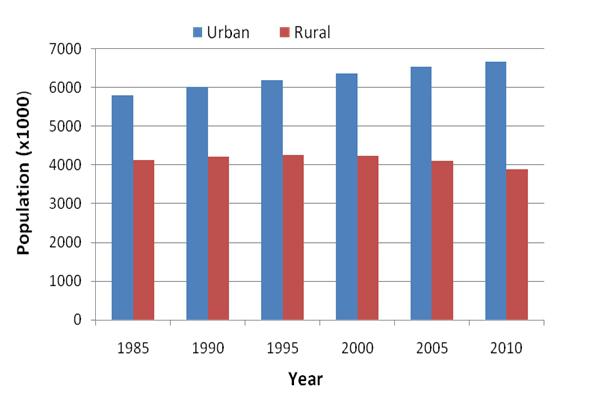 |
Figure 1. Changes in urban and rural population between 1985 and 2010 in Greece. Source: (Greek National Statistical Service 2010) |
Land terracing was a common practice for soil conservation in hilly areas. Stones from remote areas were transported by animals and used for building walls in selected sites and then these walls were filled with soil from the surrounding area and planted with olives, cereals and vines. As a result of rural out-migration, many of these terraces have been abandoned, particularly those cultivated with cereals, and in some cases with olives and vines due to: (a) difficulties in accessibility and cultivation with machinery; (b) low prices for agricultural products and; (c) high maintenance costs. Once abandoned, the collapse of these terraced slopes may be rapid and soil can be easily washed out by surface water runoff and gravity, resulting in high rates of land degradation.
In the last few decades the landscape of Crete has experienced a significant and rapid rise in urbanisation and mass tourism. The total number of tourists in Crete exceeded 2 million per year (3.5 times greater than the domestic population) and this number may double by 2025 (Chartzoulakis et al. 2001). In some dry areas, particularly along the coast, farmers have sold their land to developers for the construction of tourist infrastructure. Low incomes from farming, and the high prices offered for tourist activities, motivates farmers to change land use, reshaping landscape, and altering resources. Furthermore, the population of Crete has increased in the last four decades (Figure 2 below). The rate of increase was especially high in the area of Heraklion, with the seasonal immigrant population reaching 601,131 in 2001, putting significant pressure on land for transformation from agriculture to residential or industrial uses.
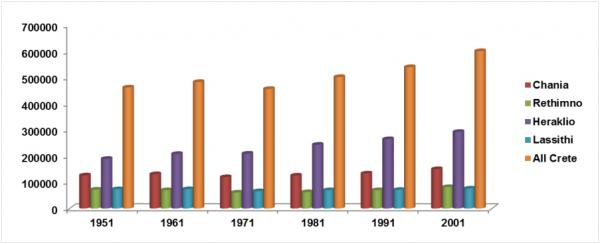 |
Figure 2. Population change between 1951 and 2001 in Crete. Source: (Graph compiled by the authors based on data from the Greek National Statistical Service) |
Farm size and land fragmentation
Greek agriculture is based on small-sized, family-owned dispersed units, while the extent of cooperative organisation has stayed comparatively low despite efforts to increase this in the last 30 years, mainly through European Union incentives. Based on EUROSTAT data (2008) the average size of a holding in Greece 5.6 ha. Although the average farm size in Greece has increased since 1960, there has been no decline in the percentage of farms in the smallest-sized group of 2.8 ha. The continued existence of these small farms can be attributed to part-time farming, and to the farm-family life cycle. The average farm size across regions is found to be negatively related to population pressure, positively related to industrialization, and positively related to mechanisation (Lianos and Parliarou 1986). Data collected during the EU research project DESERTLINKS showed that land fragmentation is high, especially in hilly areas ranging from 4-8 parcels per holding. Farm size and land fragmentation is higher in Crete compared with the national average (Beopoulos and Vlachos 2005).
Farm size and land fragmentation is an important driver of LEDD. Based on results from the EU research project DESIRE (contract No: 037046) (Kosmas et al. 2011 unpublished data), as farm size decreases, land fragmentation increases and the sensitivity of the land to degradation and desertification also increases. At small farm sizes, farmers tend to avoid applying traditional measures of soil erosion control, such as contour farming, strip cropping, vegetated water ways, etc. Large farm size can have an impact on the shape of the farm such as uniform fields with less boundary features and isolated trees, as well as on the degree of intensification of operations as capital replaces labour, which enables farmers to produce higher output from the land. Intensification of agriculture may lead to ground water pollution, soil compaction, etc.
The Common Agricultural Policy
Greece joined the EEC (European Economical Community) in 1981 and Greek agriculture became subject to the Common Agricultural Policy (CAP). Up until 1992, the aim of the CAP was to increase production, and to provide cheap rural products accompanied by reasonable rural incomes. The consequences of the CAP in Greece were the intensification of agricultural production, extensive mechanisation of crop production, creation of monocultures, such as cotton, large surpluses of some products, the disappearance of some unique Greek plant varieties which were replaced by hybrids, and the loss of the rural balance with its self-sufficiency in agricultural products (Vlachos 2008). Greek farmers have re-orientated crop production towards the globalised market and Greek agriculture is no longer based solely on the needs of the country or the European Union. This has resulted in the orientation of Greek agriculture to three main crops; olives, cotton, and tobacco. As a result, the country has simultaneously lost its self-sufficiency in products such as cereals, fruits, and vegetables.
The CAP, through its structural policies, supported an adequate income to farmers, contributing to the development of regional economies and reform of landscapes, particularly in less favoured areas. In addition, subsidies allocated under the CAP accelerated the intensification and specialisation process in agriculture. Subsidies, allocated for cereals based on the area cultivated encouraged farmers to keep highly degraded land under cultivation, or to expand cultivation into marginal areas, even though crop yields were low, resulting in accelerated erosion and land degradation (Louloudis et al. 2000; Briassoulis 2003). This has been enhanced by the simultaneous effect of regional development and infrastructure policies that reinforced the impacts of the CAP.
CAP has significantly affected cropland areas and land use types in Crete. Many marginal areas under natural vegetation were cleared and olive groves have been planted. These areas become particularly vulnerable to erosion due to inadequate soil protection from erosion and reduction of infiltration rates which follows loss of organic matter content and soil structure decline. Widespread olive production in steep hilly areas in combination with a lack of water and grazing has resulted in desertification problems. Drip irrigation has been expanded across hilly and mountainous areas with negative impacts on water resources. Although the amount of water required for irrigation of olive plantations is relatively low compared with arable crops, there has been a dramatic over-exploitation of aquifers accompanied by water quality deterioration (Briassoulis 2003; Wilson and Juntti 2005; Juntti and Wilson 2005). In addition, exploitation of natural resources has been significantly affected by regional development, infrastructure, spatial planning policies and the implementation of Integrated Mediterranean Programmes.
Higher profitability of irrigation farming
The higher profitability of irrigating farming and the low profitability of dry farming due to climatic conditions (low rainfall, high evapotranspiration rates) has significantly influenced farmers to expand arable land and change land management practices in Greece. Expansion of agricultural land was undertaken in natural areas by clearing vegetation or changing from dry farming to irrigation farming, resulting in many cases in land degradation problems. In addition, intensive farming has increased the use of mechanisation and agro-chemicals and the selection of new plant varieties which have negatively affected water availability and quality (Karavitis and Kerkides 2002). These changing practices have negatively affected soil structure, soil organic matter content and biodiversity, and contributed to increased land degradation and desertification risks (Greek National Committee for Combating Desertification 2001).
In Crete, as in the rest of the country, the higher profitability of irrigated farming has led to over-exploitation of water resources. The amount of water allocated for irrigation is estimated to be 82 percent of total consumption. Water consumption in general in Crete has increased more than four percent per year (Angelakis et al. 1998). Most of the total water consumption is used in agriculture for the irrigation of olive groves, vineyards and vegetables. The increased demand of water, either for urban or agricultural use, cannot always be met, despite adequate precipitation. Water imbalance is often experienced, due to temporal and spatial variations of precipitation, increased water demand during the summer months and the difficulty of transporting water due to the mountainous areas.
Low prices for agricultural products
Although Greece has a clear competitive advantage in the production and marketing of food products (mainly fruit and certain vegetables), the food industry has been slow in adjusting to the EU’s competitive standards. Relatively high prices, low quality, shortfalls of high demand products and low levels of marketing standardised quantities resulted in decreasing shares in the major international markets (Miliakos 2006). Only recently has the industry started addressing problems such as storage and packaging, advertising and promotion campaigns, brand names and contracts with large retail chains. Greek agricultural products are influenced by the Common Agricultural Policy (CAP). This causes higher producer and consumer prices in many agricultural products. However, producer prices still show significant variations due to: (a) limited transmission of CAP institutional prices; (b) the fact that some agricultural products are not regulated by the CAP and; (c) unexpected changes in climatic conditions (Apergis 2003).
Olive groves cover large areas of Greece. In addition, Crete is the main olive oil producer in the country. Areas covered by olive groves are mainly sensitive to land degradation and desertification. Furthermore, Greece is the third largest producer worldwide, with a 16 percent share of the international market in the production of olive oil and is second largest at the European level in the production of table olives (Miliakos 2006). EU regulation prohibits the sale of olive oil in unbranded packs greater than 5 litres. The domestic market for standardised olive oil is controlled by a few large firms and agricultural cooperatives. The existing organisation of marketing cannot effectively promote olive oil to world markets, resulting in low prices for producers.
Low prices of agricultural products, and strong competition from other countries, especially for olive oil and citrus fruits, has greatly decreased farm incomes. Under such conditions, farmers have adopted different cultivation practices in order to continue to receive subsidies, or have changed to more profitable crops, even though the soil conditions may not be suitable. Other practices include the clearing of natural vegetation to grow olives or vines in order to increase income, with a resulting increase in land degradation and desertification. Furthermore, because of low farm incomes, investment in soil and land protection measures is not always a priority.
Urbanization of coastal areas
The recent rapid socio-economic growth in Greece (rural migration, second homes, tourism development) and modernisation (mainly in agriculture, transport networks, and infrastructures) have brought radical changes to Greek coastal landscapes. Public works, transport infrastructures and the expansion of urban areas has had a significant impact on the natural environment, creating a rural-urban continuum (Beriatos 2008). Greece, with a total population of approximately 11 million, is characterized by its high coastal concentration. The population living on the relatively narrow strip of land one or two kilometres wide is approximately 3.5 million, representing 33 percent of the total population. If the population living in areas up to 50 km from the coast is also included, then the coastal population is estimated to about 8.8 million or 85 percent of the total. The total urbanized coastal area is estimated to cover around 1315 km2, or 1.31 percent of the total land area. Projections for coastal urban growth indicate a further increase in the mid and long term. The process of population concentration in the coastal zones was initiated in the late 20th Century. It was promoted by a number of public incentives that where in favour of rapid economic development following the end of World War II.
The natural and cultural assets of coastal areas attract up to 11 million tourists each year (90 percent of all tourist activities and recreation are located on the coast). As a result, tourist activities account for a large proportion of the land use in coastal areas. Urbanisation and tourist development in Greece has often been undertaken on an illegal basis, or without proper planning to protect productive agricultural land.
The concentration of the population in the coastal zone has caused a significant rise in soil sealing, accompanied by intensification of agriculture in the lowlands, abandonment of agricultural terracing land, an increase in the number and frequency of forest fires, overexploitation of water resources, soil contamination, soil salinisation, water pollution, coastal erosion, flooding of lowlands, and the disappearance of wetlands.
Climate change
Agriculture is significantly affected by climate variability and extreme weather events, such as droughts, floods and severe storms. Human actions have already changed atmospheric characteristics such as temperature, rainfall, levels of carbon dioxide (CO2), and ground level ozone. While food production may benefit from a warmer climate, the increased potential for droughts, floods and heat waves will pose future challenges for farmers (Karavitis and Kerkides 2002).
Climate change will have a considerable and negative impact on many sectors in Greece. Climatic conditions are the most important physical environmental characteristics affecting water resources and land management practices. Under semi-arid or dry sub-humid climatic conditions accompanied by irregular rainfall with long dry period and high summer temperatures, farmers move to less water consuming crops or adjust cultivation practices in order to store more rain water into the soil or to reduce soil water evaporation by tillage. Such practices in hilly areas can greatly contribute to high erosion rates due to surface water runoff and tillage operations. Farmers consider that understory vegetation competes with crops for water resources, so they remove it using agri-chemicals or they cultivate the soil (Metzidakis et al. 2006).