
Grazing land
Characteristics of grazing land: Spain and Central Pyrenees
Authors: Conceptión Alados, Erea Paz, Frederico Filliat, Maite GartziaEditor's note 12Jun2012: Text source D211-2.4
Grasslands (land covered with herbaceous plants with less than 10 percent of tree and shrub cover, according to UNESCO) (Suttie et al. 2005), occupy around 13 percent of the land surface of Spain (Fillat et al. 2008). Livestock production has been an important activity in Spain since the Middle Ages. In particular, the production of quality wool played a key role in the development of Spanish socio-cultural heritage (Pinilla 1995). The grazing system was based on extensive exploitation of land, mainly through transhumance activity, which allowed the optimum use of pastures (Rebollo and Gomez-Sal 1998).
Pyrenean mountain ecosystems consist of diverse resources, and optimum production varies temporally along the altitudinal gradient (Garcia-Ruiz 1996) (Figure 1). The upper part of the mountains were used for grazing activities, leaving the lower part for agriculture. For example in the Borau valley, 73 percent of land use above 1700m was dedicated to extensive grazing, meanwhile 73 percent of land between 800m and 1300m was dedicated to agriculture (Vicente-Serrano 2001). During summer (July to October) abundant fodder is available, but in winter, fodder production is very limited. This is the basis for Pyrenean transhumance (Puigdefábregas and Balcells 1966), where livestock is moved to the Ebro depression during fodder shortages in winter time.
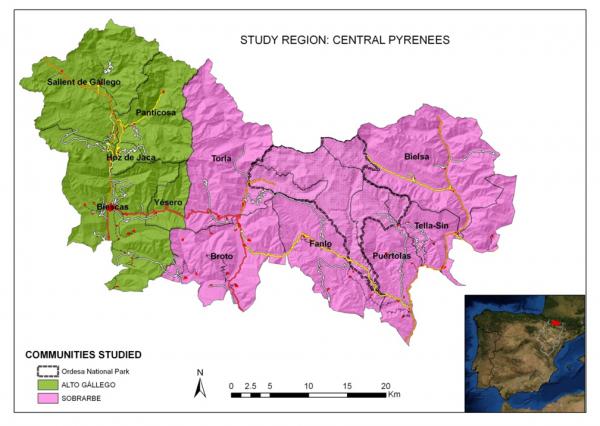 |
Figure 1. Location of the Central Pyrenees study site. Source: (Figure produced by the author, C. Alados) |
At lower altitudes, farming activities were mainly focused on the production of wheat, which reached its maximum extent at the end of the 19th century, with almost 28 percent of the land below 1,600m being cultivated (García-Ruiz et al. 1996). This was also the period with the highest population density in the Pyrenees. Almost all land was occupied, even land with very difficult topographic conditions. The better land, close to settlements, was improved with fertilizers, and stone walls were built on slopes to form flat terraces. Society was characterised by dense human population, living in big families with strong social cohesion. The traditional activity in the area consisted of grazing, frequent wildfires and rain-fed farming. Those activities resulted in important soil erosion in hill-slopes (García-Ruiz et al. 1996).
At the beginning of the 20th century, between 1905 and 1920, new roads were built to connect mountain communities to the valley floors (Pujadas and Comas 1975). The new roads irrevocably changed what had been self-sustaining communities, which had, up to that point, been able to provide most of the resources needed. As a result of the new transport links, food was imported into these valleys from elsewhere, resulting in the loss of competitiveness of mountain products and the subsequent abandonment of this traditional way of rural life (Puigdefábregas and Balcells 1970).
In the Pyrenees, grasslands are subalpine pastures that have replaced native forests, and have been grazed continuously for at least the last 500 years (Montserrat and Fillat 1990). One third of the Pyrenees flora is associated with grasslands. Reconstruction of past climate and vegetation since the Last Glacial Maximum (LGM) in the Pyrenees has revealed a widespread deforestation processes caused by forest fires around 3300 BP, probably related to the expansion of domestic livestock farming (García-Ruiz et al. 2001). With the exception of a few annuals that predominate in the gaps created by natural erosion or animal disturbances, most of the plants in the pastures are perennial grasses and forbs that reproduce clonally. In Spain, as in Western Europe, grassland communities are maintained by repeated physical disturbances of shrubs and trees and management activities such as fire and grazing for maintaining pastures and preventing plant succession in subalpine ecosystems (Ellenberg 1988b; García-Ruiz and Valero-Garcés 1998). These landscape structures created by human intervention have been maintained by herbivores and lead to plant-animal interactions in which each species has a particular role. These vegetation communities were adapted to the traditional methods of agricultural production which have now died out.