
Grazing land
Characteristics of grazing land: Crete and Asterousia
Author: Constantinos KosmasEditor's note 12Jun2012: Text source D211-2.2
One of the study sites investigating LEDD in grazing land is the Asteroussia Mountains, located in the island of Crete. Crete is the largest island in Greece (Figure 1) and is highly affected by land degradation and desertification. Domestic livestock production has been carried out since Neolithic times; about 10,000 years BP in Greece. Livestock became part of the environment affecting plant communities, ecosystems and landscapes. Grazing land in Greece covers an area of 5,300,000 hectares or 44 percent of the Greek territory (Zervas 1998; Sarlis 1998). Even though grazing land is affected by serious degradation problems and plant productivity is in decline, grazing contributes significantly to the economy of the country. Grazing land is found at a wide range of altitudes from lowlands to alpine in the following zones: (a) the lowland zone with altitude 0-600 m, (b) the middle zone with altitude 600-800 m, and (c) upper zone with altitude >800m (Polyzos 1991; Sarlis 1998). The upper zone covers 50 percent of the total area of pastures, producing 53 percent of the total palatable biomass. The middle and low zones cover 32 percent and 18 percent of the total grazing land respectively, producing 33 percent and 18 percent of the total biomass (Zervas 1998).
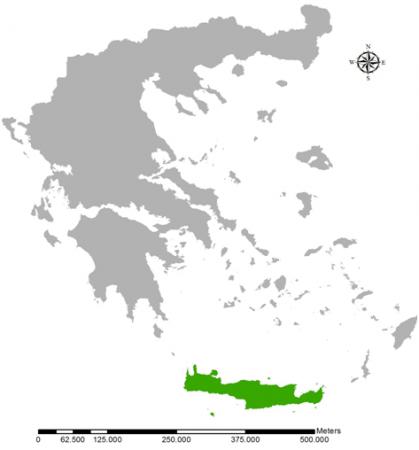 |
Figure 1. Location of Crete within Greece. Source: (Author C. Kosmas) |
The ‘grazing areas’ of Greece (Figure 2) are covered on average by grass (32 percent); shrubs (15 percent); shrubs and forest with grass under storey (27 percent); and forest with grass under storey (26 percent) (Zervas 1998). According to this classification, 58 percent of this area is suitable for sheep and cattle grazing, while the remaining 42 percent is better suited to goat species. Grasslands in Greece are composed mainly of annual species (Zervas 1998). Pastures comprise a diversity of plant species, which is sustained by high grazing pressure for relatively short periods. Species counts are high, although there is considerable variation depending on soil fertility and grazing pressure. Swards may include species such as Avena sativa, Festuca arundinacaea, Trifolium spp., Hordeum spp., Medicago hispida, Vicia spp., and less commonly species such as Bromus catharicus, Dactylon cynodon, Dactylis glomerata, Haynaldia villosa and Securigera securodata. Wooded pastures dominated by shrubs and trees may include species such as OIea sp., Pistacia lentiscus, Arbutus undero, Quercus spp., Phillyra spp.,and Medicago arborea.
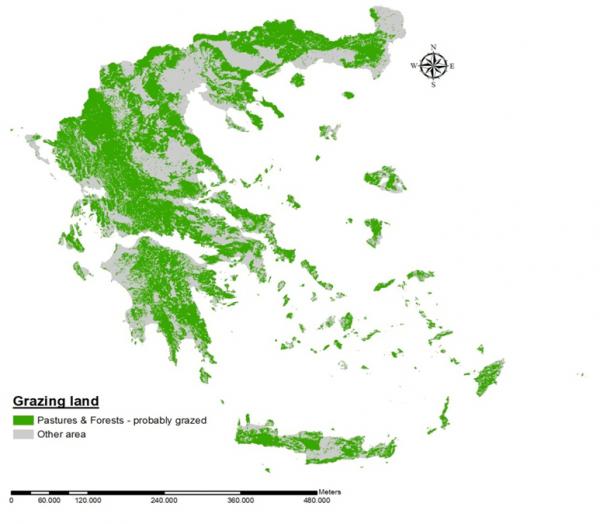 |
Figure 2. Grazing land distribution in Greece (including forests which are mainly grazed). Source: (CORINE 2000 data) |
Concerning land tenure, 83 percent of grazing land is state-owned or communal, and only 7.5 percent is under private ownership (Natsis 1985). Furthermore, 80 percent of forests are grazed annually, while the rest of the land (20 percent) is under protection from grazing. Dense high forests are not considered as grazing land although they may also be used for grazing (Papanastasis and Kontsiotou 1994). Of the total agricultural production of Greece, 70.3 percent derives from crop production and the remaining 29.7 percent from livestock production (Kaldis and Galanopoulos 2002).
Grazing land is found in all climatic zones in Greece, despite conditions being characterized as unfavorable for high grass production. The long duration of drought in the summer and low winter temperatures restrict plant growth. Therefore, natural pastures can be used for grazing for a short period during winter, spring or autumn but never throughout the whole year. Pastures are found in the following areas and climatic zones of Greece:
- The mountainous, alpine climate zone. This includes the Pindos mountain chain which, running in a NNW-SSE direction, separates the country into two parts with different climatic characteristics, especially regarding rainfall.
- The continental zone of north Greece including the mainland of Epirus, Macedonia, Thrace, and a large part of Thessaly, which has a climate changing gradually from characteristic Mediterranean to the colder climate of central Europe.
- The marine Mediterranean Ionian zone including the coastal regions of western Greece and the Ionian islands.
- The Mediterranean mainland zone including the southeastern part of Greece (Aegean) up to Thessaly and the Aegean islands. The climate of this region is similar to the marine Mediterranean but with lower winter temperatures and longer summer droughts.
The amount of rainfall ranges (from 780 to 1,280 mm per year) in the western part of Greece, this amount being reduced by about half in the eastern part, ranging from 380 to 640 mm per year. As far as temperature is concerned, grazing land is found between the isotherms of 14.5°C and 19.5°C. During the cold period, temperatures increase with decreasing latitude, whereas in the warm period, and especially between May and August, temperature increases from the coast to the mainland and particularly on the plains.
Grazing land in Greece is found on a wide variety of soils, usually too poor to support adequate biomass production. Soils on the lowlands are usually deep (depth >150 cm), well drained, medium to fine-textured, free of or rich in carbonates, with low organic matter content (usually lower than 2.8 percent in the surface horizon), formed mainly on alluvial deposits, and classified as Fluvisols, Cambisols and Luvisols. Soils in sloping areas are usually shallow (depth 10-50 cm), well drained, medium to fine-textured, low or rich in carbonates (depending on parent material), low in organic matter content (lower than 1.8 percent), formed mainly on marl, shale, conglomerates, limestone, flysch, and classified as Cambisols, Regosols, and Luvisols. Limestone is one of the main parent materials on which pastures exist with a high degree of soil degradation. Flysch is another important parent material on which soils have higher productivity than soils formed on limestone. Concerning topography, grazing lands are found in a variety of physiographic conditions. In most cases they are located on moderately sloping (6-12 percent), strongly sloping (12-18 percent), steep (18-35 percent) and on very steeply sloping (>35 percent) areas. Slopes are usually greater in the upper zone (altitude >800 m).
The ruminant production system, dominated by sheep and goats, may be intensive or extensive. The intensive system is the most common for cattle with more than 80 percent of the total raised in barns or sheds, the rest left out to graze. In the case of sheep and goats, three main pastoral systems exist (Papanastasis 1990):
- Domestic or house system where a few animals per family are kept in barns to produce milk and meat. Feeding is with hay and concentrates the whole year round.
- Village or flock system in which animals are put out to graze on rangelands during the day and brought in overnight.
- Transhumance or nomadic system, with migration between lowlands in winter and highlands in summer.
Village and transhumance systems are the most common in Greece and are classified as extensive. Transhumance grazing systems operate at a variety of spatial and temporal scales and degrees of complexity. Animals may be moved daily from hills to valleys, or seasonally to the mountains for summer grazing. The high stocking rates, pastoral techniques and frequent fires have led to a significant decline of pasture quality and productivity, and an increase in the proportion of unpalatable plant species.
Grazing land in the lower zone is mainly used during the winter period or throughout the year. As a result of relatively favorable air temperatures, grass production is mainly dependent on rainfall. Grass production is greater in spring than in autumn but, due to lack of water, plants dry quickly and animals move to upper elevations. Pastures in the middle zone (600-800 m) are grazed mainly by goats throughout the whole year. Grass production in the middle zone is especially high during spring, while grazing can be limited for some periods during winter due to the presence of snow. Grazing land in the upper altitude zone receives large numbers of animals during the summer period, but is usually under-grazed due to a lack of infrastructure (roads and drinking water for the animals).
Grazing land is widespread throughout the island of Crete, covering 166,404 ha or 20.1 percent of the total area (CORINE 2000) (Figure 3). Grazing land in Crete is mainly found in hilly and mountainous areas under a variety of climatic and soil conditions. The long duration of drought in summer and the low temperatures prevailing during winter restricts plant growth. Therefore, natural pastures can be used for grazing for short periods during winter, spring or autumn but are not suitable for year-round grazing. Soils are usually shallow, formed mainly on limetone, marl, shale and flysch parent material, and are highly degraded due to soil erosion.
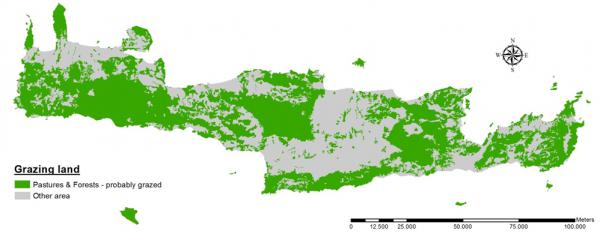 |
Figure 3. Geographical distribution of natural pastures in Crete study site. Source: (CORINE 2000 data) |
The number of sheep and goats on the island has almost doubled in the last three decades (Figures 4 and 5), while the number of cows has decreased (Greek Agricultural Statistical Service 2001). Livestock husbandry is a traditional activity which has shaped the mountains of Crete since the Neolithic period (Lyrintzis and Papanastasis 1995). However, in the last few decades the number of grazing animals has increased dramatically, mainly due to EU subsidies since 1981, when Greece became a member of the European Union. Based on national statistics (Greek Agricultural Statistical Service 2001), the numbers of sheep have increased five-fold and the number of goats doubled between 1961 and 1991. These high numbers have resulted in average stocking rates of 4.6 sheep-equivalents/ha/year (Menjli 1994), which is at least four times higher than the grazing capacity of rangelands (Papanastasis et al. 1990).
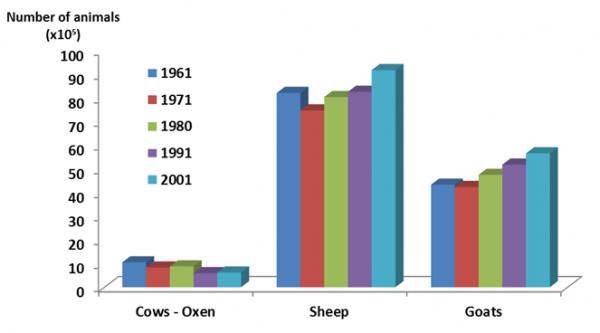 |
Figure 4. Change in animal populations in Greece during the last decades. Source: (Greek Agricultural Statistical Service 2001) |
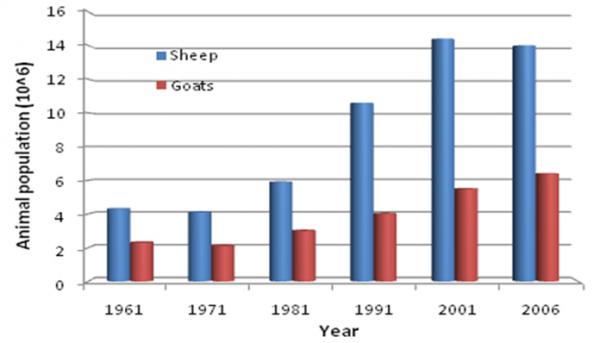 |
Figure 5. Change in animal population in Crete during the last decades. Source: (Greek Agricultural Statistical Service 2001) |
Shepherds periodically damage the natural vegetation deliberately by setting fires to eradicate the woody vegetation and encourage the growth of palatable grass, which is then overgrazed. The occurrence of a fire may temporarily increase the productivity of the land. After fire some species regenerate rapidly, creating favorable conditions for grazing. Studies conducted in eastern Crete have shown that the number of plant species, herbs and grasses, almost doubled after fire, while the number of shrubs and trees decreased. The first year after fire was very crucial for erosion, as the soil was relatively bare (Grove and Rackham 1996).