
Forests & shrubland
Characteristics of forests & shrubland: general
Editor's note: Text extracted from D311-2.1
Forests ecosystems and shrublands represent one of the most important terrestrial biomes in terms of distribution and also in terms of goods, services and benefits they provide to humankind. Forest ecosystem services derive directly or indirectly from a wide range of functions related to the biogeochemical processes and physical properties of forest and shrubland systems (FAO 2010a). Increasing demand for forest resources generated by socio-economic development includes not only energy and wood demand, but also land for agriculture and grazing. As a result, forest resources are often overexploited and/or mismanaged and, eventually, suffer land and ecosystem degradation.
According to the Global Forest Resources Assessment (FAO 2005), forests currently cover about 3.9 Gha worldwide, or 30 percent of total land area. The forest area is unevenly distributed worldwide, with 52 percent of forests in low latitudes (approximately 0-25° N and S latitude), 30 percent in high latitudes (approximately 50-75° N and S latitude), and 18 percent in mid-latitudes (approximately 25-50° N and S latitude). Based on a sub-regional summary of the distribution of forests, Europe and Russian Federation accounts for one-quarter of total forest area (5 percent and 20 percent respectively), followed by South America (21 percent) and North and Central America (18 percent). Other wooded land distributed worldwide is estimated to be at least 1.3 Gha, representing about one-third of total forest area (Figure 1).
 |
Figure 1. The world’s forests. Source: (FAO 2005. |
The worldwide forest status can be represented by four main categories (Figure 2, Global Forest Resources Assessment FAO 2005):
- Primary forest, in which there are no clearly visible indications of human activity and ecological processes are not significantly disturbed (36 percent of total forest area).
- Natural forests consisting of naturally regenerated native species in which there are clearly visible indications of human activity (53 percent).
- Semi-natural forests, comprising native species, and established through planting, seeding or assisted natural regeneration (7 percent).
- Forest plantations, representing forests of introduced species and in some cases native species, established through planting or seeding (4 percent): a. Productive forest plantations (3 percent); b. Protective forest plantations (0.8 percent).
Within the other wooded land, 69 percent is classified as modified natural, 28 percent as primary and the remaining 3 percent as semi-natural.
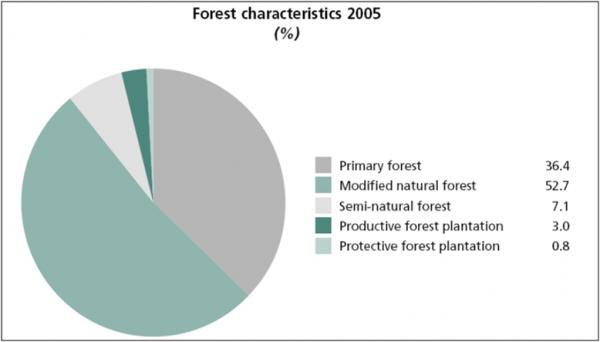 |
Figure 2. Forest Characteristics. Source: (FAO 2005) |
Forests provide a wide range of ecosystem services that contribute significantly to the overall economic and social development of humankind. Forest ecosystems and shrublands have, in most cases, a high or very high level of complexity that directly impacts on their ability to simultaneously provide multiple and differentiated ecosystem services and, consequently, raises the need to adopt proper and efficient management methods, especially in the perspective of their high social, economic and ecological importance (Daily 2000; Kremen 2005). The management complexity of forest ecosystems and shrublands is mainly due to:
- the high number of ecosystem services (i.e. higher than agricultural or simplified pastoral systems);
- the diversity of ecosystem services (i.e. regulating, supporting, production, cultural);
- the types of ecosystem services ((i.e. direct, indirect, tangible and intangible) (Gee and Burkhard 2010));
- the scale of influence (i.e. from site-specific to global);
- the interdependence and interrelationship among forest ecosystem services and other types of ecosystems.
The range and importance of forest ecosystem services are also diverse and primarily depend on the biophysical and socio-economic setting. The lack of an efficient system for forest service valuation and its inclusion in national economic accounting is responsible for the poor recognition of their overall contribution (Croitoru 2007). The most important forest ecosystem services are: conservation of biodiversity; protection of watersheds and regulation of hydrological cycles (Pinto et al. 2010); mitigation of desertification and land degradation processes; and regulation of biogeochemical cycles through carbon sequestration and storage. For these reasons, forest ecosystem complexity needs to be preserved through proper and efficient forest management, to improve the contribution of forest services to social, economic and ecological cohesion as fundamental components of human well-being ((MEA 2005) Figure 3).
 |
Figure 3. Linkage between Ecosystem Services and Human Well-being. Source: (MEA 2005:28) |
For forest and shrubland ecosystems in particular, it is possible to define the ecosystem services reported in Table 1, both by type, scale (MEA 2005; De Groot et al. 2010; Vihervaara et al. 2010; Pinto et al. 2010; Petrosillo et al. 2010; Yapp et al. 2010) and principal dimension of interest (Pinto et al. 2010; Gios and Clauser 2009).
Table 1. Main ecosystem services as functions of services type, dimension of interest and scale
| Service | Type | Principal dimension of interest | Scale |
| Regulating | Climate and microclimate regulation Carbon sequestration Pollination Water regulation (flood control/prevention) Drought mitigation Soil erosion protection/prevention Natural hazards mitigation |
ecological ecological - econ. ecological ecol. - econ. - social ecological ecol. - econ. - social ecological - social |
local - global regional - global local local - regional local - regional local local - global |
| Supporting | Disturbance regulation/mediate (includes human disturbances and natural hazards mitigation) Soil fertility recovery/generation Waste treatment (Detoxification and decomposition of wastes) Purification/control of water and air Biological regulation and pest control (bioremediation) Nursery habitat; Support critical life cycle requirements and provide structural and nutritional niches (photosynthesis) Biodiversity conservation Wildlife protection Water supply and water quality Employment support |
ecological ecological - econ. ecological - econ. ecological - econ. econ. - ecological ecological ecological ecological econ. ecological econ. |
local – regional local local - regional local - regional local - regional local local - regional local - regional local - regional local |
| Provisioning | Timber products (raw materials), Non-Wood Forest Products (NWFPs) Fibre Renewable energy, fuel Food (nuts, mushrooms, fruits, honey, spices, herbs, flavourings,) Biochemical products (plant and animal products with medicinal value.) Pasture (fodder for cattle, sheep and swine) Genetic resources |
econ. - ecological econ. - ecological econ. - ecological econ. - ecological econ. - ecological econ. - ecological ecological |
local local local local local local local - regional |
| Cultural | Cultural and diversity, sense of place and identity, knowledge systems and cultural heritage values Educational values Cognitive and spiritual services, inspiration and aesthetic values Social relations Recreation and ecotourism |
social social - econ. social social - econ. social |
local - global local - global local - global local - regional local - regional |
Source: (Adapted from De Groot et al. 2010; Gios and Clauser 2009; MEA 2005; Petrosillo et al. 2010; Pinto et al. 2010; Vihervaara et al. 2010; Yapp et al 2010).
Table 1 highlights the high level of diversity in type and scale of forest ecosystem services and the complexity of forest ecosystem functions. This complexity is a function of the distribution of forests globally, with different types of services related to climate, forest type, social and economic assets. On a global scale, forests affect climate through biophysical properties such as albedo, which controls the amount of incoming solar radiation that is reflected back to the atmosphere, regulating the amount absorbed and converted to heat (Ollinger et al. 2008; Lohila 2010). Forests have lower albedo in comparison to grassland, desert or ice and snow cover (Table 2 and Figure 4), absorbing most of the incoming solar and infra-red radiation. Some of this energy is used by the trees for photosynthesis but a greater part is released as 'sensible heat', creating a warming effect and raising the atmospheric temperature (Bala et al. 2007; Bonan 2008). In the Mediterranean environment, forest ecosystem services are mainly related to regulating functions such as climate and microclimate regulation, biogeochemical cycles (carbon and water), drought mitigation, soil erosion protection and prevention, and land degradation and desertification prevention (Croitoru 2007; Petrosillo et al. 2010). In particular, these ecosystem services are related to soil protection from wind erosion, coastal protection from shoreline erosion and crop protection from salt-spray and aerosols.
Table 2. Radiation-weighted annual means of surface albedo of vegetation types in the Northern Hemisphere (1991-2000).
| Dominant vegetation type | Annual albedo |
| Tropical evergreen forest Tropical deciduous forest Temperate evergreen broadleaf forest Temperate evergreen conifer forest Temperate deciduous forest Boreal evergreen forest Boreal deciduous forest Mixed forest Savanna Grassland Dense Shrubland Open Shrubland Tundra Desert Land Ice |
0.09 0.11 0.11 0.10 0.13 0.18 0.20 0.16 0.13 0.19 0.15 0.21 0.38 0.24 0.52 |
Source: (Bala et al. 2007).
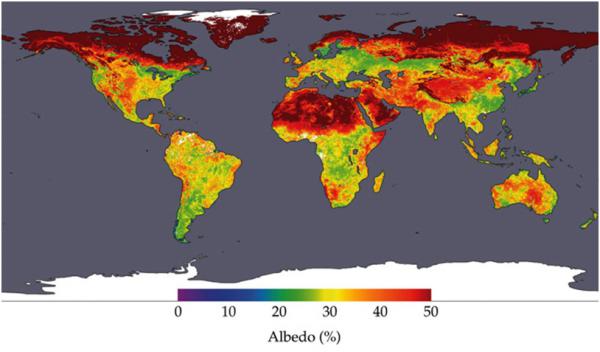 |
Figure 4. Albedo of the Earth's terrestrial surface as measured by the TERRA satellite. Data collected from the period April 7-22, 2002. Source: (NASA Earth Observatory. Available online at: http://earthobservatory.nasa.gov/IOTD/view.php?id=2599). |
Forests also play a very significant role in regulating the global carbon cycle, which affects global climate change. In particular, forests absorb atmospheric carbon dioxide during photosynthesis, storing carbon in wood, leaves, roots and soil, representing above and below-ground biomass. In this way, forests represent a carbon sink in the global carbon cycle. At the same time, forests release carbon dioxide to the atmosphere through respiration and organic matter oxidation processes, as well as through the deliberate or unintended results of human activities (i.e. harvesting, fires, deforestation), representing a carbon source. The contribution of forests to carbon cycles must be evaluated, taking into account the use of harvested wood, e.g. wood products storing carbon for a certain period of time, or energy generation releasing carbon in the atmosphere. In cases the net balance of carbon emissions by forests is negative, i.e. carbon sequestration prevails, forests contribute to mitigating carbon emissions by acting as a carbon sink to sequester additional carbon. In cases where the net balance of carbon emissions is positive, forests contribute to the greenhouse phenomenon and climate change.
The role of forests in regulating the global carbon cycle is affected by both changing climatic conditions and human activities. Changes in rainfall and temperature can have either damaging or beneficial impacts on forest health and productivity, which are very complex to predict. Depending on the circumstances, climate change may produce a shift of forest cover towards higher elevations and latitudes and will either reduce or increase carbon sequestration into forests, which causes uncertainty about the extent to which the world’s forests can contribute to climate change mitigation in the long term. Forest management activities have the potential to influence carbon sequestration by stimulating certain processes like forest regeneration or expansion and forest productivity and mitigating the impacts of negative factors (Nabuurs et al. 2007).
Another important ecosystem service provided by forests is the protection and regulation of water resources through the reduction of surface erosion and sedimentation; moderation of floods; enhancing precipitation (e.g. ‘cloud forests’) and mitigating salinity. Forests also provide protection from natural hazards such as snow avalanches and landslides. Other relevant ecosystem services of Mediterranean forests and shrublands in particular include supporting functions such as biodiversity conservation, genetic resources, wildlife protection, water supply and water quality by filtering water pollutants and regulating water yield and flow (Chazdon 2008).
On a local scale, forest and shrubland ecosystem services provide provisioning services, due to their capacity to produce a wide range of wood and Non-Wood Forest Products (NWFPs), such as timber products, renewable energy, food (berries, mushrooms, edible plants, bushmeat) and pasture. These services provide employment opportunities in the processing and trade of forest products and energy. Finally, forest and shrubland ecosystem services also include cultural services as forests create sites and landscapes of high cultural, spiritual or recreational value.
One of the key factors which influence conservation of forest ecosystem complexity and of related ecosystem services is the forest management system (De Groot 2010).A simple change in forest management or land use may lead to a significant change in the supply of ecosystem services.
The economic benefits derived from forests are usually measured in monetary terms and include: income from employment in the forest sector; the value of forest goods and services; the contribution of the forest sector to the national economy; energy supplies and international trade. In this case, the economic benefits of the forest sector can be assessed by measuring the profitability of forest enterprises, or levels of investment.
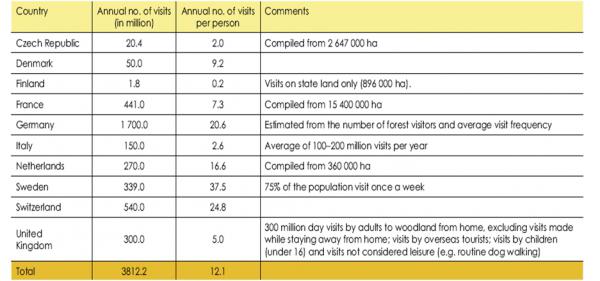
The social benefits of forests are often more difficult to measure and can vary considerably among countries, depending on their level of development and their forest use traditions. For example, at the global level, almost 4 percent of forests are managed primarily for recreation, education, tourism and other social services. In most cases, touristic and recreational functions are more developed and managed in Europe and North America. According to the National Visitor Use Monitoring Results of the USDA Forest Service (2009), in the period from 2005 to 2009 about 170 million people visited US National Forests System and Wilderness for tourism or recreational purposes. At the European level, the number of annual of visits is estimated to be much higher than North America, as shown in Table 3.
Table 3. Estimated number of forest visits in European countries.
Source: (MCPFE 2007).