
Cropland
LEDD issues in cropland: general
Authors: Constantinos Kosmas, Katerina Kounalaki, Mina KaramesoutiEditor's note 30 Apr 2012: Text source D111, section 3.1.
Although LEDD issues are primarily environmental problems, they generate associated socio-economic consequences. The LEDD issues in cropland that are examined in this deliverable are presented in Table 1 below. The table distinguishes between the environmental and the socio-economic aspects of these issues which are manifested at all spatial levels (global, national, regional, local).
Table 1. LEDD issues in cropland
| Type of Issue | LEDD Issue |
| Environmental issues | Soil erosion Soil organic matter decline Loss of biodiversity Ecosystem fragmentation Soil compaction Soil salinisation Soil crusting Water quality decline Flooding Landslides Soil contamination Soil sealing Land desertification Land and ecosystem fragmentation Increased incidence of fires Productivity decline Water stress |
| Socio-economic issues | Rural depopulation Land use change Loss of traditional knowledge Poverty Unemployment Loss of social cohesion Land abandonment Decline in property values Farm and land fragmentation |
Source: LEDDRA Study Site Application Plan 2011
Cropland worldwide is facing various LEDD issues related to the demands for: (a) increasing food and biomass production for a growing world population; (b) adaptations to climate change; (c) expansion of urban areas; and (d) over-exploitation of land resources. These issues lead to various degradation processes such as soil erosion, soil compaction, soil salinisation, soil contamination, organic matter decline, and soil sealing (Albaladejo 1990).
Agricultural production per unit area has increased substantially over the last few decades due to irrigation, fertilization, mechanisation and modern varieties of crops with higher yields and stronger resistance to pests and diseases. Intensive agricultural production, however, affects land degradation by causing heavy metal contamination, soil organic matter decline, soil erosion and soil salinisation amongst other issues. Land degradation and desertification are reducing the available land area for agricultural production (Bullock and Houerou 1996). At present, soil erosion has resulted in a loss of croplands at about 0.06 to 0.07 x10⁶ km2 per year, and soil salinisation has already affected up to 8 percent (0.2x10⁶ km2) of the 2.53x10⁶ km2 of currently irrigated croplands (World Resource Institute 1992). In the last decades, intensification of agriculture coupled with mismanagement has led to soil erosion rates which are faster than the rate of soil formation. Once this threshold is crossed, the inherent fertility and water storage capacity of the land begins to fall, adversely affecting crop production. Furthermore, the expansion and mismanagement of cropland has resulted in the advance of deserts in Africa both north and south of the Sahara and throughout the Middle East, the Central Asian republics, and western and northern China (Brown 2005), further reducing the available cropland area.
Soil erosion
Soil erosion remains the world's biggest environmental problem, threatening both developed and developing countries (Figure 1 below). It is a widespread problem throughout Europe, Asia, Africa, and America. Soil erosion on cropland ranges from about 13 tons per hectare per year (tonnes/ha/year) in the US to 40 tonnes/ha/year in China (Pimentel and Wen 2004). Worldwide, topsoil erosion averages 30 to 40 tonnes/ha/year, or 30 to 40 times faster than the replacement rate of topsoil (Pimentel 2006). Between 1945 and 1990, an estimated 20 million km2 of agricultural land (almost 18 percent of the earth's vegetated land) has been degraded as a result of human activity. Of these, an estimated 12 million km2 (almost 11 percent of the earth's vegetated land) has been moderately or strongly degraded. Soil erosion has caused abandonment of 4.3 million km2 of arable land during the last four decades (World Watch Institute 1990; World Resources Institute 1990).
Soil erosion occurs naturally due to the interaction of the atmosphere and the water cycle with land surfaces. Although the future distribution and intensity of natural erosion processes may be affected by climate change, leading to land degradation, accelerated erosion due to unsuitable land uses and land management practices is the main LEDD issue in sloping areas. Factors mainly responsible for accelerated soil erosion are clearance of forests for expansion of agriculture, changes in plant cover due to intensive cultivation, over-grazing, controlled burning or wildfires, levelling of the land surface, ploughing of soil mainly in directions perpendicular to the contour lines, poor maintenance of terracing land and cultivation of steep slopes.
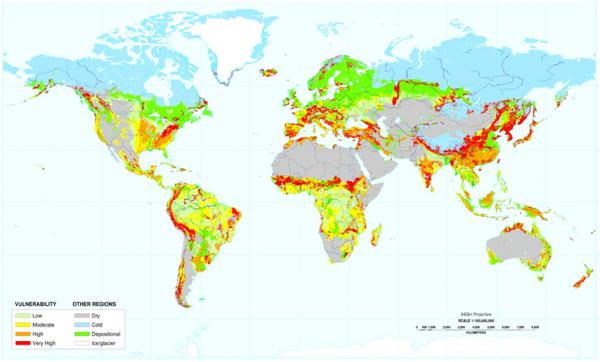 |
Figure 1. Global water erosion vulnerability. Source: (United States Department of Agriculture, Natural Resources Service 1999). |
Land degradation and desertification due to soil erosion is a serious threat to soil quality and productivity. The effects of soil erosion on productivity depend largely on the thickness and quality of the topsoil and on the nature of the subsoil (Acton and Padbury 1993). Productivity of deep soils with thick topsoil and excellent subsoil properties may be virtually unaffected by erosion. However, most hilly soils are shallow or have some undesirable properties in the subsoil such as cemented horizons, or bedrock that adversely affects yields. In either case, productivity decreases as the topsoil gets thinner and undesirable subsoil is mixed into the Ap-horizon by tillage, or as water-storage capacity and effective rooting depth decrease. Several authors (Frymire 1980; Hipple 1981; Kosmas et al. 1993) have found a significant positive correlation between topsoil depth and wheat production, noting that this relationship was largely influenced by slope position on the landscape.
Many studies have shown that soil erosion in sloping areas is attributed to vegetation cover and land use management changes (Patton and Schumm 1975; Bryan and Campbell 1986). Many authors have demonstrated that in a wide range of environments both runoff and sediment loss decrease exponentially as the percentage of vegetation cover increases (Elwell and Stocking 1976; Lee and Skogerboe 1985; Francis and Thornes 1990). Vegetation and land use are clearly important factors controlling the intensity and frequency of overland flow and surface wash erosion (Bryan and Campbell 1986; Mitchell 1990). Extensive Mediterranean areas cultivated with rain-fed crops such as cereals, vines and almonds mainly expand into hilly areas with relatively deep or shallow soils, and which are very sensitive to erosion. Kosmas et al (1997) has graded the different types of land use under Mediterranean conditions in order of decreasing effect on soil erosion as follows: vines, eucalyptus, winter wheat, shrubland and olives under semi-natural conditions (Figure 2 below).
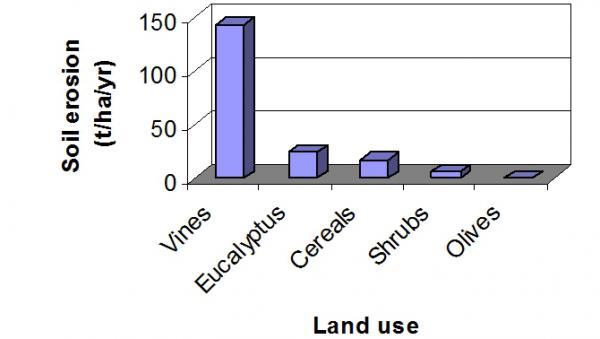 |
Figure 2. Average annual soil erosion rates measured in various land uses along the Mediterranean Europe. Source: (Kosmas et al. 1997) |
Rain-fed cereals, and particularly wheat and barley, which cover the largest parts of the Mediterranean uplands, present serious threats of soil erosion from late October to early January when soils are only partially covered by growing plants. Repeated cultivation of soils, associated with continuously burning plant residues, has favoured soil crusting and overland water flow. Measurements conducted during the implementation of the MEDALUS projects in areas cultivated with cereals have shown that in areas with total precipitation of less than 280mm, sediment loss was not a threat. Sediment loss increased with increasing rainfall and may fluctuate generally between 15 and 90tkm-² per year, in the range of 280mm to 700mm rain per year (Kosmas et al. 1997). Inbar (1992) reported values of 20t km-² yr-¹ for the Catalunya (Spain) area with annual precipitation of 600-700mm which lack behind the values measured in wheat fields in wet years.
Vineyards under existing land management practices remain almost bare during the winter period, creating favourable conditions for overland water flow and sediment loss. Repeated cultivation of vineyards, associated with other management practices (application of herbicides and pesticides) resulted in decreased organic matter content and aggregate stability favouring soil crusting, overland flow and erosion. Soil compaction is also another form of soil degradation resulting from heavy machinery used in vine-cropping. Measurements on soil erosion conducted in vineyards along the Mediterranean have shown that sediment loss ranged from 67t km-² yr-¹ to 460t km-² yr-¹. These values greatly exceed those measured in fields cultivated with wheat (Kosmas et al. 1997). Therefore, vines in hilly areas in the Mediterranean region promote high erosion rates and desertification risk is high.
Olives are another type of land use widely expanded in hilly areas of the Mediterranean region. Olives are particularly adapted to Mediterranean climatic conditions. Contrary to perennial crops lacking under storey vegetation, the lowest rates of runoff and sediment loss should be expected under olive groves grown under semi-natural conditions. Under this land use, annual vegetation and plant residues have a high soil surface cover (Figure 2), occasionally up to 90 percent, so preventing surface sealing and minimising the velocity of the runoff water. Sediment losses measured in Greece were lower than 5.3t km-² yr-¹. The presence of annual vegetation and plant residues on the soil surface are responsible for the drastic reduction of soil loss, even to nil values. Therefore, olives can greatly protect Mediterranean uplands from further degradation and desertification.
Soil erosion generated by surface water runoff is one form of soil loss affecting land degradation, another is soil erosion caused by tillage implements and this has greatly contributed to land degradation. Tillage erosion has contributed to a progressive down slope translocation of soil exposing light-coloured subsoil materials on the soil surface in the upper parts of a hillslope, dispersing rock fragments over larger areas, reducing soil water holding capacity, and plant productivity (Poesen and Lavee 1994; Govers et al. 1994; Poesen 1995; Lobb 1997; Thapa et al. 1999). The availability of heavy, powerful machinery in previous decades has favoured deep soil ploughing with high speeds in directions usually perpendicular to the contour lines. This has resulted in the displacement of large amounts of soil materials from the upper convex parts (summit, shoulder, backslope) of a hillslope to the concave parts (footslope, toeslope) and decreased significantly the production of various crops on the convex positions, especially on soils with subsurface limiting layers. Lindstrom et al. (1992) have estimated an annual soil loss of approximately 30tha-¹, after simulating moldboard ploughing for a period of 8 years. Soil erosion data measured in areas cultivated with cereals in Greece has clearly shown that water erosion was responsible for the loss of a few millimetres (1-3) of soil per year or even less (Kosmas et al. 1997), while the estimated total annual loss of soil due to tillage in the same areas ranged from 4-16mm per year (Tsara et al. 2001).
Soil salinisation
According to the FAO (Land and Plant Nutrition Management Service), over six percent of the world's land is affected by salts. Salt-affected soils cover over 400 million hectares. Much of the world’s land is not cultivated, but a significant proportion of cultivated land is salt-affected (Table 2 below). Of the current 230 million ha of irrigated land, 45 million ha are salt-affected (19.5 percent) and of the 1,500 million ha under dryland agriculture, 32 million are salt-affected to varying degrees (2.1 percent). Salinity is a major problem in semi-arid and arid zones (Bot et al. 2000). Salinity is a problem in irrigated areas with poor drainage. It is estimated that at least 20 percent of all irrigated lands are salt-affected. Salinity costs global agriculture an estimated 12 billion dollars a year – a figure that is increasing.
Table 2. Regional distribution of salt-affected soils, in million hectares
| Regions | Total area (Mha) | Salt-affected soils | |
| Area (Mha) | Area (%) | ||
| Africa | 1,899 | 73 | 3.8 |
| Asia, the Pacific and Australia | 3,107 | 444 | 14.3 |
| Europe | 2,011 | 80 | 3.9 |
| Latin America | 2,039 | 112 | 5.5 |
| Near East |
1,802 | 106 | 5.9 |
| North America | 1,924 | 20 | 1.0 |
| Total |
12,781 | 831 | 6.7 |
Source: (FAO Land and Plant Nutrition Management Service 2007)
In the last four decades, favourable soil and climatic conditions and the availability of ground or surface water has resulted in intensive farming of the lowlands of the Mediterranean. Furthermore, the development of fast and cheap transportation has encouraged the expansion of domestic and international mass tourism especially in the Mediterranean region. Tourism development has affected the physical environment, land-use patterns and the allocation of water resources. The high demands of water for human consumption have caused water allocation problems, over-exploitation of aquifers and increases in the price of water, forcing the use of water of low quality for irrigation. Soil salinisation and the related threat of sodification have mainly affected areas with semi-arid, arid and dry sub-humid climatic conditions. The accumulation of salts in the soils occurs naturally when there is a net upward movement of water to the soil surface due to high evapotranspiration rates, as well as when irrigation is poorly managed and/or depends on poor quality water.
The three main processes which have caused soil salinisation are: (1) Rising ground water table close to the soil surface; (2) excessive use of water for irrigation in dry climates with clayey soils, and (3) intrusion of saltwater into aquifers when water enrichment of aquifers is lower than water use. In areas with Mediterranean climatic conditions, where evaporation exceeds rainfall, there is a potential for the accumulation of soluble salts. According to expert assessments about 25 percent of Mediterranean irrigated lands face severe problems of salinity/alkalinity and each day many thousands of hectares would be affected by salts due to poor-quality irrigation water, improper irrigation practices and climate change (Bellino and Varallay 2004; EEA 2003).
Generally, plant productivity is not affected by low salt concentration, but above a certain concentration, depending on the plant species, productivity is drastically reduced. High concentrations of salts such as sodium chloride, magnesium and calcium sulphates, and bicarbonates affect plant growth both directly, for their toxicity, and indirectly, by increasing osmotic potential and lowering root water uptake. Under dry climatic conditions, continuous salt accumulation has led to land desertification, especially in low lands with poorly drained soils. Furthermore, land management practices, such as extensive use of heavy amounts of fertilizers or the use of heavy cultivation machinery, which reduce the quality of soil drainage, have contributed to increasing salt concentrations adversely affecting plant growth.
Soil contamination
Anthropogenic contamination of soils includes a wide range of contaminants, from atmospheric deposition, industrial activities and vehicle traffic to waste spreading, application of fertilizers and pesticides. Higher levels of some heavy metals have been shown to affect soil biota and therefore potentially soil system functioning. In general, soil contamination presents a problem that can affect water resources, food production, above-ground biodiversity, and human health.
Since World War II, there has been a rapid increase in the use of synthetic organic chemicals for the control of weeds, insects, and other pests, contributing significantly towards the increase in global food production. It has also been recognised that the use of chemicals for pest control is a cost as well as being an effective measure. Agricultural systems and agronomic practices in Europe have been the subject of major changes, particularly in the last 30-40 years, leading to even greater dependence on chemical inputs. Land degradation problems such as soil erosion (Kosmas et al. 1997), soil organic matter decline and surface water eutrophication are posing serious threats to the sustainability of modern agricultural systems (Francis and Thornes 1990). Tillage operations present a serious threat to soil erosion in sloping areas (Tsara et al. 2001). The use of herbicides facilitates the practice of minimum-tillage or no-till, which, together with crop rotations, probably contributes to environmental protection through reduction of soil erosion and runoff losses of nutrients and other contaminants (Kookana et al. 2006).
Organic matter decline
In terrestrial ecosystems the amount of carbon in soil is usually greater than the amount in living vegetation (Post and Kwon 2000). Various land-uses result in very rapid declines in soil organic matter (Davidson and Ackerman 1993; Post and Mann 1990). Much of this loss in soil organic carbon can be attributed to reduced inputs of organic matter, increased decomposability of crop residues, and tillage effects that decrease the amount of physical protection to decomposition. Recent trends in land use and climate change have resulted in soil organic carbon loss at a rate equivalent to 10 percent of the total fossil fuel emissions for Europe as a whole. In general, soils with low organic carbon content can be found in warm, dry climates and soils with a higher organic carbon content can be found in colder, wetter climates. Almost half of European soils have low organic matter content, principally in southern Europe but also in areas of France, the United Kingdom and Germany.
Soil organic matter plays important role in maintaining key soil functions. It affects physical properties such as soil aggregate stability, water absorption, soil erodibility, as well as chemical properties related to plant nutrient availability and accumulation of contaminants (Reeves 1997). Decline of organic matter content constitutes a component in land degradation. The equilibrium of organic matter content in the soil is strongly influenced by climate, soil water regime as well as texture and land management practices such as tillage. The amount of organic matter content of soil reflects a dynamic equilibrium between input rates of plant residues and rate of organic matter decomposition by the soil biota. The strategic role of soil organic carbon in reducing atmospheric CO2 concentrations was recognised in Article 3.4 of the Kyoto Protocol of the United Nations Framework Convention on Climate Change.
Apart from climatic factors (mainly temperature), the main processes responsible for loss of soil carbon are soil erosion and mineralisation of organic matter. Leaching of dissolved organic and inorganic carbon is another important mechanism of loss of carbon from the soil in cropland. Exact evaluation of this C pool is difficult because of heterogeneity in time and space. The global loss by erosion could be in the range of 150 to 1500 million tonnes per year, which is rather less than it was estimated at the continental level (Lal 1995). Methods used in the past for erosion control, such as land terracing, contour farming and increases in plant cover have also contributed to carbon sequestration.
Tillage operations have been conducted to increase aeration of the soil promoting mineralization of organic matter by soil micro-organisms. Tillage practices have caused a general decrease in organic matter in intensively cultivated soils, especially in Europe, and the important CO2 emissions linked to agriculture in the past. Carbon sequestration in cropland and a reduction in losses to the atmosphere are ways to meet emission reduction targets. Average global carbon sequestration rates, when changing land use from agriculture to forest or grassland, are estimated to be 33.8 and 33.2 gCm-² per year, respectively (Post and Kwon 2000).
The main land management practices proposed in the past to increase soil organic matter were conservation agriculture, involving minimum or zero tillage, continuous protective cover of living or dead vegetal material on the soil surface, application of biosolids (manure, crop residues, compost), cover and deep-rooting crops, land use change to grassland or woodland, fertilization and irrigation (Lal 2004). Furthermore, farmers used to burn plant residues instead to incorporate them into the soil, reducing drastically organic matter content and aggregate stability. Residue-burning had negative consequences on carbon sequestration, aggregate stability, and soil erosion rates.
Soil sealing
Soil sealing is characterised as the cover of soil by inert material, such as cover by infrastructure, roads and urban and industrial development. The term is also used to describe a change in the physical properties of the soil leading to impermeability to air and water (e.g. compaction by agricultural machinery). This degradation process leads to interruption of the interface between soil, the biosphere and the atmosphere, affecting water and gas cycles, energy flows between the pedosphere and atmosphere, and the geochemical cycle of nutrients (Burghardt et al. 2004). The most significant impact of soil sealing is the increase of surface water runoff, often leading to catastrophic flooding (Burghardt et al. 2004). The consequence of soil sealing is the formation of an artificial environment largely devoid of biological activity and associated ecosystems. The extent and intensity of soil sealing in areas of Europe is significant, particularly in urban coastal zones such as those in the Mediterranean, where there has been significant in-migration into urban coastal areas over the last few decades for work and as a result of tourism development (LACOAST ATLAS 2000).
Spatial planning strategies determine, to a great extent, the progression of soil sealing. Unfortunately, neither the economic, ecological or social impacts of soil loss due to soli sealing have been considered adequately to date. In the meantime, as the EU has recognised, there is a clear need to include environmental concerns and objectives in spatial planning, in order to reduce the effects of uncontrolled urban expansion. Rational land-use planning is therefore critical; to enable the sustainable management of soil resources, and to limit the impact of soil sealing (Blum 1998).
Soil compaction
Compaction is a major problem in areas with high livestock population density and/or areas where cultivation is done using heavy machinery. Compaction due to livestock pressure is a severe problem in the Sahelian region, the Horn of Africa, Central Asia, north-eastern Australia, Pakistan, and Afghanistan (Nachtergaele et al. 2010). Compaction due to the use of heavy machinery is severe in the United States, Europe, South America, India and China (Nkonya et al. 2010).
Soil compaction is a process of land degradation and desertification in which the biological activity and the productivity of agro-ecosystems is reduced due to decreased air and water conductivity into the soil causing higher risk of soil erosion. Soil deforms in response to external forces arising from surface loadings and tillage. Higher forces may cause compaction when the pore structure is compressed and the functioning of the soil system to water and gas flow, as well as root extension, is impeded. Soil compaction has been enhanced in the last few decades due to the introduction of heavy machinery for cultivation with high speeds and ploughing the soil to depths greater than 30 cm (Figure 3). The pressure exerted on the soil is diffused across the whole volume causing reduction of soil porosity or increase in bulk density and disintegration of soil aggregates (Hillel 1980; Soane and Ouenwerkerk 1994). The pressure applied to the soil is positively related to the weight of the machinery, and negatively related to the area of contact of the soil with the tractor wheel, and the speed movement.
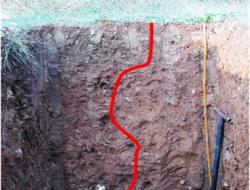 |
Figure 3. Change in soil porosity in sub-surface horizons due to soil compaction from cultivation machinery. Source: (Author, C. Kosmas) |
Soil compaction is a particular issue when machinery is used in wet conditions (Lawrance 1978). Changes in the physical properties of soils as a result of compaction affect plant growth, crop production, and movement of biota. Plant root length is restricted in compacted soils due to high resistance to penetration, therefore, nutrient and soil water absorption is reduced by the growing plants. Furthermore, increased soil compaction is associated with low rates of soil hydraulic conductivity, causing water ponding in flat areas of land or high surface water runoff in sloping lands.
Land desertification
The United Nations Convention to Combat Desertification (UNCCD) in 1994 defined desertification as “land degradation in arid, semi-arid and dry sub humid areas, resulting from various factors including climatic variations and human activities”. Although this definition does not clearly distinguish between desertification and land degradation, though it explicitly includes climatic conditions as a causative element, it is now widely regarded to be the authoritative definition of desertification. Desertification occurs in drylands, which cover a third of the earth’s land surface - over 110 countries (GEF-IFAD 2002). The estimates vary between four percent and 74 percent of drylands being affected (Safriel 2007). The USDA-Natural Resources Conservation Service (USDA-NRCS) has developed maps of ‘Global Desertification Tension Zones’ which depict areas vulnerable to desertification (Eswaran et al. 2001). Figure 4 highlights the growing problem of desertification worldwide. Desertification reduces the land’s resilience to natural variations in climate. It disrupts the natural cycle of water and nutrients. It intensifies strong winds and wildfires.
The principal desertification processes are degradation of the vegetative cover, accelerated water and wind erosion, salinisation and water-logging (Nkonya, et al. 2010). These processes affect major land uses in arid regions including irrigated agriculture, and rain-fed cropping. Rain-fed cropland desertification is commonly expressed as increased water and wind erosion. Salinisation and water-logging are the principal degradation processes on irrigated land.
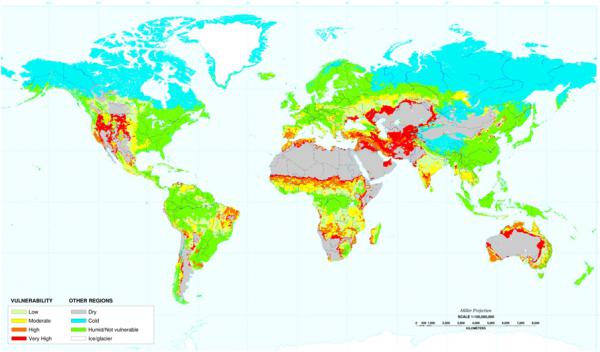 |
Figure 4. Global land desertification vulnerability. Source: (USDA- Natural Resources Service 1998) |
The effects of dust storms and the sedimentation of water bodies can be felt thousands of kilometres away from where the problems originated. Desertification is a threat to biodiversity. It can lead to prolonged episodes of famine in countries that are already impoverished and cannot sustain large agricultural losses. Poor rural people who depend on the land for survival are often forced to migrate or face starvation. Desertification affects the life of over 500,000 people; the so-called environmental refugees, who include many of the world’s poorest and most marginalised populations. Each year 12 million hectares of land are lost to deserts. This is the area of land to grow 20 million tonnes of grain. Land degradation, in turn, threatens the livelihoods of a billion of the earth’s inhabitants. Degradation caused by over-cultivation, overgrazing, deforestation and inefficient irrigation affects an estimated 20 percent of the world’s drylands, an area as large as China.