
Cropland
Characteristics of cropland: Italy and Alento
Authors: Giovanni Quaranta, Rosanna SalviaEditor's note 30 Apr 2012: Text source D111-2.3. To be edited again to avoid overlap with D131.
Italy: agriculture, farming and agricultural policy
Italy, with a surface area of 301,277 km², is characterised by a variety of climatic and environmental conditions. A Mediterranean clitmate prevails, with cold wet winters and hot dry summers. Rainfall varies from less than 600 mm/year to more than 1200 mm/year, rising to over 2000-3000 mm/year in some areas. The lowlands, flat and valley areas, cover 6,976,373 ha (23.2 percent of the territory); the mountain areas occupy 10,611,957 ha (35.25 percent of the country), while the hill areas cover about 12,542,779 ha (41.55 percent of the territory). Due to the range of rainfall, hydrological, altimetric and climatic regimes (from Mediterranean to continental and Alpine), Italy presents a wide diversity of ecosystems, landscapes and agriculture.
Agriculture’s role in the Italian economy is small and decreasing, but is more important in some regions. Farming contributes just over 2.6 percent of GDP, but nearly 5 percent of employment (1.3 million labour units) although there are marked regional differences, with contributions rising in the South to over 3.4 percent of GDP and nearly 8.6 percent of employment (INEA 2010). According to the national statistical service, ISTAT, in 2007 the total area utilised for agriculture (UAA) was about 12.7 million hectares, of which 55 percent was taken up by arable crops, 27 percent by permanent meadows and pasture and 18 percent by permanent crops. 1,002,414 hectares are managed organically and 49,654 units are involved.
A closer look at the utilisation of the agricultural area shows a predominance of field and tree crops, which involve two third of farms. Permanent meadows and grazing are much less widespread (21 percent of farms) and linked above all to raising livestock. Field crops are particularly associated with the size of farm, and, in contrast, tree crops tend to be more frequent on farms of a smaller size. Horticultural crops, olive groves and grapes account for nearly 45 percent of total agricultural value, compared to 11 percent for cereals and almost 35 percent for livestock (INEA 2010). Horticultural and permanent crop production dominates in the South, with livestock and cereals more prominent in the North. With over 75 percent of mountainous land and a high population density, pressure on land is intense. Agriculture, as the major land use activity, accounted for 42 percent of land use in 2007, although the reduction of area farmed is the highest reduction among OECD countries.
According to the latest survey of farm structures and output (SPA) carried out in 2007, there are at present 1,679,000 farms in Italy. In the last Census, farms with less than 20 hectares of UAA, 95 percent of all Italian farms, occupied only 44 percent of used agricultural surface area (ISTAT 2000). Farms with over 20 hectares of UAA, just 5 percent of farms, occupied more than 55 percent of total Italian UAA. Despite the increase experienced in the last decades, the average size of Italian farms is still much lower than the European average, currently 7.6 hectares vs 16 hectares in the EU-25.
The disparity between farm size and UAA is also reflected in income: 67 percent of farms have a turnover of less than 10,000 euro, 32 percent have a turn-over of between 10,000 and 500,000 euro and only 0.5 percent have a turn-over of over 500,000 euro. Small farms, which numerically speaking is the majority of farms, produce just 8.5 percent of total production and 7.3 percent of the Added Value. Small farms represent 33.5 percent of total work share, considerably lower than the 60.7 percent of medium-large sized farms. In 2009 the Added Value (AV) to base prices in the primary sector was around 25 billion euro. An analysis of figures from 1980 to 2009 shows a steady increase in AV up until 2000, followed by annual fluctuations from 2000-2009.
Areas under irrigation accounted for 17 percent of farmland by 2007, mostly concentrated in drier Southern regions which account for over 60 percent of the irrigated area, 30 percent of farms and about 50 percent of total agricultural production. About 50 percent of the value of agricultural production and 60 percent of farm exports are derived from irrigated farming. Agriculture’s share in total water use is about 60 percent, reflecting the prominent role of irrigation, with two-thirds of water drawn from surface water. The last two censuses (1990-2000) show an increase in depopulation and abandonment of farming shown by a constant decline in population numbers, in UAA, and in the number of farms. The total population has fallen by 1 percent, with highs of 2 percent in the most disadvantaged areas, whilst national population has increased by 0.4 percent. Depopulation of rural areas has led to an increasingly ageing farming community: in 2007 only 6.9 percent of farms were run by farmers under 40, over 44 percent were run by farmers over 65; young farmers represent only 16 percent of the total, that is one out of six farmers is considered a young farmer (ISTAT Study of Farm Structure and Production 2005 and 2007).
According to estimates made in the report La povertà in agricoltura. Una mappa del rischio e del disagio rurale in Italia (Poverty in Agriculture. A map of areas at risk and in poverty in rural Italy) by Eurispes (Eurispes 2007), almost one million famers are in poverty. The report found that around 10 percent of farming families are below the poverty line; that is below the minimum level of income deemed necessary for an adequate standard of living which in Italy is 7,500 euro annually. In comparison with other sectors, farmers are the most at risk of poverty: three percent of families in which the head of the family is employed in industry are under the poverty line, less than two percent of families employed in service industries and less than five percent of families employed in other sectors, the latter also including a large number of retired people, are under the poverty line.
Higher rates of poverty amongst farming families are confirmed by the large percentage of farming families that have an annual income of between 7,500 and 12,500 euro, above the poverty line but still considered poor, especially where family size consists of more than one member. In 2000, 26 percent of farming families earned between 7,500 and 12,500 euro compared to just six percent in the industrial sector, five percent in service industries and eight percent in other sectors.
Agricultural policies in Italy mostly derive from EU policies. Financial support for the primary sector is made up of two aggregates: firstly farming subsidies, both from national authorities (state and regional organizations) and the EU, and secondly tax breaks for farmers (Finuola 2010). Public sector farming subsidies remain strong: from 2000-2009 Italian farmers received around 15.5 billion euro a year on average. The importance of subsidies can be seen though its influence on macro variables in different sectors: more than half of Added Value and almost a third of Agricultural Forestry Production is covered by public sector finance; the last decade, particularly in the middle years, saw AV subsides of 56 percent and production subsidies accounted for 33 percent of added value. CAP subsidies make up the majority of all subsidies, 43 percent of total subsidies were from CAP in the middle half of the decade, or 64.8 percent if we only take transfer income into consideration.
Cropland in the Alento study site
The Alento study site is located in the Campania region. It has a surface area of around 55,000 hectares (Figure 1). The Utilized Agricultural Area (UAA) accounts for the 34 percent of the total area. Most of the area is hilly and mountainous, while only a small proportion is flat land. The inherent difficulties of farming on sloping land have led to the construction of terraces and embankments in steep areas. In fact, over the centuries, man has brought about significant changes in large areas of the landscape with the aim of creating land suitable for farming. Agricultural land was adapted by varying the profile of the terrain to gain sub horizontal surfaces and managing the flow of rainfall runoff.
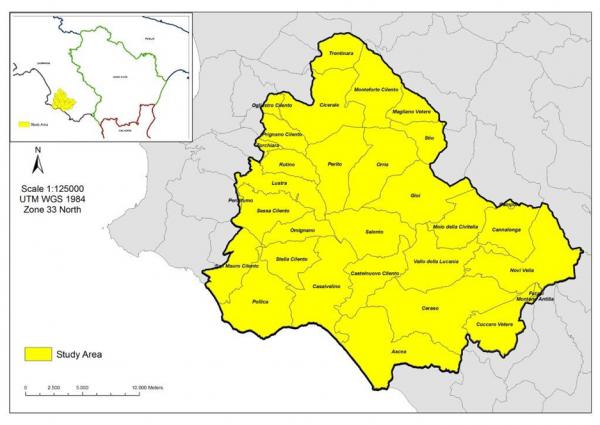 |
Figure 1. The Alento study site. Source: (Prepared by MEDES Foundation) |
The structural characteristics of farming in Alento are summarized in Table 1. The figures show predominantly extensive farming, especially when compared to neighbouring areas. Only 60 percent of the ‘Total Agricultural Area’ (TAA) is used productively and therefore considered ‘Utilized Agricultural Area’ (UAA). A study of the relationship between TAA/UAA in the area shows areas where UAA represents under 50 percent of the total surface area yet in some areas UAA reaches 87 percent of total surface area.
Table 1. Structure of Agricultural Sector
| Alento | UAA/TAA | % Irrigated UAA/total UAA | Average Farm Size |
| 60% |
29% | 2.40 |
Source: (ISTAT 2001)
Only 29 percent of UAA is irrigated and this land is exclusively reserved for high value crops. Figures for irrigated UAA vary considerably within the study area, for example, only five percent of farming land in use is irrigated in San Mauro Cilento compared to 50 percent in Salento, where there is an intensification of farming on areas on flat land. The data on farm size reveals an agricultural sector in crisis. The average farm size in the study areas is just 2.40 hectares.
Cropland within the study area can be divided into two principal uses; annual crops and permanent crops. As Table 2 shows, the study area is highly specialized in farming permanent crops; in fact 54 percent of UAA is destined for permanent crops whilst annual crops make up only 12 percent. The remaining part of UAA is used as permanent pasture land.
Table 2. Share of cropland on UAA
| Alento | Percentage of UAA under annual crops | Percentage of UAA under permanent crops |
| 12% | 54% |
Source: (ISTAT 2001)
In some areas of the Alento, including Stella Cilento and Salento, over 80 percent of UAA is under permanent crops and in San Mauro Cilento, Omignano and Orria the figure is higher still at over 70 percent. The lowest figures are found in Cannalonga where 15 percent of UAA is under permanent crops and just five percent of UAA is under annual crops, revealing an area of vey low agricultural activity.
A detailed analysis of the distribution of land use and of crop specialization reveals that cereals dominate annual crop production with 25 percent of UAA under cereal crops (Table 3 below). Vegetable crops make up 17 percent of UAA though peak at 40 percent in Sessa Cilento and Castelnuovo Cilento. Land under permanent crops is almost entirely used for olive plantations (79 percent) whilst 13 percent, the areas of flat irrigated land, is used for cultivating fruit, mainly peaches.
Table 3. Land Use
| Alento | Percentage of total surface area of land under: | ||||||
| Annual cereal crops | Annual vegetable crops | Annual forage in rotation | Permanent grapevines | Permanent olive groves | Permanent citrus fruit | Permanent fruit cultivation | |
| 25% | 17% | 28% |
7% | 79% |
1% | 13% | |
Source: (ISTAT 2001)
Table 4 shows another characteristic of the area’s agricultural structure; a high presence of land fragmentation concerning all crops. Although aided somewhat by cooperatives and associations, this distinctive trait of Alento’s agriculture reduces profitability in the agriculture sector and complicates efforts to carry out the stream-lining needed to ensure that this sector can continue to compete on the international stage.
Table 4. Average farm sizes according to crop production
| Alento | Average size of farm cultivating |
|||
| |
Cereal crops | Vegetable crops | Olive groves | Fruit |
| 0.96 | 0.35 |
1.16 |
0.54 | |
Source: (ISTAT 2001)
Considering the added value from agriculture to base prices, the agricultural industry represents around eight percent of the total income produced (ISTAT 2005), on average 3.1 percent in Campania, 4.3 percent in southern Italy and 2.5 percent in Italy. The key to this area’s apparent success in the agricultural sector, at a time when the sector as a whole is suffering severe reductions, is mainly due to a lack of alternatives, rather than the strength of local products alone.
The social importance of cropland in the study area can be seen in Table 5 below, which shows the rates of agricultural labour per farm and per hectare. The figures show that the agricultural sector provides relatively intensive employment. The crops which require the most workers are: vegetable crops, fruit crops and olive production. The data on hired labour, however, highlights the dominance of family workers on farms. Indeed most famers only resort to hiring workers during their busiest times for help with harvesting and pruning.
Table 5. Use of Farm Labour
| Alento | No. of days worked per farm | No. of days worked per hectare of cropland | % No. of days worked by hired labour/total work |
| 81 |
51 | 21% |
Source: (ISTAT 2001)
As shown in the land use figures in Table 3, olive trees are by far the dominant crop in the Alento area, which has a long and important history of olive production. The plantation techniques used today for olive farming are still much the same as in the past, such as the pruning of branches to create an open vase tree shape and wide irregular spacing of trees. The trees in this area are large and centuries old. The type of harvesting techniques employed depends upon the size of the trees and the steepness of the terrain. Olive cultivation is very much an important part of the local economy thanks to the presence of numerous local businesses that specialize in the production of various olive-based products. Currently there are three main types of olive cultivation in the area:
- Small-scale olive cultivation with relatively low yields found mostly in hilly areas where harvesting is most problematic. These trees have a long history and were once an important source of income for farmers and workers during the quietest months of the farming calendar. Many of the olive plantations in the area today are the remnants of those old olive groves whose produce was destined solely for the local farming community. At that time olives and olive-oil were an important part of people’s diet as they were their only source of fat. Though there have been many technological advances in the cultivation and harvesting of olive plants over the last fifty years, the vast majority of olive plantations herein described have remained untouched as the slow growth of the trees, their age and the modes of production employed, prohibit the implementation of modern farming techniques.
- In an attempt to make olive production economically viable, the plantations found on fertile land with layouts conducive to good yields have abandoned herbaceous cultivation and added new plants in an attempt to become specialized olive producers. These types of plantations form the main body of olive production in the area despite the fact that they are mostly located on hilly land and have very high production costs due to high labour costs, especially for pruning and harvesting. Not only do these plantations make an important contribution to local olive production but they also have a role in preserving the traditional landscape of the region and protect slope stability on the hillsides.
- Finally, there is a third type of olive cultivation that concerns the newer plantations that have been designed using modern technical criteria. These plantations are generally very small and receive public funding (rural-development policies have been put into place and have proved that olive production can be economically viable on flat land and even on the fertile soil of gentle hill slopes). Nevertheless, the fact remains that the only use for many inaccessible and impracticable areas of land is the planting of olives whereas the most suitable land for olive trees is almost always used for cash crops that create more income. Therefore, only high-production and high-quality olive plantations whose produce can fetch higher at retail are able to survive in the market and be competitive.
In the lower lands, in recent years, there has been a marked increase in the cultivation of peaches, especially early varieties which thrive in mild climates. Herbaceous crops are also on the increase, thanks to a favourable climate and irrigation. Horticultural crops, in particular, are spreading both in open fields and in unheated greenhouses.