
Forests & shrubland
Responses to LEDD in forest & shrubland
Editor: Alexandros Kandelapas
Editor's note: text source D312-3.
LEDD issues and responses to LEDD in forests and shrubland: analysing the relationships among the three capitals
The most pressing LEDD issues in the forest and shrubland study sites are related to changes in the components of natural capital, and their subsequent impact on components of social and economic capitals. In particular, forest productivity decline, forest fragmentation and loss of biodiversity are driven by, and in turn impact upon, the availability and quality of natural capital components such as vegetation, soil, water and climate.
| LEDD Issue | Response | |
| Baixo Guadiana (Spain/Portugal) | Matera (Italy) | |
| Forest productivity decline | New directions and guidelines for decision making in sustainable forest management (Adecuacion del Plan Forestal Andaluz, HORIZONTE 2015, Afforestation Forestry Law to protect forest biomass, land use plans) |
Sustainable management of resources in forest areas (Forest Management Plans) Energy demand Forestation Plans Knowledge transfer |
| Loss of biodiversity | Environmental restoration and ecological rehabilitation |
Landscape protection and conservation measures Forest management plans Land abandonment Energy demand Knowledge transfer |
| Forest fragmentation | Afforestation Environmental restoration and ecological rehabilitation Forestry law to protect forest biomass |
Triennial Forestation Plan Fire Protection Plan Tourism development CAP policies and subsides |
| Soil erosion and deterioration, soil sealing | Afforestation Environmental restoration and ecological recuperation Rural de Andalucia 2007-2013 (PDR) (development of rural Andalucia), Measure 216, the establishment of vegetation and island forests Follow-up Measures, specifically EU Regulation 2080/92 Regional planning of the territory, the PROT on desertification linked up with the National Action Plan of Portugal (PANCD) |
Sustainable management and improvement of regional forest areas Slope protection with naturalistic engineering Support for sustainable agriculture Optimal hydrological resource management Knowledge transfer Forest management plans Infrastructural development Tourism development |
| Water stress and phytosanitary deterioration of forest cover | Afforestation Irrigation Plan |
Triennial Plan of Forestation of the Basilicata Region and Forest Management Plans developed to improve forest functionality Tourism development Urbanization Regional Basin Plans Knowledge transfer |
| Land desertification | Irrigation Plan Regulation (CE) n 1290/2005 Land-use plans |
Regional program to combat drought and desertification Partnership in national and international research projects Knowledge transfer |
| Socio economic issues | Leader projects (PFEA) support for the creation of rural and agricultural employment opportunities |
Regional prevention plans |
Source: LEDDRA Partners 2012
The changes in natural capital components induced by LEDD issues also reflect changes in the components of social and economic capitals particularly through the alteration of their critical characteristics and thus their critical ecological social and economic functions. The loss of critical forest ecological functions is the result of a complex web of human induced and abiotic factors, including climate change, forest fires, forest fragmentation, poor harvesting and management practices, overgrazing, development pressure and depopulation. For example, a reduction in ecosystem productive capacity impacts not only vegetation production but also economic capital components (loss of incomes) and social capital components (loss of livelihoods, knowledge and social cohesion).
The predominant types of responses to LEDD issues in forest and shrubland contexts tend to be institutional or legal planned responses; initiatives and policies which originate at regional, national and supra-national (EU) levels (Akhtar-Schuster et al. 2011). These formal responses are generally based on technical measures designed to regulate or improve the management of natural capital components such as soil and water. In some cases, non-LEDD policies such as economic, development policies, for example, may also have indirect impacts on LEDD issues through the creation of favourable socio-economic conditions for the conservation of natural capital components (LEDDRA Partners 2012). Although the main institutional responses to LEDD issues are generally directed towards reducing impacts on natural capital components, they may also either create opportunities to reduce impacts, or conversely exacerbate impacts on associated components of social and economic capitals.
Responses to forest productivity decline, soil erosion and deterioration
Forest productivity decline is a complex LEDD issue, the drivers of which can be difficult to disentangle. From an anthropocentric perspective, high forest productivity is positively correlated with local management practices in order to produce commercially viable timber as well as other products and services. This approach is directly linked to the presence of local communities for which forestry activities represent an important source of income. Often, forestry activities are closely coupled with small-scale agricultural production with less emphasis on forest productivity. Regulatory changes requiring higher standards in terms of productivity, product quality and employee safety, these measures entail increased production and/or investment costs for farmers, forest owners and small companies.
In Europe, in areas where agricultural production is integrated with forestry activities, the removal of agricultural subsidies, often leads to the abandonment of forest management. These processes may result in a general reduction in pressure at ecosystem level, through land abandonment or farm diversification, reduction of intensive forest management, reduction in grazing and reduction of ecosystem fragmentation. However, forest abandonment in turn leads to stand ageing, reducing productivity and increasing fire risk and phytosanitary threats. Abandonment of forest production also leads to the abandonment of forest tracks, roads and other forest infrastructure.
Abandonment of forestry activities may have negative impacts on social capital through loss of local ecological knowledge and abandonment of local customs and traditional cultural activities and the often deep and nuanced understandings of local environmental conditions associated with them. Such loss of can also hamper stakeholder engagement in future sustainable forest management efforts. Conversely in the long term, land abandonment may have positive impacts such as forest expansion, increases in forest understory biomass, increase in biodiversity and thus an increase in ecosystem productivity and carbon sequestration.
Sustainable forest management is a possible response to forest decline. However, the term 'sustainable' may prove difficult to define and measure. In applying the idea of sustainable forest management, disagreement may arise in how best to achieve it and how to resolve conflicts between groups of stakeholders and/or users. Compounding these difficulties is the dynamic nature of the forests themselves, in both temporal and biological terms. Scale is also a critical consideration: management practices carried out at the local level can have unanticipated (positive or negative) implications at regional and landscape levels; may impact on other capital components, and on social and economic functions and processes.
Critical, therefore, in any attempt to respond to LEDD issues by managing forests sustainably, is the engagement of as many stakeholder groups as possible. One mechanism which has been successfully used to achieve the integration of stakeholder viewpoints is the development of participatory planning approaches such as forest management plans which may have a range of impacts on multiple components of natural, social and economic capitals through:
- vegetation management and its functions
- improved market supply, impacting local employment and business opportunities
- provision of employment opportunities, enabling rural areas to retain young people and families, thereby increasing social cohesion.
Recent developments such as the economic crisis, the rising cost of energy and renewable energy incentives - particularly in Europe - are fuelling new dynamics for forests, with both positive and negative consequences. Increased demand for renewable bio-fuels such as wood products represents an opportunity for increased forest profitability, preventing many of the impacts of forest productivity decline. On the other hand, demand for biofuels may also lead to short-term exploitation of forest economic potential, resulting in serious damage to forest ecosystems. Poor harvesting practices may have negative effects especially when coupled with other factors such as sudden high intensity rainfall events leading to soil erosion channels on logging roads landslides and slope instability in steeply sloping areas.
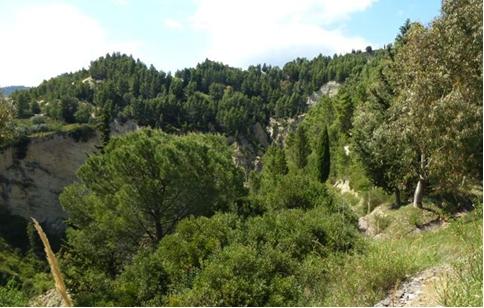 |
Institutional responses to soil erosion may also exist at the national or regional level: the Regional Programme for Combating Drought and Desertification of Basilicata is such a case. Its specific measures include sustainable forest management, afforestation and reforestation programs, slope protection using eco-compatible engineering practices support for sustainable agricultural practices, landscape protection measures, optimisation of hydrological resource and watershed management and others. |
Different capital components are linked in various ways and positive impacts on some capital components may be counterbalanced by negative impacts on others. For example, landscape protection measures, in the context of Forest Management Plans, may include restrictions in forest grazing and reduction in livestock numbers on farms. While this may lead to effective reduction in soil erosion. it also affects small-farm profitability and employment opportunities, with direct consequences on components of economic and social capital in already marginal rural areas.
In the Baixo Guadiana study site, traditional hunting activities in dehesa and montado systems, provide another example of an indirect response to forest productivity decline. While hunting has always been present in dehesa systems, since the 1960s, land owners have been increasingly managing their properties with aim of maintaining healthy populations of wild ungulates, particularly red deer and wild boar, for hunting purposes. In these areas, hunting has become one of the most important economic activities for local communities, slowing patterns of outmigration and providing much needed employment opportunities. This has led to a reduction in the destruction of dehesa and montado, and an associated increase in natural patterns of regeneration.
Responses to forest fragmentation
Forest fragmentation is the process whereby previously contiguous vegetation cover is broken up into smaller patches that can become isolated. In this way forest biodiversity is threatened through the modification of ecosystem functions and the endangering of the viability of species of plants, mammals, birds and insects. Fragmentation may be the result of logging activities, fires, outbreaks of pests and diseases. The causes of forest fragmentation include both proximal sources (local human activities or actions such as agricultural expansion) and wider, underlying driving forces which occur at higher spatial levels, and which may also constitute indirect and/or negative responses to LEDD. Underlying drivers may include, human population dynamics or agricultural policies designed to support farm incomes.
While biological processes of tree mortality (phytosanitary diseases, stand ageing) tend to operate at relatively slow speeds (excluding wildfires and catastrophic weather events), anthropogenic causes of tree mortality tend to operate much faster. Patchiness can lead to further tree mortality through increased vulnerability to wind, soil erosion and desiccation (known as 'edge effects'), and vice versa, loss of forest can impact on local climate variability.
Loss or reduction of ecosystem services which occurs as a result of forest fragmentation can have a negative impact on local and regional livelihoods and quality of life. As economically important tree species become scarcer, the economic viability of forest areas decreases. On a broader scale, reduction in ecosystem services such as climate control, surface water management or pollination by native bees, has economic and social impacts extending beyond the immediate locality.
Understanding the complexity of the SES in which forests are situated is crucial for analysing how proximal and underlying drivers work together to produce forest fragmentation, and how they combine to create the specific context in which responses to this issue arise. In the Basilicata region, implementation of policies for tourism development is a case of the complex mix of drivers leading to forest fragmentation: the creation of tourism infrastructures has led to patchiness of forest cover (particularly in coastal areas) and, in some cases, to complete forest destruction. Rapid coastal urbanization in Basilicata is driven by national tourism development policies (during the 1980s and 1990s) but also more recent regional regulations. These policies have contributed to the economic development of marginal rural areas, at the cost of increasing pressure on coastal maquis habitats, isolating patches and reducing coastal scrub viability. Knock-on impacts from the loss of coastal forest and scrub include increased or accelerated soil loss from marginal and fragile coastal habitats, further exacerbating scrub and forest loss at patch margins. Other major infrastructure development projects inland can also have significant impacts. For example, construction of reservoirs and dams for water regulation and irrigation as well as other landesque infrastructure such as those related to watershed management, torrent control and slope stability in mountain basins can lead to reduced coastal sediment deposition and consequent accelerated erosion of coastal areas exacerbating patchiness and fragmentation in coastal forest environments.
Increasing urbanisation and coastal development (including tourism) also leads to increases in fire risk in forests. Sources of ignition in the Mediterranean are predominantly anthropogenic and occur during the summer peak in tourism.
Responses to forest fragmentation include institutional responses such as forest protection and restoration measures, such as re-forestation and fire management plans..
In the Matera study site, fires and other drivers of forest fragmentation have been addressed through a number of institutional responses including the Triennial Forestation Plan 2009-2011, the Regional Fire Protection Plan 2009-2011 and Forest Management Plans. More importantly, these responses have been designed in an integrated manner, to ensure cross-compliance between actions within each plan.
The Triennial Fire Protection Plan promotes actions and provides financial support to help protect forests from fires and land degradation. Initiatives include wildlife conservation, awareness-raising campaigns and environmental education, training courses in fire prevention, Support for research on fire prevention and restoration of fire-damaged forests.
The Triennial Forestation Plan includes measures to promote reforestation/afforestation, forest restoration and protection. Plans provide a wide range of specific actions that attempt to mitigate forest fragmentation including the realization and maintenance of firebreaks, the maintenance of forestry road networks for effective fire control , re-naturalisation practices for reforested areas and supporting/orienting natural forest expansion in order to create ecological corridors
The application of both the Triennial Fire Protection Plan and the Triennial Forestation Plan have produced positive effects on the landscape by addressing a range of environmental, social and economic issues. In addition, by developing an institutional response to forest fragmentation, these plans have also increased employment opportunities, through the application of fire protection and prevention practices and the reforestation program. The application of both plans has resulted in the direct employment of over 3,700 workers in the forestry sector per year, providing a significant benefit to rural communities which may have few other new employment opportunities. It has also increased skilled, higher level employment opportunities: specialist forest management staff with local environmental knowledge, have been able to find employment in their home communities.
Conversely, and highlighting the negative impact that unplanned institutional responses can have on forests, the implementation of CAP policies have led to expansion of land cultivated for cereals, particularly through the conversion of generally unsuitable Mediterranean Macchia areas. As a result permanent tree cover has been reduced and soil erosion has increased. Loss of Macchia has also led to a severe reduction in forest biomass and associated impact on critical functions such as regulation of hydrological processes. The negative influence of CAP subsidies on dehesa and montado forests is also well documented: farmers have been encouraged to increase stocking rates beyond local carrying capacities, resulting in a rapid decline in productivity and land abandonment. This is a key issue in the Baixo Guadiana study site (Spain), where sustainable management of dehesas relies on appropriate stocking rates to maintain the wooded layer, thus avoiding the invasion of scrub species and reducing the risk of major wildfire.
Responses to loss of biodiversity
Loss of forest biodiversity is a complex issue, with many different drivers operating at higher and lower spatial scales, and which interact to produce cumulative and sometimes unanticipated impacts, associated with LEDD issues. Often, development policies (tourism, industry, infrastructure) have inadvertent negative impacts on biodiversity conservation and on the quality and function of forest cover. For forests, increase in tourism pressure may lead to increased water stress and phytosanitary deterioration of forest cover, increased fire risk, increased risk of disease and pest transmission and loss of wildlife habitat, amongst many other issues.
In the Matera study site, the main response to biodiversity loss has been to develop management plans based on the general principles of sustainable forest management, assisted by the regional Rete Natura 2000 Project. This initiative provided a set of conservation measures for each Natura 2000 site, coupled with site specific Forest Management Plans developed to establish the technical and normative instruments for the assessment and protection of specific forest ecosystems against biodiversity loss. These measures involve a large amount of resources, and can lead to increases in employment opportunities in the forestry sector and in sustainable tourism. Employment opportunities may slow rural depopulation and decrease land abandonment. Biodiversity conservation may also benefit economic systems by providing new opportunities for development when existing economic activities have become unsustainable (diversification of agriculture into eco-tourism projects, use of forest resources for leisure and recreation).
Indirect responses to LEDD issues can come from unexpected quarters. For example in the Basilicata Region (Matera study site), the discovery of an economically viable oilfield has resulted new funding streams for community projects which have been set up to compensate Municipalities for the impacts of drilling and extraction activities. After agreement between oil companies and the Regional administration, funding is provided for interventions for environmental mitigation in the region. Projects include reforestation, forest management and restoration, and multiple linked actions necessary to protect existing biodiversity and environmental quality in protected areas in the region.
Direct responses loss also include knowledge transfer. The University of Basilicata has been particularly active in this area since the early 1980s, providing initiatives of forestry professionals with high levels of specialist as well as local environmental knowledge. Training for regional planners and stakeholders has also been provided resulting in the creation of spin-offs and the formation of local forest management groups. In the long-term, this process has addressed a variety of LEDD issues such as forest productivity decline, biodiversity support and conservation, as well as forest fragmentation. It has also led to increased awareness of sustainable forest management principles by local stakeholders (especially municipalities) and improved local governance structures by fostering deeper levels of trust between local foresters, farmers and local authority bodies. Networking between diverse stakeholder groups has also been supported, enabling better information sharing and encouraging compliance with sustainability objectives through peer pressure.
The value of other responses may be harder to assess. For example, policy changes relating to increased competition and animal health (closure of small slaughterhouses) have led to increase in the cost of beef production in mountainous areas (fuel, feed, transport). The viability of farms in mountainous areas has been undermined and land is either abandoned or sold on. While this may see to have short term positive results for biodiversity conservation through the reduction of anthropogenic pressure, one has to consider that small-scale forestry activities were a core part of these small farms: the impacts on components of social capital, (community cohesion, employment opportunities, social memory) have been clearly negative.