
Forests & shrubland
LEDD issues in forests & shrubland: general
Editor's note 30 Apr 2012: Text source D311, section 3.1.
Although LEDD issues are primarily environmental problems, they generate associated socio-economic consequences. The LEDD issues in forests & shrubland that are examined in this deliverable are presented in Table 1. The table distinguishes between the environmental and the socio-economic aspects of these issues which are manifested at all spatial levels (global, national, regional, local).
Table 1. LEDD issues in forests and shrubland
| Type of Issue | LEDD Issue |
| Environmental issues | Soil erosion Soil organic matter decline Loss of biodiversity Ecosystem (forest) fragmentation Soil compaction Soil salinisation Soil sealing Land desertification Forest productivity decline Water stress Phytosanitary deterioration of forest cover |
| Socio-economic issues | Rural depopulation Land use change Loss of traditional knowledge Poverty Unemployment Decrease in profitability of land Land abandonment Decline in property values |
Source: LEDDRA Study Site Application Plan 2011.
LEDD issues in forest and shrublands are both of an environmental and human origin that increase the fragility and instability of these ecosystems and decrease their capability to provide ecosystem services. Human-induced issues can vary spatially and temporally. They are generally linked to the overexploitation of forest resources, land use change and air pollution. On the other hand, environmental pressures such as extreme climatic events (e.g. drought, ice, storms and floods); global warming; insects and phytosanitary diseases represent other relevant causes for the deterioration of forest ecosystem and for soil erosion and land desertification.
Forest productivity decline
One of the most important phenomena related to the degradation of forests & shrublands worldwide is the decline of forest productivity. The loss of forest ecosystem productive capacity, i.e. a reduction in the ability of forest soils to retain nutrients and a decline in soil water storage capability, results from a wide range of both human and biophysical factors. Biophysical factors such as climate change and increases in the frequency of extreme climatic events are responsible for long-term processes of forest productivity decline (Boisvenue and Running 2006). These drivers are often closely coupled to human drivers including grazing, forest fires, poor harvesting and management practices and they result in different levels of disturbance affecting nutrient cycling and soil properties. In particular, soil erosion and compaction together with reduction in soil organic matter content imply a simultaneous loss of nutrient and water storage capability (Pimentel et al. 1995; Lai 2000).
The effects of climate change vary at the regional scale due to general climatic conditions. Generally, forest productivity and ecosystem productivity at high latitudes show a positive feedback with an increase in carbon sequestration (Myneni et al. 2001). On the contrary, in the Mediterranean region, increasing temperature and related increasing evapotraspirative demand, lead to a general decline in forest ecosystem productivity (Peñuelas et al. 2008; Piovesan et al. 2008). An important phenomenon related to climate change is heat waves, affecting climate regimes worldwide with increasing frequency. These climate phenomena are mainly responsible for ecosystem productivity decline worldwide, with an associated increase in other disturbances including forest fires (Westerling et al. 2006) and desertification processes. In particular, as Ciais et al. (2005) showed, the European-wide heat and drought wave of 2003 has been responsible for a 30 percent reduction in forest assimilation process, which resulted in an ecosystem carbon dioxide release to the atmosphere equivalent to 4 years of European ecosystem productivity (Figure 1).
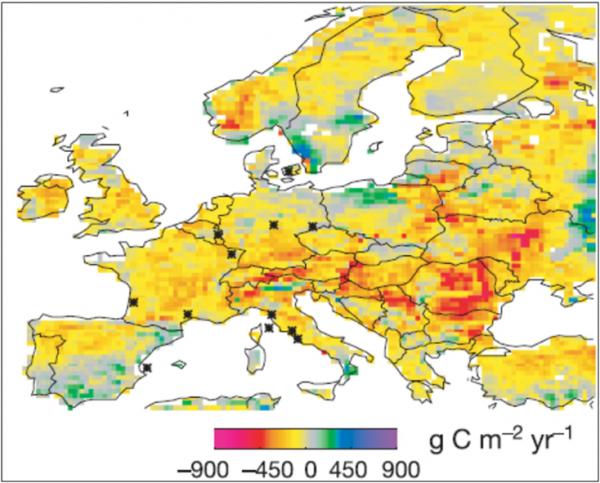 |
Figure 1. European-wide anomaly of NPP during 2003. Source: (Ciais et al. 2005). |
Loss of biodiversity
Loss of biodiversity represents an often irreversible process affecting the ecosystems at different levels, because it implies the extinction of genes, species and ecosystems. Although extinction is a natural process as testified by a number of past extinction crises, human activities have caused an exponential increase in extinction rates during the last century (Diaz et al. 2006). The principal drivers of biodiversity loss, such as habitat and land use change, overexploitation, pollution, invasive alien species and climate change, are constantly increasing in intensity on a global scale (Millennium Ecosystem Assessment 2005b) (Figure 2).
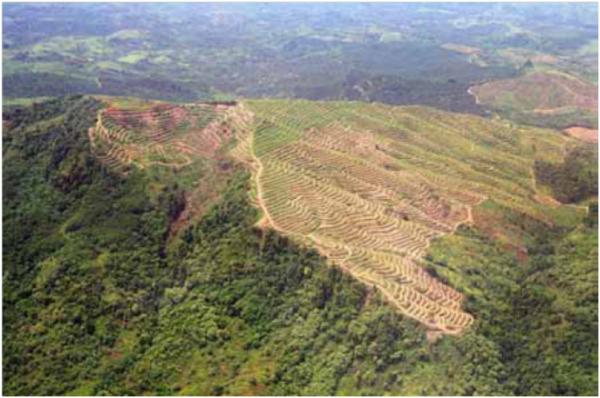 |
Figure 2. Deforestation is land use conversion, not harvesting of timber. If a harvested forest is allowed to regenerate, the ecosystem effect of harvesting is carbon neutral; but if the forest is converted to another land use, carbon is released into the atmosphere (forest cleared for rice production, Indonesia). Source: (FAO/FO-5616/H. HIRAOKE). |
Loss of biodiversity in forest ecosystems implies not only the extinction of species, but also the destruction of habitats and ecosystems. Logging activities also push roads into previously untouched forests. Even where logging is selective, access roads and tracks used to facilitate extraction damage soil (soil erosion and compaction), plants and other organisms (Lindenmayer and Noss 2006).
The conservation of biodiversity has become a pressing issue for the scientific community, involving the study of vulnerable as well as culturally valued species and ecosystems, conservation practices and policies. The conservation of biodiversity is also critical for economic systems and markets, due to its financial benefits and the costs of its loss. This represents an opportunity for the re-structuring of economies and financial systems following the global recession (Secretariat of the Convention on Biological Diversity 2010).
Forest fragmentation
Forest fragmentation is another important LEDD issue, occurring when habitats, landscapes and ecosystems become disconnected by human or non-human factors. Fragmentation results in a physical separation of habitat units in a previously continuous system. This phenomenon may occur naturally, after catastrophic geological events such as volcanic activity, geological faulting, tectonic movement, mass land slumping, major sea level rise and climate oscillation. However, human exploitation of forest ecosystems is one of the primary causes of landscape transformation and fragmentation. Local forest loss spatial processes include:
- Attrition: the disappearance of patches,
- Shrinkage: a decrease in the size of remaining patches,
- Perforation: it occurs when holes or voids are made in a habitat, i.e. an extensive forest perforated by logged areas. Perforations are an ecologically important type of fragmentation because they introduce potential edge effects deeper into intact forests, compared to erosion of forest patch perimeters (Riitters and Coulston 2005);
- Fragmentation: in the narrow sense of the term, is the breaking up of a habitat into smaller parcels. It includes the two processes of dissection and fragmentation.
Human-induced habitat fragmentation is mainly driven by agricultural land conversion processes, urbanisation, pollution, deforestation, introduction of alien species and forest fires. Fragmentation is the result of direct loss of forest area caused by land use change but it is also the result of “edge effects” of urban or agricultural land uses. Fragmented forest landscapes are characterised by more abrupt boundaries between native and non-native vegetation and are typically found in areas which have been developed for production forestry, where remnants of native vegetation are mixed with non-native tree species. In general, these processes transform isolated ecosystems from healthy forests into monocultures of timber production species, leaving only isolated historical remnants of native vegetation. Relict landscapes are also the result of urban/suburban development and expansion (urban sprawl). Fragmentation and dispersion of patches also induces loss of biodiversity. According to the Island Biogeography Theory, fragmented ecosystems have lower species richness per unit of area compared with contiguous habitats (MacArthur and Wilson 1963; Laurence 2008).
Soil erosion and deterioration
Healthy soil is an important component of the forest ecosystem providing water, nutrients and allowing exchange of carbon dioxide, oxygen, and other gasses that affect root growth and soil organisms. Soil erosion represents an often irreversible land degradation process affecting forest and shrubland ecosystems worldwide.
Soil erosion occurs naturally due to the interaction of the atmosphere and the water cycle with land surfaces. Although the distribution and intensity of natural erosion processes may be affected by climate change leading to land degradation, accelerated erosion due to unsuitable land uses and land management practices is a key LEDD issue in sloping areas. The main factors responsible for accelerated soil erosion are clearance of forests for expansion of agriculture and cultivation of steep slopes, changes in plant cover due to intensive cultivation, over-grazing, wildfires, levelling of land surfaces and poor maintenance of terracing land, amongst others. Soil is most susceptible to erosion processes after the removal of plant cover which protects it from wind and water, mainly from the splash effect of intense rainfall, while roots hold the soil together and anchor it in place.
Deforestation processes induced either by logging or forest fires cause a direct impact by reducing vegetation cover, and in many cases create a pre-condition for the increase of soil erosion rates. Forest fires produce large areas of bare soil, increasing soil loss particularly during the first year after a fire event (Shakesby 2011). However, the magnitude of soil erosion depends on many factors such as the frequency and magnitude of precipitation events after fire, soil texture and soil depth (Myronidis et al. 2010; Pardini et al. 2004).
Logging intensities directly influence surface runoff and eroded soil mass through timber felling, skidding trail establishment and log skidding and/or hauling from logging compartments through feeder roads to the temporary log yard. Logging activities are also responsible for soil compaction with changes in soil bulk density, penetration resistance and micro-topography as a result of several factors related to machine mass and type and traffic intensity (Ampoortera et al. 2010). At the same time, high rainfall and intensity increase the volume of surface water runoff and thus soil mass erosion. Microtopography (slope, aspect and length) also represents a key factor increasing soil erosion rate.
Water stress and phytosanitary deterioration of forest cover
In a globally changing climate, forests & shrublands are increasingly subject to environmental pressures like extreme climatic events or pests affecting the phytosanitary status of forest cover. Global climate change is reportedly making forest ecosystems more prone to damage by altering the frequency, intensity and timing of fire events, hurricanes, ice storms, and insect and disease outbreaks, together with possible changes of species distribution and shift of forest cover towards cooler and wetter conditions. The number of catastrophic climatic events over the past decade seems to go well beyond what could be considered normal meteorological oscillation (ECOSOC 2003). Climate-related shifts in the range of pest species, many of which are forest-dependent, can further exacerbate biophysical impacts on forest health.
Water stress, especially in Mediterranean forests & shrublands, seems to be the major cause of forest productivity decline and of forest deterioration more generally. It represents the direct consequence of extreme climatic events such as continuous heatwaves and drought events. The general deterioration of forests also determines favourable conditions for pest outbreaks contributing directly or indirectly to economic and environmental losses.
While insects and diseases are integral components of forests and often fulfil important functions, sporadic outbreaks can have adverse effects on tree growth and survival, yield and quality of wood and non-wood forest products, wildlife habitat and the recreational, scenic and cultural value of forests. The lack of effective quarantine measures, increased international trade in agricultural and forest products, exchange of plant materials and long-range air travel have introduced alien pathogens and insects into new environments leading, in some places, to significant forest damage. An example is the recent diffusion of the Pine Wood Nematode (PWN), Bursaphelenchus xylophilus, one of the most serious threats to pine forests worldwide (Harrington and Wingfield 1998).
Desertification
Desertification is a process of land and ecosystem degradation and loss of organic matter owing to a complex interaction among physical, biological, political, social, cultural and economic factors. Desertification can be considered a worldwide phenomenon affecting natural ecosystems and particularly Mediterranean Regions and semi-arid ecosystems. Since 1994, with the United Nations Convention to Combat Desertification (UNCCD), the desertification process has been considered as a key environmental issue closely correlated to other key issues such as increasing land demand for agriculture, land use changes and global change.
These land transformation processes are often associated with deforestation that is used to increase the land available for grazing or intensive monoculture to produce fuelwood and biofuels. In this way, desertification is the result of a land degradation process that starts with increasing soil fertility loss and eventually results in land abandonment. Furthermore, in semi-arid regions, global climate change increases the risk of desertification and accelerates the processes of land abandonment due to the increased frequency of extreme climatic events and, consequently, to a generalised loss of ecosystem productivity. This scenario implies deep transformations from a socio-economic point of view, with consequences for the distribution of the population and for the availability of food, water and resources for human populations.
Socio-economic issues
As discussed previously, forest and shrubland ecosystems provide a wide range of fundamental environmental, social and economic services to local communities. The continuous flow of ecosystem services ensures that the necessary conditions for the development of communities and human well-being are met (Daily 1997). Therefore, LEDD issues strongly impact the socio-economic system with consequences at both local and regional scales for activities related to land management, agriculture, grazing and forestry. As a consequence of LEDD issues, the loss of productivity and the associated reduction in the profitability of human activities represents an important factor determining the socio-economic dynamics at the local level. The loss of income generation potential and the consequent reduction in development opportunities pushes most of the younger people to look for other forms of employment outside of their home area, resulting in depopulation or outmigration and population aging.
These phenomena also involve other socio-economic processes that further exacerbate the problem. As an example, the reduction of the young population and rural population aging lead to a reduction in the availability of public services such as schools and health care. Furthermore, negative consequences for well-being can also propagate elsewhere, with emigrants increasing the population and environmental pressures in already stressed urban areas (Pereira et al. 2005).
Another socio-economic issue is the abandonment of forested land and the loss of traditional agricultural and land management practices, with a consequent increase in ecosystem degradation and loss of knowledge and cultural heritage. The decrease of land profitability is also responsible for land abandonment in mountainous areas, with consequences for land cover change driven by spontaneous afforestation. This phenomenon is particularly present in the mountainous areas of Europe, with an increase of forest cover over the last decades (Poyatos et al. 2003). According to a broadly accepted conviction, this process is seen as a positive phenomenon that leads to an increase of the ‘naturalness’ of an area. However, in many cases these ‘wilderness areas’ represent a net loss of cultural landscapes and also a loss of biodiversity during the succession process, due to the invasion of aggressive pioneer or dominant species (Höchtl et al. 2005). Furthermore, forest expansion in these areas requires the definition of new strategies in managing these new forest resources and services.